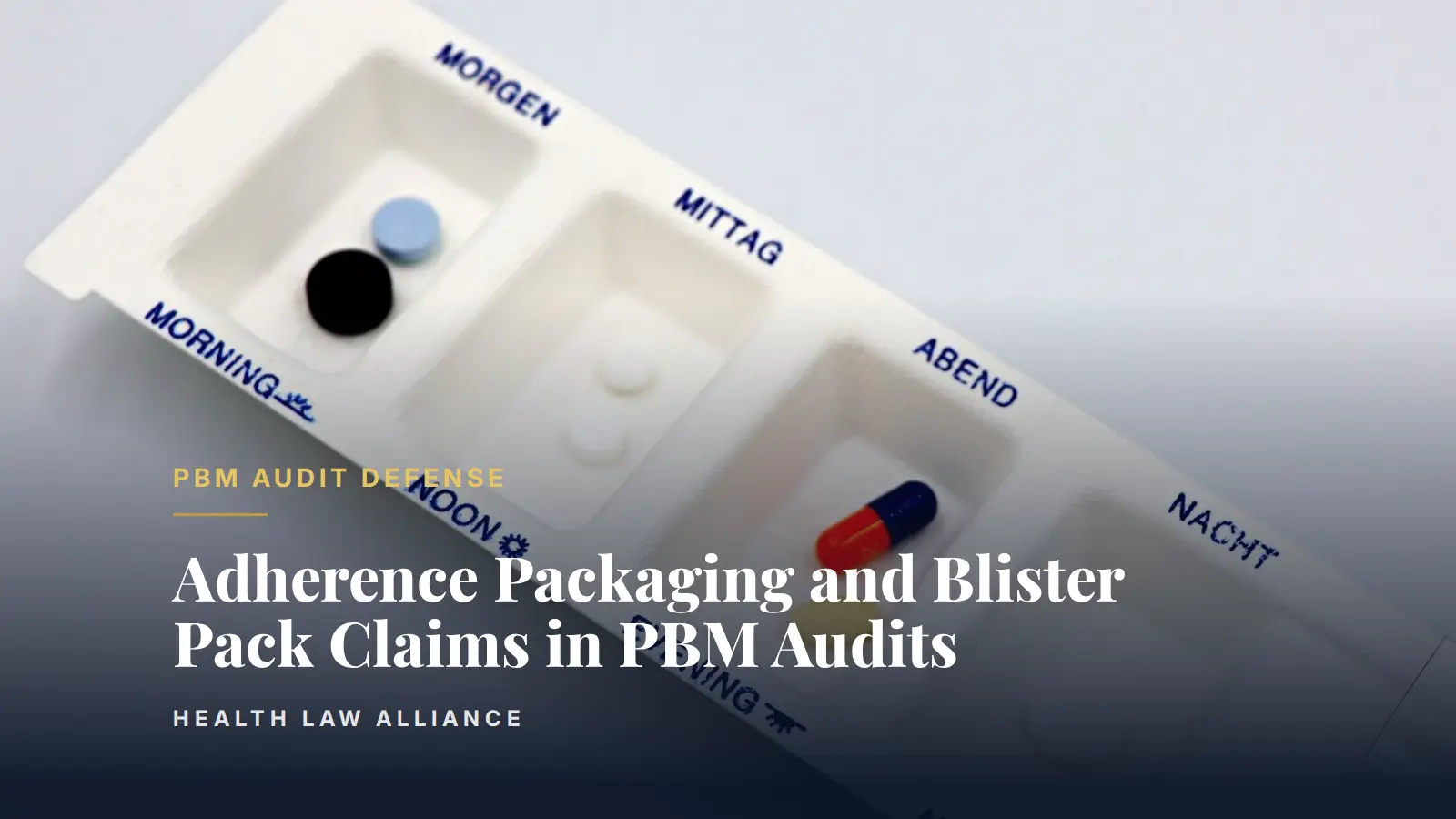
Community and independent pharmacies increasingly pack a patient's full daily medication regimen into a single pouch or blister card, an adherence packaging program built to help patients living at home take multiple prescriptions correctly. PBM audit teams treat that pack as its own claims question, separate from the clinical benefit of the program. A multi-drug compliance packaging claim carries its own packaging code, its own days' supply calculation, and its own documentation trail, and a pharmacy that treats the pack as administrative convenience rather than a billing event is the one that loses the audit.
Multi-Drug Compliance Packaging On The Claim
NCPDP's Special Packaging Indicator field, field 429-DT, tells a PBM how a prescription was packaged at the point of dispensing. CVS Caremark's 2026 Provider Manual lists code 4, Pharmacy Unit Dose Patient Compliance Packaging, for a single drug dispensed in a compliance-prompting format, and code 5, Pharmacy Multi-drug Patient Compliance Packaging, for packaging that may contain drugs from multiple manufacturers combined to ensure compliance and safe administration. Submitting the wrong packaging indicator, or billing a repacked pouch as though the drug came straight from the manufacturer's original package, creates a documentation mismatch an auditor can identify before reading a single clinical note.
Health Law Alliance's attorneys have overseen 2,000+ audits and handled 5,000+ matters, with 25+ years of experience.
Days' Supply Still Follows The Prescription
A compliance pack does not reset how a pharmacy calculates days' supply. Caremark's provider manual requires the pharmacy to submit the accurate days' supply and quantity dispensed based on the prescriber's actual dosing schedule, not on the packaging cycle, and to account for product expiration and storage limits when that schedule leaves part of a dispensed quantity unused. A pouch program that packs several drugs on a single packaging cycle does not change any individual drug's days' supply math; a dose change, a discontinued medication, or a short-dated product mid-cycle still has to be reflected on the claim for that specific drug, not smoothed over because the rest of the pack continues on schedule.
A repackaged, relabeled NDC cannot earn a pharmacy more in reimbursement than billing the same drug in its original manufacturer package would have, and Caremark's audit team treats the difference as a recoupment target.
Repackaging Labels And The Recoupment Risk
Building an adherence pack usually means repackaging bulk stock under a new, relabeled NDC rather than dispensing the manufacturer's original container. Caremark's claims-submission standards state directly that claims for repackaged, relabeled NDCs that result in higher reimbursement than claims for non-repackaged, relabeled NDCs may be subject to recoupment. Because one flagged packaging claim rarely stays isolated, a pharmacy that disagrees with a repackaging finding should expect the PBM to review the same packaging program across the full lookback period, and should preserve its repackaging and labeling records before the audit appeal clock starts running. The procedural sequence that appeal follows is covered separately in PBM Audit Appeal Levels: The Full Sequence.
Returned Packs And The Claim Reversal Clock
An adherence pack prepared but never picked up, or abandoned mid-cycle after a regimen change, is still a claim on file. Caremark's provider manual requires that any prescription not received by the patient be returned to pharmacy stock, with the claim reversed within fourteen days of the original submission. A multi-drug pouch program, where one new prescription or one discontinued medication can make an entire card obsolete before the cycle ends, produces more of these returns than single-drug dispensing does, and an audit that finds unreversed claims behind returned packs can extend from a recoupment finding into a network termination review of the whole packaging program. Long-term-care pharmacies face a related but separate short-cycle billing question, addressed on its own in LTC Pharmacy Audits: Cycle Fills and Emergency Kits; this article stays with retail and community packaging programs for patients living at home.
Why Early Legal Counsel Is Critical
It is critical that pharmacies promptly retain experienced healthcare defense counsel upon receiving a PBM audit notice that reaches into a compliance packaging program. Early legal intervention can protect the pharmacy's rights, ensure the packaging and repackaging records are gathered and produced correctly, preserve the arguments available on appeal, and allow counsel to communicate with the PBM's audit team on the pharmacy's behalf. Delaying legal representation can significantly affect the outcome of a matter, particularly once a packaging finding has already been extrapolated across the lookback period.
How Health Law Alliance Can Help
Health Law Alliance's PBM audit defense practice works with pharmacies through compliance packaging and repackaging findings, from reconstructing packaging records to briefing an audit appeal. If your pharmacy has received a PBM audit notice involving adherence packaging, contact us for a free, confidential consultation.