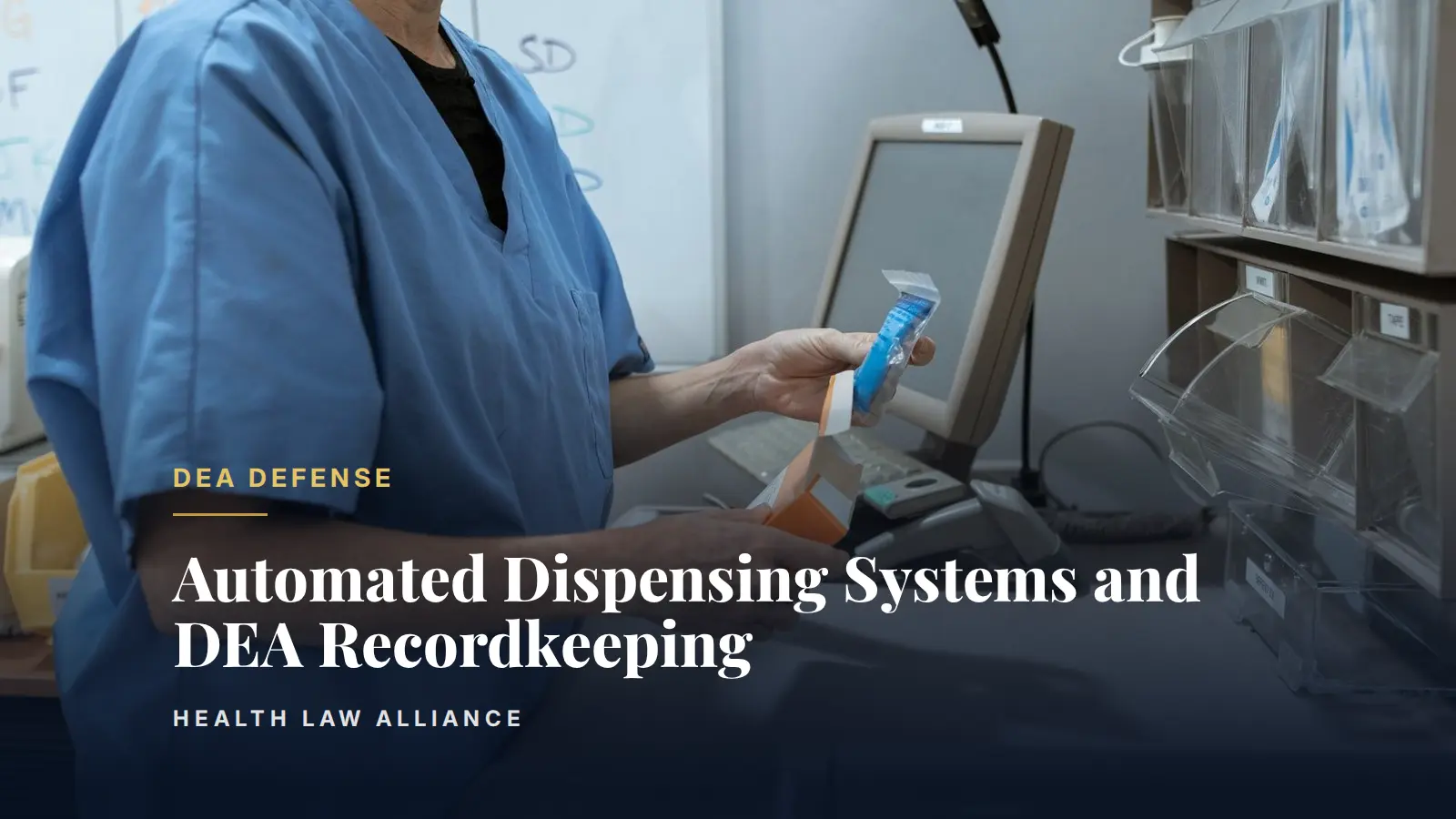
A retail pharmacy that installs an automated dispensing system (ADS) at a long-term care facility is opening a second DEA-registered location, not just placing a cabinet in a medication room. 21 CFR 1301.27 requires a separate DEA registration at each long-term care facility where the pharmacy installs and operates an ADS, and that registration carries its own documentation duties: a notarized state-authorization affidavit at application, dispensing records tied to the specific site, and an inventory that has to reconcile against the system's own transaction log. A medication room that looks orderly can still sit on a registration gap or a records gap a DEA diversion investigator finds on inspection.
Pharmacies serving long-term care facilities typically juggle several adjacent duties at once: electronic prescribing of controlled substances compliance, correctly recorded emergency oral Schedule II prescriptions when a physician calls in an order before a written prescription follows, and internal controls against employee drug diversion by facility or pharmacy staff. An ADS adds a registration and a recordkeeping obligation on top of all of it.
What Counts as an Automated Dispensing System
DEA defines an automated dispensing system as a mechanical system that performs operations or activities, other than compounding or administration, relative to the storage, packaging, counting, labeling, and dispensing of medications, and which collects, controls, and maintains all transaction information (21 CFR 1300.01(b)(45)). A long-term care facility, in the same regulations, is a nursing home, retirement care, mental care or other facility or institution which provides extended health care to resident patients (21 CFR 1300.01(b)(25)). Because most long-term care facilities are not DEA registrants, an outside retail pharmacy fills residents' prescriptions and holds the drugs at the facility in a custodial capacity; an ADS lets that pharmacy dispense single doses remotely while the drugs remain pharmacy stock until the machine releases them.
A Separate DEA Registration at Every Long-Term Care Facility
Only a registered retail pharmacy may install and operate an ADS at a long-term care facility; DEA has said a pharmacy registered solely as a central-fill pharmacy does not qualify. The pharmacy must maintain a separate registration at each facility where it places a system, and if more than one pharmacy operates an ADS at the same facility, each needs its own registration there (21 CFR 1301.27(a)-(b)). Two pharmacies cannot share a single unit, because DEA treats that arrangement as functionally identical to two registrants sharing one storage and dispensing system, which commingles stock and breaks accountability. The additional registrations are exempt from application fees (21 CFR 1301.27(c)).
The State Authorization Affidavit DEA Requires at Application
Before DEA will issue the separate registration, the pharmacy must submit a notarized affidavit attesting that the state board of pharmacy or licensing agency has authorized the specific long-term care facility's automated dispensing system (21 CFR 1301.17(c)). The affidavit must identify the signing corporate officer, the pharmacy's and facility's names and addresses, the state license or permit number, and the authorization date, plus an attestation that false information can support denial of the application or prosecution. The requirement exists because DEA's rule only works where state law separately authorizes the pharmacy to operate at the facility; federal registration does not substitute for that state-level permission.
Recordkeeping Location and the Distribution Limit
A retail pharmacy holding one or more ADS registrations may keep required records at the pharmacy or another approved central location, rather than at every facility (21 CFR 1304.04(a)(2)), and distributions to its own ADS units fall outside the 5 percent limit that otherwise caps a dispenser's distributions to other practitioners (21 CFR 1307.11(c)). Neither provision relaxes what the records must show. An inspector reconciling a facility's physical count against the ADS transaction log is testing for an accurate inventory reconciliation, not just a convenient one. A registration gap, a missing affidavit, or records that do not reconcile can support a DEA order to show cause or, in the more serious diversion cases, an immediate suspension order.
An ADS is conceptually similar to a vending machine.
Why Early Legal Counsel Is Critical
It is critical that pharmacies and long-term care facilities promptly retain experienced healthcare defense counsel upon receiving a DEA inspection finding, a show cause notice, or any other inquiry tied to an automated dispensing system's registration or records. Early legal intervention can protect the pharmacy's rights, help frame appropriate responses to DEA's requests, avoid inadvertent admissions, and preserve defenses before a finding hardens into an enforcement action. Delaying legal representation can significantly affect the outcome of a matter and expose the pharmacy to unnecessary risk.
How Health Law Alliance Can Help
Health Law Alliance's attorneys have overseen 2,000+ audits and handled 5,000+ matters, with 25+ years of experience. Health Law Alliance's DEA defense attorneys represent retail pharmacies operating automated dispensing systems in long-term care facilities, from registration and affidavit review through inspection findings and show cause proceedings. Contact us for a free, confidential consultation.