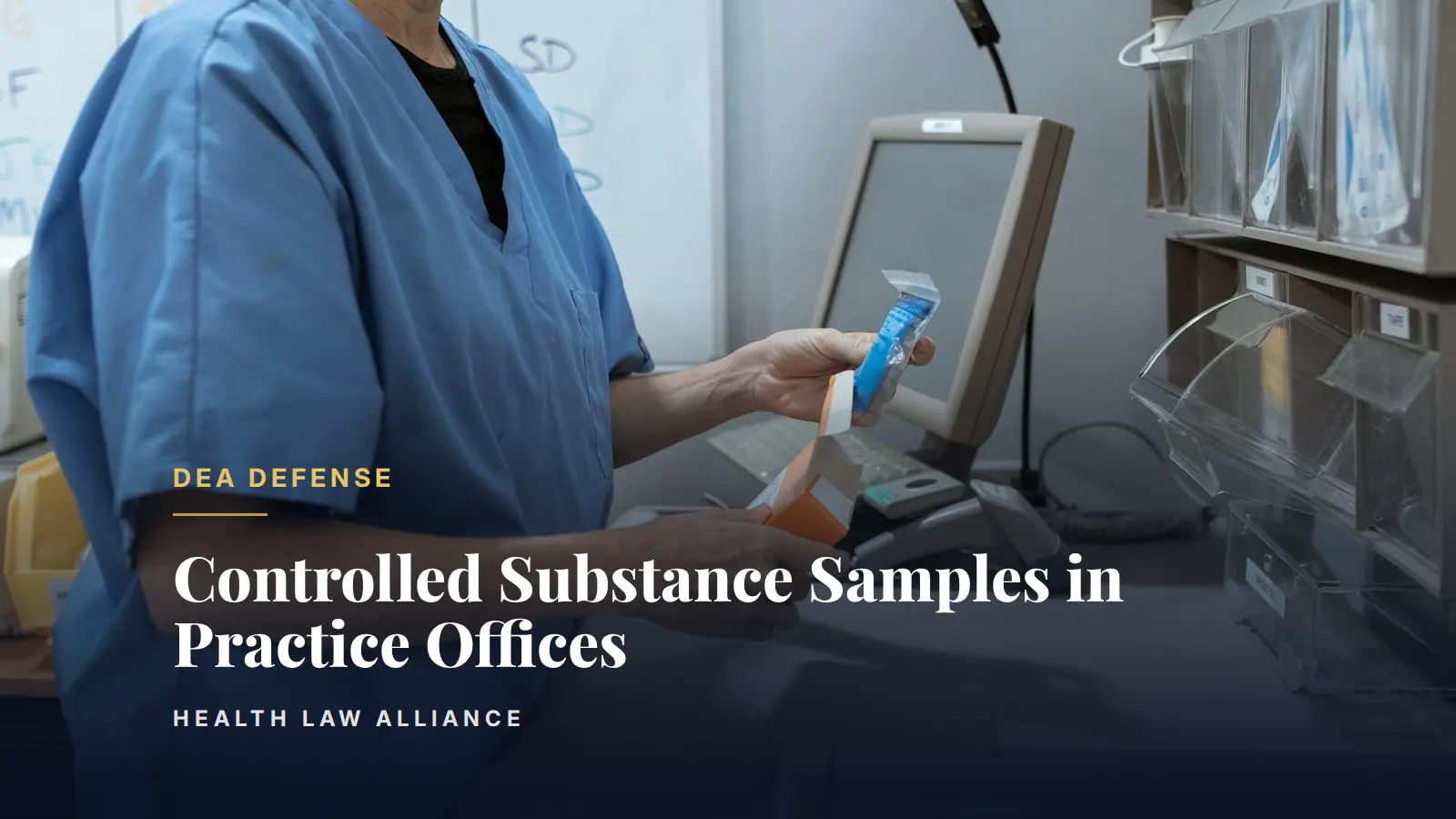
A physician practice or pharmacy that keeps controlled substance samples on hand carries real recordkeeping exposure of its own, separate from the registrant that supplied the sample. The Controlled Substances Act treats a sample the same way it treats any other transfer of a controlled substance: as a distribution. Under 21 CFR 1301.74(d), a registrant may distribute a Schedule II through V controlled substance as a complimentary sample only on the customer's written request, and only in reasonable quantities. Schedule II samples carry an added requirement: the transfer still has to move on a DEA order form. A practice that cannot produce the request, the order form, or a record of what arrived is the one a DEA inspector singles out.
The Written Request Behind Every Sample
Before a manufacturer's representative can leave a Schedule II through V controlled substance sample at a practice, the practice has to ask for it in writing. The request has to name the customer, give its address and DEA registration number, and state the specific substance and quantity wanted. It has to say the sample will be used only for the legitimate medical needs of the practice's own patients. The registrant that fills the request keeps that written request with its other distribution records, and the practice that signed it should keep its own copy. A sales call that ends with a sample on the counter and no signed request on file is a distribution neither side can account for if a suspicious order monitoring flag or an inspection asks for one.
Schedule II Samples Still Need a DEA Order Form
A written request satisfies 21 CFR 1301.74(d), but it does not substitute for the order form Schedule II distributions require. Under 21 CFR 1305.03, a DEA Form 222 or its electronic CSOS equivalent is required for each distribution of a Schedule I or Schedule II controlled substance, and complimentary samples are not among the listed exceptions. The purchaser keeps a copy of the form, submits the original to the supplier, and records the quantity received once the shipment arrives. That quantity is what the practice's own inventory reconciliation has to match the next time anyone counts the stock on hand.
A controlled substance sample that arrives without a signed request, an order form, or a matching inventory entry is the exact gap a DEA diversion investigator is trained to find.
What Stays on File, and How Long
DEA Forms 222 have to stay available for inspection for two years under 21 CFR 1305.17, kept separately from other business records and readily retrievable at the registered location. 21 CFR 1301.74(d) does not set a separate retention period for the written sample request; the provision folds it into the registrant's other distribution records, which puts it on the same practical retention cycle as the rest of the controlled substance paper trail. Preparing for a DEA Inspection Before It Happens covers building that file before a document request arrives, instead of reconstructing it afterward. DEA Recordkeeping: The Audit-Ready Controlled Substance File covers the broader recordkeeping discipline behind it.
Inspection Exposure When the Count Does Not Match
An inspector who finds samples with no signed request, no order form, or no matching dispensing-log entry is looking at the exposure described in Red Flags in Controlled Substance Dispensing: The Resolution Record. That pattern can support a DEA order to show cause or, where the agency finds an imminent danger to public health or safety, an immediate suspension order that pulls the registration before any hearing is held. Restoring a registration pulled over an unreconciled sample count is its own proceeding, discussed in Reapplying for DEA Registration After Revocation or Surrender. The firm's broader DEA defense practice starts from the same file: the request, the order form, and the count.
Why Early Legal Counsel Is Critical
It is critical that practices promptly retain experienced healthcare defense counsel upon receiving a DEA document request, an administrative inspection notice, or any other government inquiry about controlled substance samples. Early legal intervention can protect the practice's rights, help shape appropriate responses to government requests, avoid inadvertent admissions, preserve relevant defenses, and allow counsel to communicate with investigators on the practice's behalf. Delaying legal representation can significantly affect the outcome of a matter and expose the practice to unnecessary risk.
How Health Law Alliance Can Help
Health Law Alliance's attorneys have overseen 2,000+ audits and handled 5,000+ matters, with 25+ years of experience. The firm defends practices against controlled-substance record and inventory discrepancies, including orders to show cause, when a sample's paperwork does not hold up. If your practice has received a DEA inspection notice or a document request tied to controlled substance samples, contact us for a free, confidential consultation through our DEA inspections defense page.