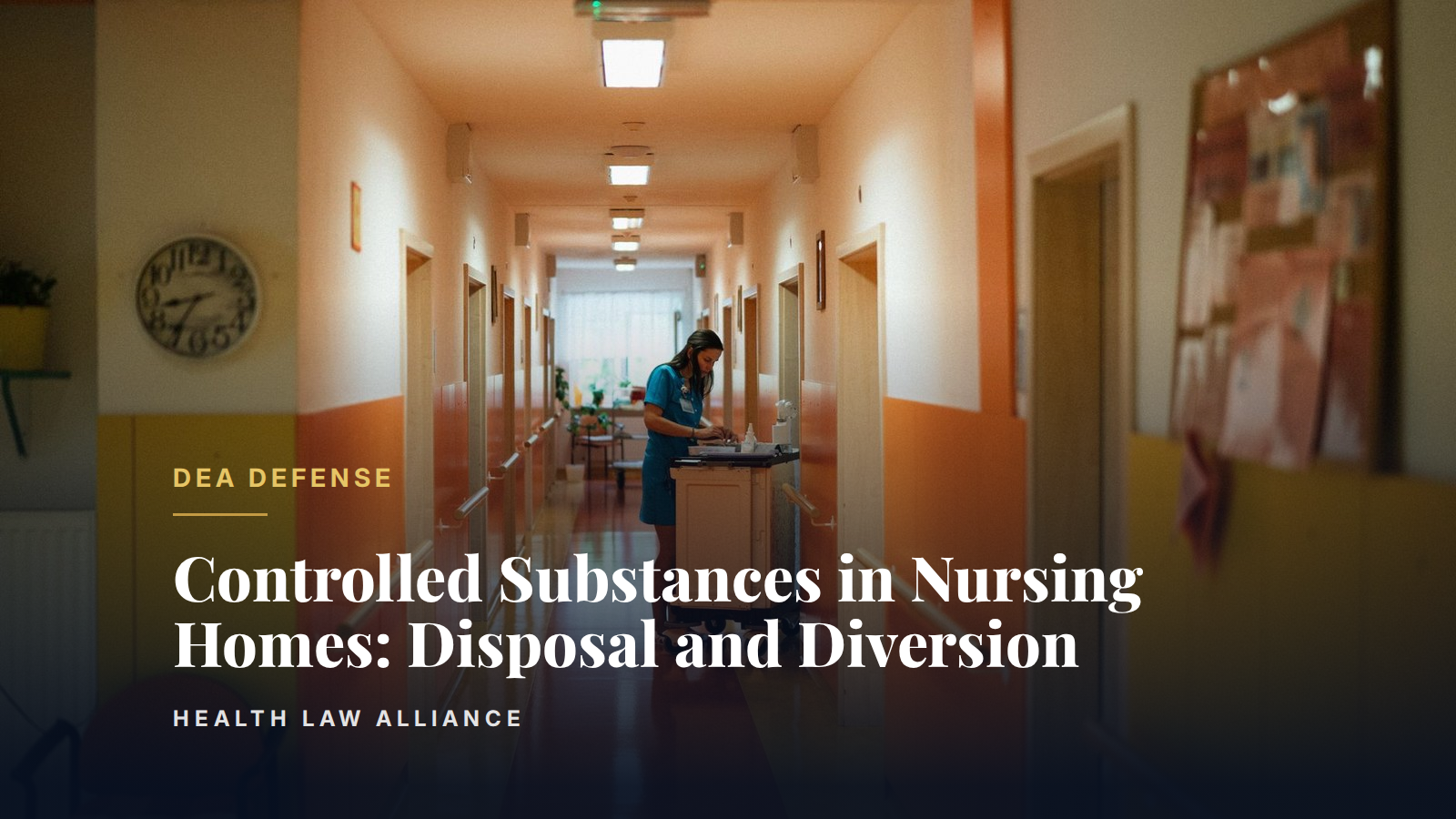
A nursing home resident dies, transfers, or has a prescriber discontinue an opioid or benzodiazepine, and the leftover controlled substance has to leave the building within a fixed federal window. DEA's long-term care disposal rule at 21 C.F.R. Part 1317 controls who may move that drug, how fast, and under whose supervision, and a facility that gets the sequence wrong risks an inventory reconciliation request or a diversion investigation.
Who May Dispose of a Resident's Medication
Under 21 C.F.R. § 1317.80(a), a long-term care facility may dispose of a resident's Schedule II through V medication on that resident's behalf only by transferring it into a collection receptacle the facility does not itself own. The receptacle belongs to, and is installed, managed, and maintained by, an authorized retail pharmacy or a hospital or clinic with an on-site pharmacy, the authorized collector, the rule's term for whichever of the two installs the box. Under § 1317.80(e), neither may operate a receptacle at the facility until its DEA registration has been modified under 21 C.F.R. § 1301.51 to cover that location. A facility that lets a pharmacy place a box without that modification, or that disposes of medication through any other channel, has stepped outside the rule.
The Three-Business-Day Disposal Window
Section 1317.80(a) requires disposal into the receptacle to happen immediately, but no longer than three business days after discontinuation of use, defined as a permanent stop directed by the prescriber, the resident's transfer out of the facility, or death. A second clock starts once the sealed inner liner is removed from the receptacle: § 1317.80(d) allows it to sit at the facility for up to three more business days, in a securely locked cabinet or room, before the collector transfers it for destruction. A contract pharmacy's suspicious order monitoring duty under 21 C.F.R. § 1301.74(b) is separate from these disposal deadlines.
The Two-Employee Handling Rule
Section 1317.80(c) does not let a single person handle the inner liner alone. Installation, removal, transfer, and storage must be performed either by one employee of the authorized collector together with one supervisor-level facility employee the collector has designated, such as a charge nurse, or by two employees of the collector itself. The outer container must stay locked whenever an employee is not present or the receptacle is not being actively monitored. A facility that routinely lets one nurse load the receptacle and carry a sealed liner to storage alone has created the gap the rule was written to close.
When a Shortage Becomes a Diversion Investigation
The DEA registrant responsible for the medication, typically the contract pharmacy rather than the nursing home itself, must notify its local DEA Diversion Field Office in writing within one business day of discovering a theft or significant loss and then file DEA Form 106 under 21 C.F.R. §§ 1301.74(c) and 1301.76(b); there is no set quantity threshold. A Department of Health and Human Services Office of Inspector General work plan item opened in February 2026 states that state survey agencies have cited almost half of nursing homes nationwide for pharmaceutical services deficiencies, and that more than 157,000 opioid-receiving residents could be at risk of overuse, misuse, or diversion without effective controls. Prosecutors have charged staff directly: Vermont's attorney general charged a long-term care nurse with drug diversion in October 2026. The case traces back to a medication count that did not match the record.
The two-employee handling rule and the three-business-day clock exist so a missing dose leaves a paper trail instead of a guess.
Why Early Legal Counsel Is Critical
It is critical that nursing homes and their pharmacy partners promptly retain experienced healthcare defense counsel upon receiving a DEA inquiry, a state survey deficiency citation tied to controlled substances, or any sign that a resident's medication record does not reconcile. Early legal intervention can protect the facility's and staff's rights, ensure the facility's response accurately reflects the disposal and inventory records, avoid inadvertent admissions, preserve relevant defenses, and allow counsel to communicate with investigators on the facility's behalf. Delaying representation can significantly affect the outcome and expose the facility to unnecessary risk.
How Health Law Alliance Can Help
Health Law Alliance's attorneys have overseen 2,000+ audits and handled 5,000+ matters, with 25+ years of experience. If your nursing home, contract pharmacy, or staff member is facing a DEA inspection, an immediate suspension order, or a DEA order to show cause arising from a controlled substance disposal or diversion question, contact Health Law Alliance's DEA defense attorneys for a free, confidential consultation.