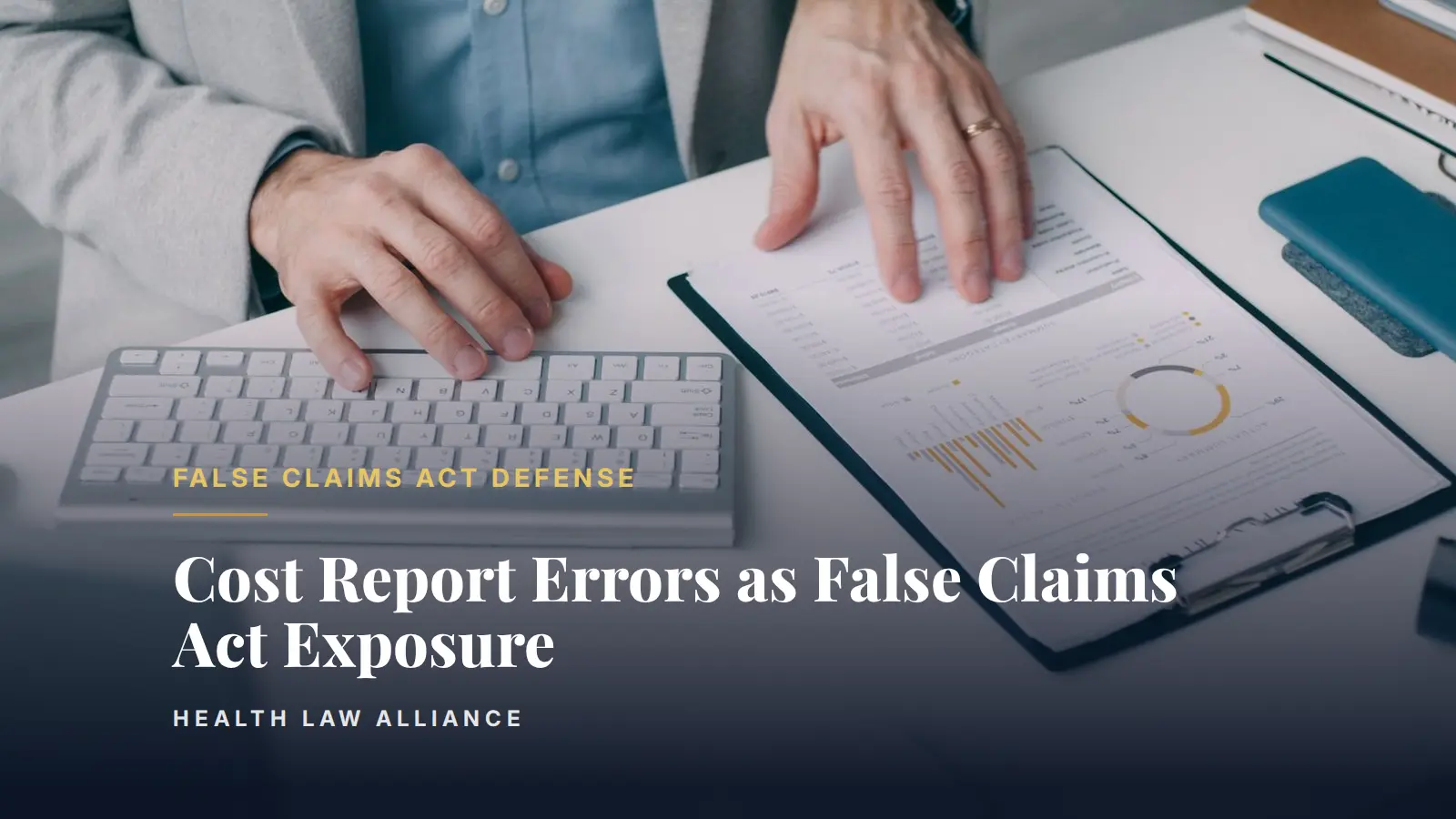
A hospital, home health agency, or nursing facility submits a Medicare cost report every year, and the chief financial officer or administrator who signs it is certifying far more than arithmetic. The Centers for Medicare & Medicaid Services requires that signer to attest, under a warning of criminal, civil, and administrative penalties, that the report is true, correct, and complete. When that certification turns out to be knowingly false, the cost report becomes a potential predicate for civil False Claims Act liability.
The Cost Report Certification
Worksheet S of the hospital cost report, Form CMS-2552-10, and the equivalent certification page on the home health agency cost report, Form CMS-1728-20, carry the same warning: misrepresentation or falsification of any information in the cost report may be punishable by criminal, civil, and administrative action, fine, or imprisonment under federal law, and the same consequences apply to kickback-tainted or otherwise illegal services. The certifying officer then affirms, to the best of their knowledge and belief, that the report is true, correct, complete, and prepared from the provider's books and records, and that the reported services complied with applicable laws and regulations. A False Claims Act theory attaches to that affirmative statement, not to the underlying cost data alone.
Common Errors That Create Exposure
The errors that turn a cost report into an enforcement target are substantive, not clerical: misallocating costs across cost centers to inflate reimbursable expense, omitting related-party transactions from the home office cost statement, overstating bad debt, or miscounting the statistics used to apportion costs each misstate figures the certifying officer represented as true and correct. Cost reports sit alongside risk adjustment submissions as another filing that can carry False Claims Act exposure. Contractors check the filed report against claims data, audited financial statements, and prior-year filings before CMS finalizes it through the Notice of Program Reimbursement.
The Knowing Standard Under the False Claims Act
Civil liability under the False Claims Act, 31 U.S.C. Section 3729, attaches only when the certifying officer acted knowingly. Section 3729(b)(1) defines knowing to mean actual knowledge of the false information, deliberate ignorance of its truth or falsity, or reckless disregard of its truth or falsity, with no proof of specific intent to defraud required. The Act does not reach ordinary negligence or a good-faith error in a complex cost allocation methodology. The government or a relator still has to show the certifying officer's state of mind when the report was signed, and that the false statement was material to CMS's payment decision under the Section 3729(b)(4) definition of material.
A cost report that is wrong is not automatically a false claim. False Claims Act exposure turns on what the certifying officer knew, or recklessly disregarded, when the certification was signed, not on whether the cost allocation later proves incorrect.
From Certification to Qui Tam Claim
A cost report certification can become the basis of a qui tam complaint filed by a relator with inside knowledge of the report's preparation, such as a former compliance officer, billing consultant, or finance employee. Filed under seal, the matter proceeds through the investigation stage covered in Inside an FCA Investigation: The Defense Timeline before the government decides whether to intervene. A provider that finds a misstatement and does not correct it faces a separate theory: knowingly retaining an identified overpayment can itself support a reverse false claim, addressed in Reverse False Claims Liability for Retaining an Overpayment. A cost-report resolution can also carry a corporate integrity agreement and put the certifying individual at risk of OIG exclusion from federal health care programs.
Why early legal counsel is critical: hospitals, home health agencies, and nursing facilities should retain experienced healthcare defense counsel promptly after discovering a cost report error or receiving a qui tam complaint, a civil investigative demand, or any other sign of a cost-report-based False Claims Act inquiry. Early legal intervention protects the provider's rights, guides how an error gets corrected or disclosed, preserves defenses before litigation positions harden, and lets counsel communicate with investigators and contractors on the provider's behalf. Delaying representation narrows the defenses available later and can affect how a knowing-standard dispute resolves.
How Health Law Alliance can help: Health Law Alliance defends healthcare providers through qui tam investigations, Civil Investigative Demands, and DOJ Civil Division investigations, from the certification review stage through any dispute over the knowing standard or materiality.
Health Law Alliance's attorneys have overseen 2,000+ audits and handled 5,000+ matters, with 25+ years of experience.
If your organization has identified an error in a filed cost report or received a qui tam complaint tied to a cost report certification, contact Health Law Alliance for a free, confidential consultation to review the matter and the exposure it carries.