
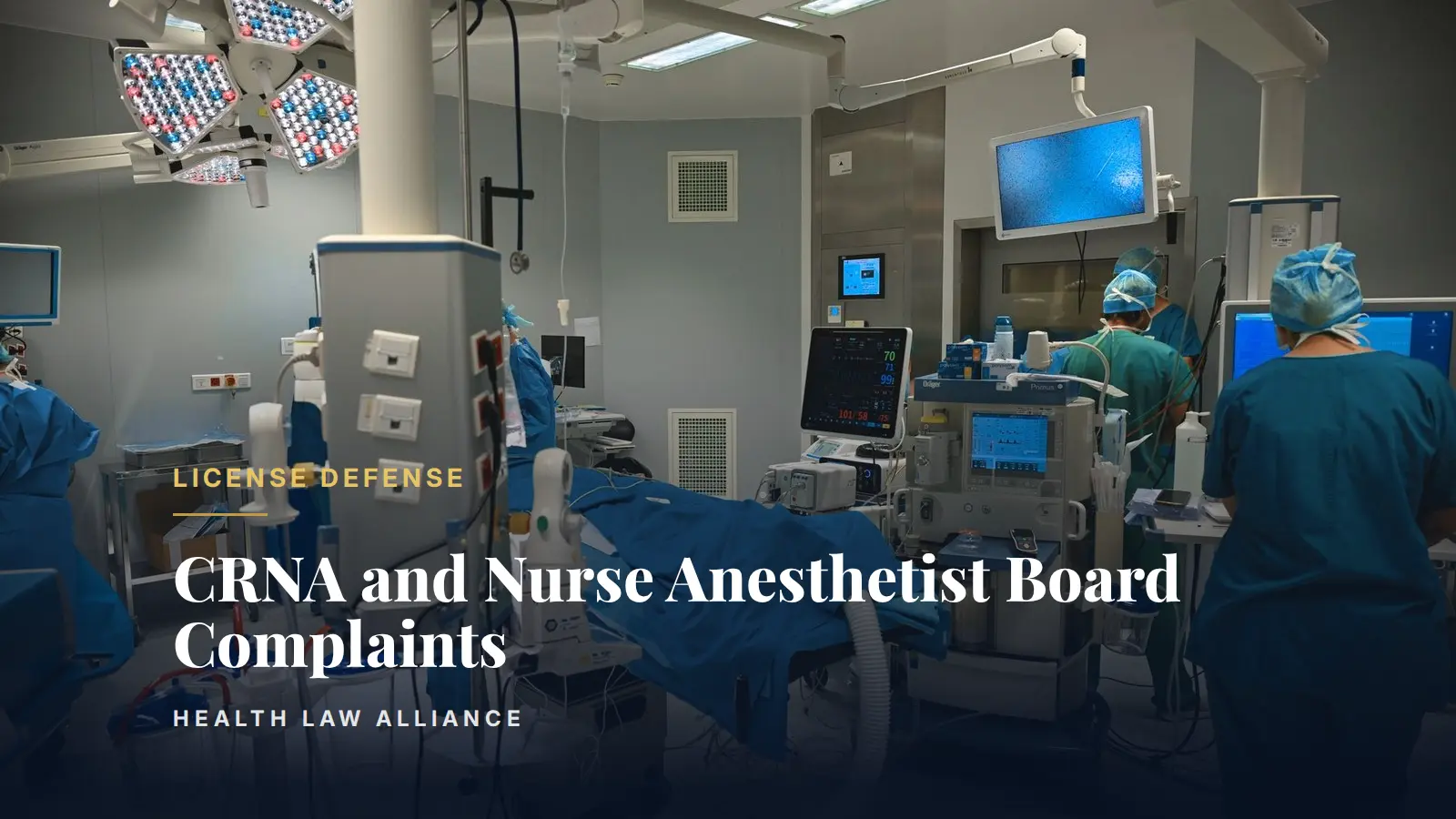
A board of nursing complaint against a certified registered nurse anesthetist (CRNA) does not always stay inside one agency. The same medication count discrepancy, monitoring gap, or supervision question that opens a nursing board investigation can draw a state medical board's review of the supervising physician's delegation and a state board of pharmacy's review of controlled substance accountability, each applying its own standard to the same underlying facts. The CRNA named in one of these complaints is managing a multi-agency inquiry.
The CRNA-Specific Exposure
Certified registered nurse anesthetists carry a different risk profile than other advanced practice nurses. Anesthesia providers hold direct access to Schedule II controlled substances in the course of their practice, and the documentation trail runs through anesthesia records and controlled substance logs rather than a standard medication administration record. Supervision and delegation arrangements between a CRNA and the supervising anesthesiologist or operating physician also vary by state, from required physician supervision to independent practice. That variation means the same clinical event can be a straightforward nursing board matter in one state and a separate supervision question for a second board in another.
What Triggers a Board of Nursing Complaint
Allegations against CRNAs cluster around four fact patterns. Medication handling complaints involve controlled substance counts that do not reconcile, undocumented waste, or irregular automated dispensing cabinet activity. Monitoring complaints allege a patient was inadequately observed during a case or that vital-sign and depth-of-anesthesia documentation does not match the clinical record. Supervision complaints question whether the CRNA practiced within the delegation agreement or the state's scope-of-practice rules for that setting. Diversion complaints, the most serious category, allege the CRNA removed a controlled substance for personal use, substituted saline or another diluent for an opioid, or falsified a count or waste record to cover the activity. A single incident can produce more than one of these allegations at once.
When the Pharmacy or Medical Board Gets Involved
A board of nursing investigation can run alongside inquiries from other agencies looking at the same incident. A state board of pharmacy can review controlled substance accountability independent of the nursing board, because the facility's recordkeeping is its own regulatory obligation. A state medical board can open a parallel review of the supervising or delegating physician, asking whether the physician reasonably relied on a qualified CRNA or should have caught the pattern earlier. Where the facts suggest fraud or a controlled substance crime rather than a documentation lapse, a federal inquiry can run on a separate track entirely, arriving as a subpoena or a target letter long before the state boards finish their review, and a substantiated finding can carry collateral exposure such as an OIG exclusion from federal healthcare programs.
How a Board Investigation Unfolds
A complaint against a CRNA can come from a colleague, a supervising physician, hospital risk management, a patient, or a self-report obligation the CRNA's own employer owes the board. The board screens the complaint for jurisdiction, opens a file if it states a plausible violation, and assigns an investigator who requests the anesthesia record, the controlled substance log, and a written statement from the CRNA. A disciplinary finding, a settlement, or a license action resulting from that investigation is the kind of event that generates a National Practitioner Data Bank report, which follows the CRNA into every future credentialing application regardless of where the case was resolved. A CRNA who believes the report is inaccurate can dispute it or add a statement to the file, though neither step undoes the underlying board action.
A single complaint against a CRNA can open three separate licensing inquiries, nursing, medicine, and pharmacy, before any of them reaches a hearing.
Why Early Legal Counsel Is Critical
It is critical that a CRNA promptly retain experienced healthcare defense counsel on receiving notice of a board of nursing complaint, a pharmacy board inquiry, or any related investigative request. Early legal intervention can protect the CRNA's rights, confirm which boards actually have jurisdiction over the conduct alleged, help frame a written response that does not hand a second board new grounds to open its own file, and allow counsel to communicate with each board directly. Delaying legal representation can significantly affect the outcome and expose the CRNA to unnecessary risk across every agency reviewing the same facts.
How Health Law Alliance Can Help
Health Law Alliance has represented 2,500+ clients nationwide. The firm defends pharmacists, physicians, nurses, and other licensed healthcare professionals, including CRNAs, in state board disciplinary proceedings from the first notice through any hearing. If you have received a board letter or an investigator's request concerning your practice as a CRNA, contact Health Law Alliance's professional license defense attorneys for a free, confidential consultation before you respond.