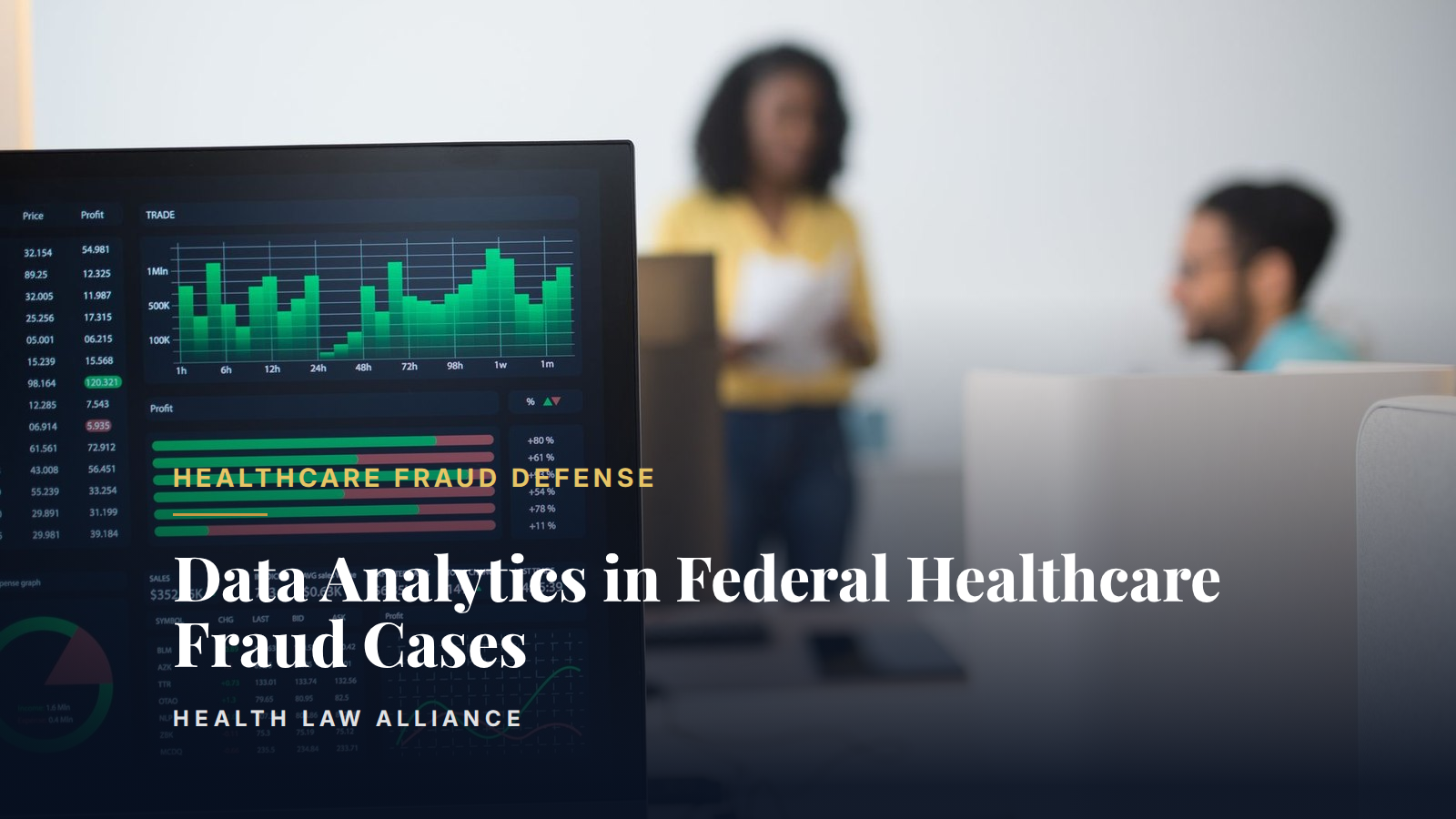
Federal healthcare fraud investigations increasingly start with a spreadsheet, not a whistleblower complaint. The Department of Justice (DOJ) and the Centers for Medicare & Medicaid Services (CMS) now run predictive analytics against Medicare and Medicaid claims before a single subpoena issues, flagging outliers for investigation. The June 23, 2026 National Health Care Fraud Takedown charged 455 defendants, including 90 doctors and licensed medical professionals, in schemes involving more than $6.5 billion in alleged false claims, an operation DOJ credited to expanded data analytics and a new cloud partnership with CMS.
How the Government Builds a Data-Driven Fraud Case
Since 2011, CMS has run its Fraud Prevention System on Medicare fee-for-service claims on a streaming basis, applying predictive analytics before payment goes out, the same approach credit card companies use to catch suspicious charges. DOJ's Health Care Fraud Unit added a Data Fusion Center in June 2025 and a Financial Intelligence Review Team to flag outlier billing and trace money movement. In June 2026, DOJ's fraud division gained cloud-computing access to CMS's Integrated Data Repository, letting analysts run AI models directly against Medicare and Medicaid claims rather than waiting for a referral. The stated goal is intervention before payment, not recovery after the fact.
Which Billing Patterns Draw Scrutiny First
The analytics rank providers against national peer benchmarks by specialty. A physician who orders far more of a given test or procedure than nearly all peers in the same specialty becomes a scoring outlier, the pattern behind recent takedowns concentrated in wound care, behavioral health, genetic testing, telemedicine, and Medicaid billing. The same data pull cross-references referral relationships. A physician who refers a disproportionate share of business to an entity in which the physician holds a financial interest can raise a Stark Law question, and a referral pattern tied to compensation can raise an Anti-Kickback Statute question, both surfaced before an investigator ever reviews a chart.
Statistical Sampling and the Extrapolated Demand
Once the analytics flag an outlier, the government typically pulls a claims sample and extrapolates its error rate across the full universe of claims billed during the review period, turning a review of a few hundred files into an eight-figure demand. Courts are split on when that shortcut is reliable. In United States ex rel. Martin v. Life Care Centers of America (E.D. Tenn. 2014), the court permitted a sample covering more than 54,000 Medicare claims to establish liability itself, not just damages. Other courts have refused, most notably United States v. Vista Hospice Care (N.D. Tex. 2016), where hospice eligibility turned on individualized clinical judgment that a statistical sample could not substitute for. This is frequently the stage at which a civil investigative demand or a grand jury subpoena follows the data review. Physicians who receive either should review our guides on responding to a civil investigative demand (CID) and on grand jury subpoenas in healthcare investigations.
A billing pattern that scores as a statistical outlier is not the same thing as a claim that is legally false, and that distinction is where a data-driven fraud case is won or lost.
Rebutting a Statistics-First Theory
A statistics-first case is won or lost on methodology, not on the dollar figure the government leads with. The defense starts with the sample: whether the claims selected were truly random or stratified, whether the sample size meets accepted thresholds (HHS-OIG treats 100 claims as a working minimum), and whether the error rate reflects a false claim rather than a documentation gap or a coding disagreement. See our companion piece on where enforcement draws the line between a billing error and fraud. The civil-versus-criminal distinction matters too: civil False Claims Act liability can rest on a preponderance of statistical evidence, while a criminal healthcare fraud charge requires the government to prove intent that a spreadsheet alone cannot supply.
Why Early Legal Counsel Is Critical
It is critical that physicians promptly retain experienced healthcare defense counsel upon receiving a subpoena, audit notice, civil investigative demand, or other government inquiry that references billing pattern analysis. Early legal intervention can protect the physician's rights, ensure the response addresses the sampling and extrapolation methodology at issue, avoid inadvertent admissions, and preserve defenses that a delayed response can forfeit. Delaying legal representation can significantly affect the outcome of the matter.
How Health Law Alliance Can Help
Health Law Alliance defends physicians and healthcare companies against fraud investigations built on data analytics, from the initial document request through a statistics-first False Claims Act theory. Our bench includes a former federal prosecutor and a former senior healthcare compliance executive, background that shapes how we evaluate a government sampling methodology and where it can be challenged. If your practice has received a subpoena, a civil investigative demand, or another inquiry referencing an outlier billing pattern, contact us for a free, confidential consultation.