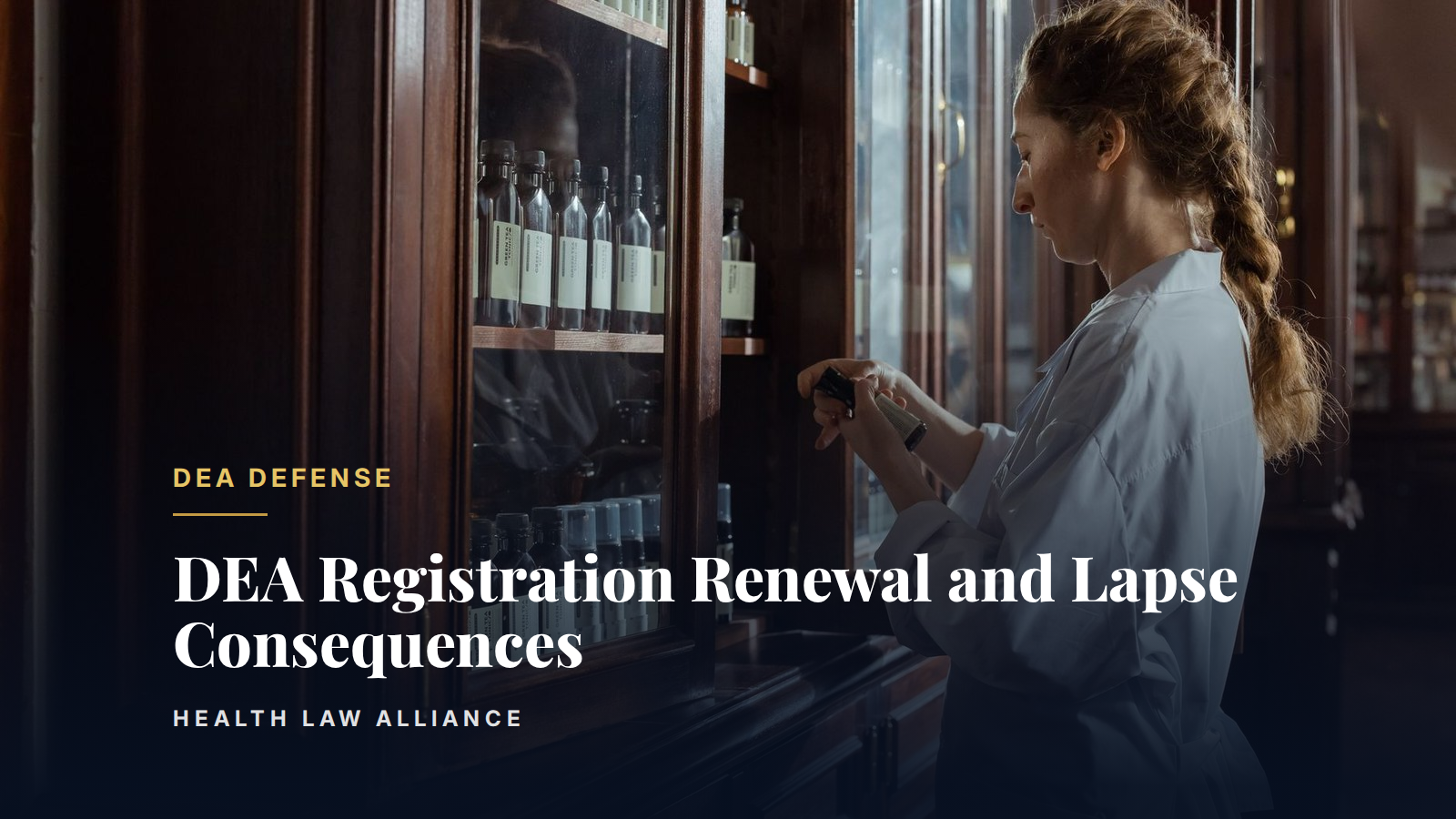
A pharmacy's authority to dispense controlled substances does not renew itself. Under 21 U.S.C. § 822(a)(2), every registrant that dispenses controlled substances must hold a registration issued by the Attorney General, valid only for the fixed term set by regulation. When the renewal window closes without a completed application on file, the registration expires, and the pharmacy's authority to handle Schedule II through V controlled substances stops at that moment, regardless of intent, staffing turnover, or an overlooked notice. What follows can range from a costly reinstatement scramble to a DEA administrative action and criminal exposure under the Controlled Substances Act.
The Three-Year Renewal Cycle and DEA's Renewal Notices
For retail pharmacies, hospitals, clinics, and practitioners registered to dispense Schedules II through V, a DEA registration issues for a three-year term under 21 CFR § 1301.13(e)(1). Tracking that expiration date is the registrant's responsibility, not DEA's. The agency supports that responsibility with electronic reminders sent to the registrant's email address on file at 60, 45, 30, 15, and 5 days before the expiration date, a practice DEA adopted after retiring paper renewal notices. A registration lapses on its stated expiration date if no completed renewal application is on file by then, regardless of whether the reminder emails were received, read, or routed to a former employee's inbox.
The 45-Day Rule That Preserves Authority During Processing
Filing late does not automatically mean losing authority the moment the clock runs out. Under 21 CFR § 1301.36(i), if a registrant applies for reregistration at least 45 days before the existing registration's expiration date, and DEA has not issued a decision by that date, the existing registration is automatically extended and remains in effect until DEA acts on the application. That extension is the registrant's protection against DEA's own processing delays, but it applies only when the application is filed at least 45 days out. A renewal submitted 44 days, 10 days, or the day before expiration carries no such protection. DEA retains discretion to extend other registrations when consistent with public health and safety, but that is a discretionary accommodation, not a right the pharmacy can rely on.
What a Lapsed Registration Exposes the Pharmacy To
When a registration expires before a completed renewal is on file, the registrant loses federal authority to handle controlled substances at that location, in full, immediately. DEA's own published guidance allows reinstatement of an expired registration for one calendar month after the expiration date. After that window closes, the registrant must file for an entirely new registration rather than a renewal, and the application starts over, including DEA's review of the public interest factors that govern new applications and denials.
Reinstatement eligibility does not restore authority retroactively. Federal law prohibits handling controlled substances under an expired registration for any period, and continuing to fill controlled substance prescriptions after expiration exposes the pharmacy and the pharmacist-in-charge personally to civil penalties under 21 U.S.C. § 842 and potential criminal exposure under 21 U.S.C. § 841 for dispensing without authorization. It can also draw the kind of DEA administrative scrutiny that leads to an order to show cause or, where DEA finds an imminent danger to public health or safety, an immediate suspension order in place of a routine renewal review.
A pharmacy that keeps filling controlled substance prescriptions after its DEA registration expires is operating with no federal authority to do so, the same legal position as a pharmacy that was never registered at all.
Why Early Legal Counsel Is Critical
It is critical that pharmacies and registrants promptly retain experienced healthcare defense counsel upon discovering a lapsed DEA registration or receiving a related DEA inquiry. Early legal intervention can protect the registrant's rights, guide appropriate responses to DEA requests, avoid inadvertent admissions, preserve relevant defenses, and allow counsel to communicate with DEA on the registrant's behalf. Delaying legal representation can significantly affect the outcome of a matter and expose the registrant to unnecessary risk.
How Health Law Alliance Can Help
Health Law Alliance represents pharmacies and practitioners in DEA registration matters, from renewal lapses and reinstatement questions to order to show cause proceedings that follow an expired or contested registration. The firm's DEA defense practice works directly with DEA on the registrant's behalf to resolve a lapse before it escalates into administrative action. If a registration has expired, is close to expiring, or DEA has raised a question about renewal, contact us for a free, confidential consultation.