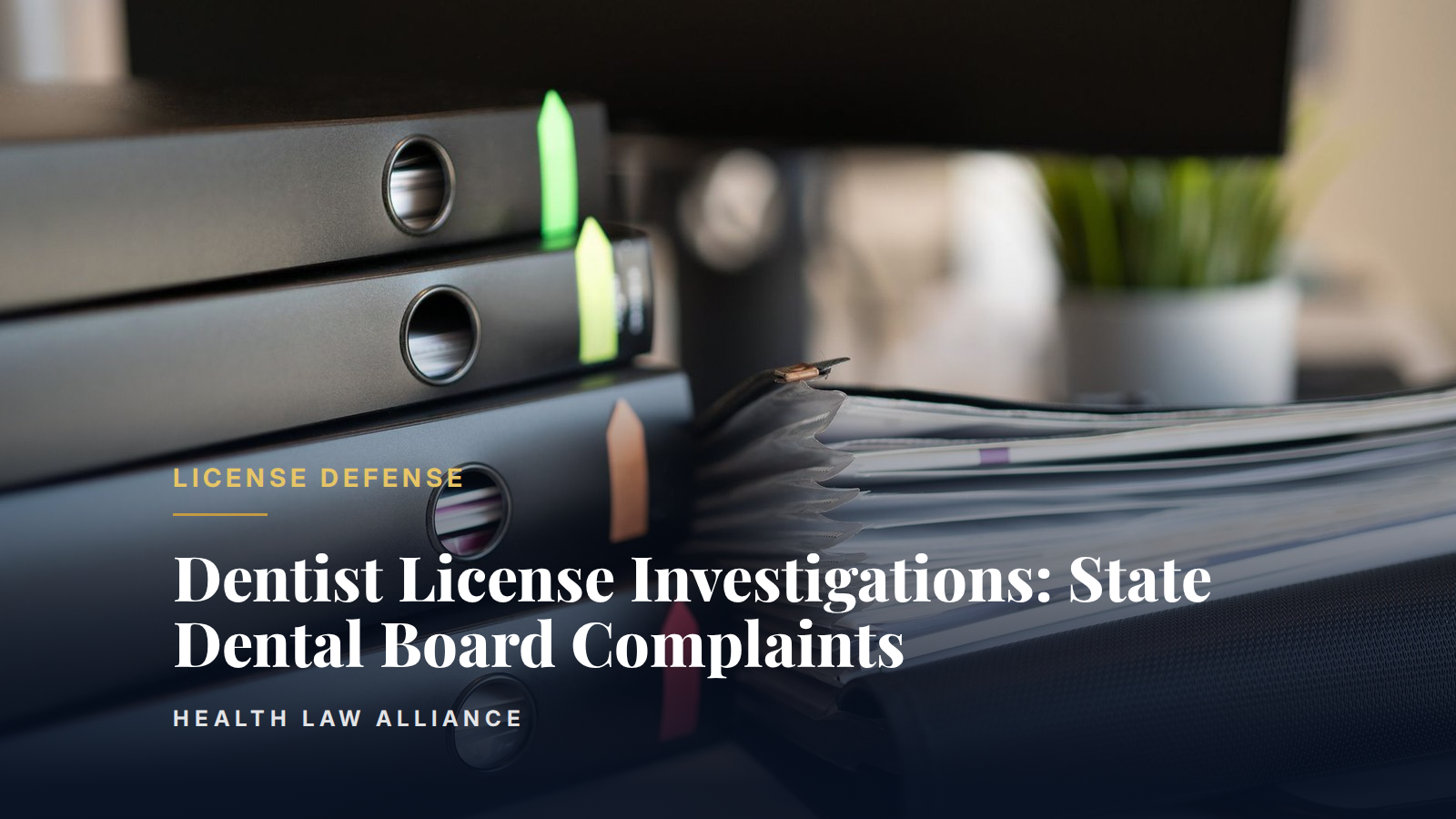
A patient complaint, a staff member's hotline call, or a routine insurance audit can each open a dental board investigation. The dentist named in it learns about it from a letter requesting the complete patient chart. The inquiry carries stakes comparable to a lawsuit: suspension, probation, or revocation of the license that supports the practice, mandatory reporting to the National Practitioner Data Bank, and, where the conduct resembles fraud, a referral to prosecutors. What the dentist says and produces in the first weeks becomes part of the board's permanent record.
What Draws a Dental Board Complaint
Dental board complaints concentrate in a few recurring categories: a bad outcome blamed on the dentist, a billing dispute, an infection-control lapse, a sedation or anesthesia incident, or a records problem. California's Dental Practice Act lists disciplinary grounds under Business and Professions Code Section 1680: obtaining a fee by fraud, altering a patient's record with intent to deceive, knowingly failing to follow infection-control guidelines, and failing to report, within seven days, a patient's death connected to treatment or the hospitalization of a sedated or anesthetized patient, or any other hospitalization resulting from dental treatment. New York's Education Law Section 6530 separately treats negligence on more than one occasion, and gross negligence on a single occasion, as misconduct, and requires an accurate patient record kept for at least six years.
Not every billing complaint belongs in front of the board. The Dental Board of California's own consumer guidance states that fee and billing disputes fall outside its jurisdiction, and directs those complainants to the dental office or the patient's insurer instead. A dentist who receives a board letter framed around money, rather than fraud, has reason to ask whether the board has authority over the complaint at all.
How the Board Investigates
The mechanics vary by state, but the shape is similar: intake screening, a file review, and a decision to close the file, settle, or refer the matter to a hearing. Texas sets hard numbers: under Occupations Code Chapter 255, the dental board must complete a preliminary investigation not later than the 60th day after it receives the complaint, notify the dentist and complainant of the case's status at least quarterly until it closes, and cannot act on a complaint filed after the fourth anniversary of the date the conduct occurred. New York's Office of Professional Discipline investigates every complaint it receives by statute before deciding whether to dismiss it.
What to Say, and Not Say, Before Counsel Is Retained
A dentist contacted by an investigator should produce what the law requires and say nothing else. California's Business and Professions Code Section 1684.1 attaches a specific penalty to that production: a licensee who does not produce requested records faces a civil penalty of $250 per day past the 15th day, up to $5,000. Missing that deadline turns a records request into its own violation, separate from whatever the original complaint alleged.
An investigator's first phone call is already an interview. What the dentist says on it before counsel reviews the chart cannot be undone.
Our guide to how a medical board investigation opens with the first contact from an investigator covers the same decision point for physicians, and the posture it recommends, say nothing substantive on the first call and route further requests through counsel, applies equally to a dental board matter.
When a License Complaint Reaches Beyond the Board
A dental board lacks a prosecutor's subpoena power, but its findings do not stay contained to the license. A referral of a billing-fraud finding to a state Medicaid Fraud Control Unit or the HHS Office of Inspector General can trigger an OIG exclusion from federal healthcare programs, a subpoena, or a target letter, independent of the board's own discipline. A dentist licensed in more than one state faces a second layer: a board action reported to the National Practitioner Data Bank can surface at every other license the same dentist holds when it comes up for renewal.
Why Early Legal Counsel Is Critical
It is critical that a dentist promptly retain experienced healthcare defense counsel upon receiving a board complaint, an investigator's letter, a subpoena, or any other government inquiry. Early legal intervention can protect the dentist's rights, ensure appropriate responses to the board's requests, avoid inadvertent admissions, preserve relevant defenses, and allow counsel to communicate with the investigator on the dentist's behalf. Delaying legal representation can affect the outcome of a board matter and expose the dentist to risk that a timely response could have avoided.
How Health Law Alliance Can Help
Health Law Alliance represents dentists and other licensed healthcare professionals in state board investigations, from the first records request through any formal hearing.
Health Law Alliance has represented 2,500+ clients nationwide.
If you have received a complaint letter or records request from a state dental board, contact Health Law Alliance's professional license defense team for a free, confidential consultation.