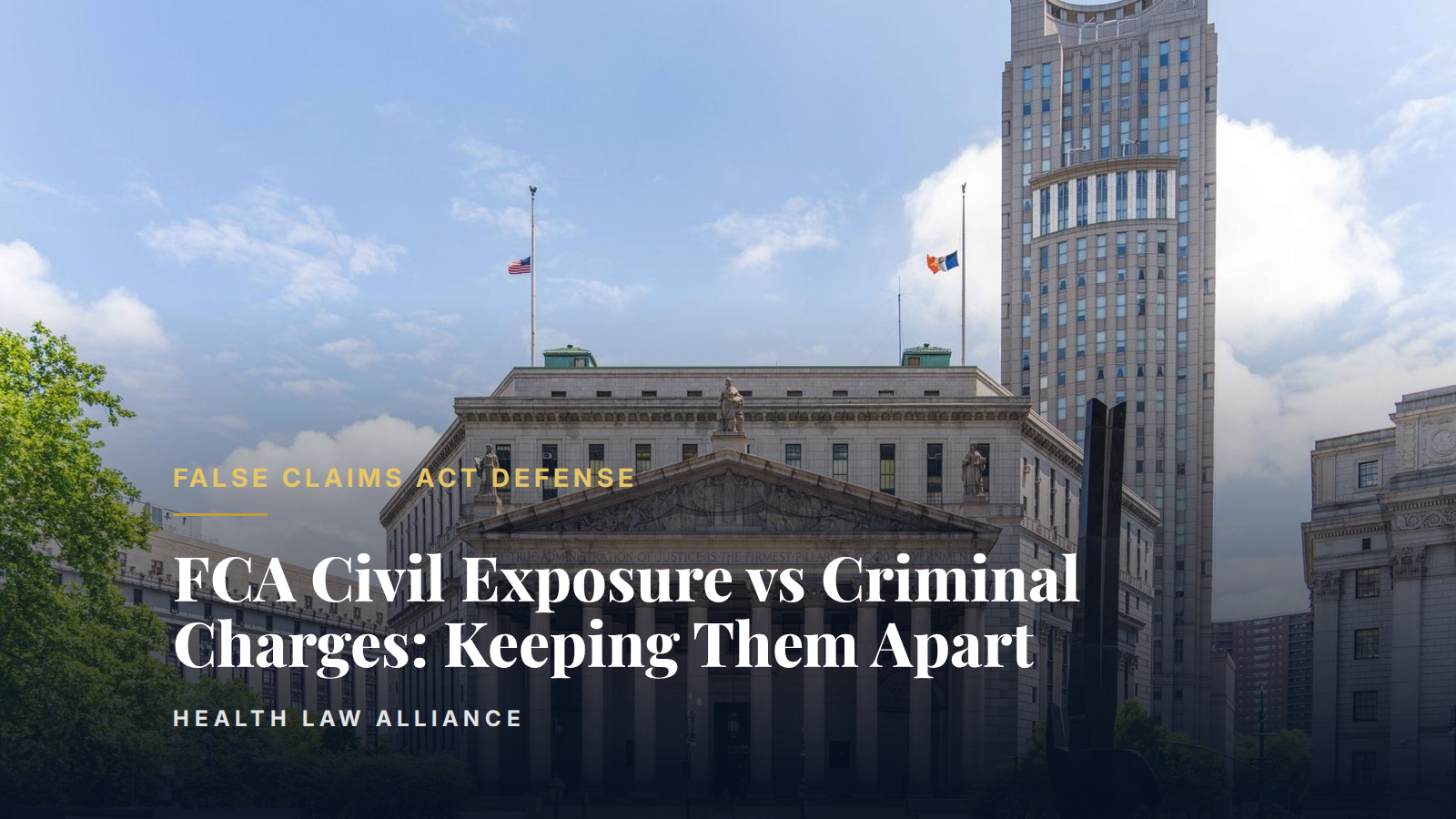
A civil demand letter under the False Claims Act and a criminal target letter can arrive from the same U.S. Attorney's office, but they rest on entirely different statutes. The False Claims Act, 31 U.S.C. § 3729, is a civil statute exposing a practice to treble damages and per-claim civil penalties. Criminal healthcare fraud exposure runs through a separate body of law: the healthcare fraud statute at 18 U.S.C. § 1347, the Anti-Kickback Statute when charged criminally under 42 U.S.C. § 1320a-7b, and false statement statutes such as 18 U.S.C. §§ 1001 and 1035. A physician who cannot tell these tracks apart risks misjudging what is actually at stake.
The Civil FCA Standard
The False Claims Act is a civil enforcement tool, pursued by the Department of Justice or by a private relator in a qui tam action. Liability attaches when a provider knowingly submits a false or fraudulent claim for payment, and the statute defines knowledge broadly: actual knowledge, deliberate ignorance, or reckless disregard of the truth all satisfy the standard. Specific intent to defraud is not required. Remedies are financial, not custodial: treble damages on the government's loss plus a per-claim civil penalty. A civil FCA judgment or settlement, standing alone, does not produce a criminal record.
Criminal Statutes That Actually Apply
Criminal exposure arises under different statutes. The healthcare fraud statute, 18 U.S.C. § 1347, requires the government to prove a defendant knowingly and willfully executed, or attempted to execute, a scheme to defraud a health care benefit program. The Anti-Kickback Statute, charged criminally under 42 U.S.C. § 1320a-7b(b), makes it a felony to knowingly and willfully offer, pay, solicit, or receive remuneration for patient referrals, punishable by imprisonment. False statement statutes, 18 U.S.C. § 1001 and the health care specific 18 U.S.C. § 1035, criminalize false statements to federal officials or in connection with health care payment. A conviction under any of these statutes is a criminal conviction, carrying imprisonment and criminal fines, and it is never accurately described as an FCA outcome.
The Burden of Proof and Remedies Divide
The two tracks diverge on what the government must prove and what a physician stands to lose. Civil FCA liability is established by a preponderance of the evidence, the lowest standard in federal litigation. Criminal healthcare fraud and false statement charges require proof beyond a reasonable doubt, the highest standard the law recognizes, typically before a jury. Remedies track the standard: civil FCA exposure means treble damages, per-claim penalties, and program exclusion, while criminal exposure means imprisonment, criminal fines, restitution, and mandatory exclusion under a separate authority. A civil investigative demand does not put a physician in prison. A grand jury subpoena or a target letter can lead there.
Parallel Proceedings and Why They Happen
The same underlying conduct can generate both tracks at once. Department of Justice policy directs civil and criminal attorneys handling the same conduct to communicate and coordinate, and a single U.S. Attorney's office may run a civil False Claims Act matter alongside a criminal healthcare fraud investigation into the identical billing pattern. A physician might receive a civil investigative demand from the Civil Division while a criminal Assistant U.S. Attorney independently builds a case, and a target letter can surface only after the civil side has already taken documents and testimony. Evidence produced in the civil track, including depositions and document productions, can be shared with criminal prosecutors, which is why the two tracks must be treated as distinct problems rather than one letter standing in for the other.
A guilty plea to health care fraud under 18 U.S.C. § 1347 is a criminal conviction, not an FCA judgment, and a civil FCA settlement is a resolution of financial liability, not a criminal disposition. The two have never been interchangeable, and treating them as such in a response to the government is a mistake with real consequences.
Why Early Legal Counsel Is Critical
It is critical that physicians and practice owners promptly retain experienced healthcare defense counsel upon receiving a civil investigative demand, a target letter, or a grand jury subpoena. Early legal intervention can protect the physician's rights, ensure complete and timely responses, avoid inadvertent admissions that could be used across both a civil and a criminal track, preserve defenses, and allow counsel to communicate with the government on the physician's behalf. Delaying legal representation can significantly affect outcomes and expose the physician to unnecessary financial and criminal risk.
How Health Law Alliance Can Help
Health Law Alliance represents physicians facing both civil False Claims Act exposure and parallel criminal healthcare fraud investigations. If your practice has received a civil investigative demand, a target letter, or a subpoena touching on billing practices, contact us for a free, confidential consultation.