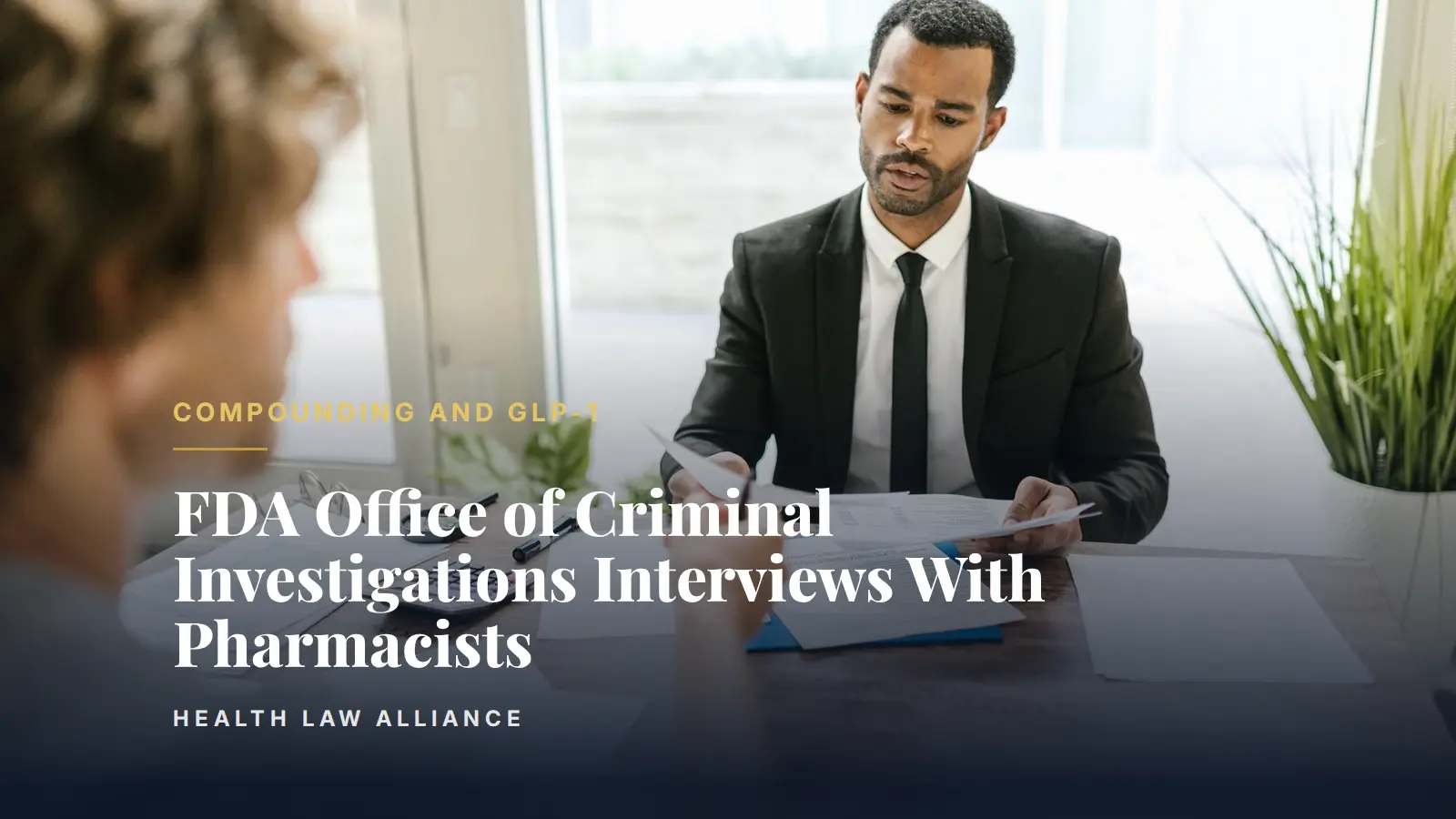
When a Special Agent from the FDA Office of Criminal Investigations calls or appears at a compounding pharmacy, the facility is no longer facing a routine compliance visit. OCI is the Food and Drug Administration's criminal law enforcement arm, and it investigates suspected violations of the Federal Food, Drug, and Cosmetic Act and related federal statutes, not formulation errors or paperwork gaps. Its special agents carry firearms, have authority to execute arrest and search warrants, and refer the cases they build to the Department of Justice for prosecution. A pharmacist asked to sit for an interview in that setting is in a different conversation than the one a civil FDA inspector conducts during a routine inspection, and the first decision in it, whether to speak at all, deserves counsel's input before it is made.
What FDA OCI Actually Investigates
OCI pursues suspected criminal conduct involving FDA-regulated products: illegal diversion of prescription drugs, distribution of counterfeit or misbranded drugs, and fraud schemes that put patients at risk. For a compounding pharmacy, that scope can reach manufacturing problems such as contamination or sterility failures in a compounded drug, one of the categories OCI investigates. An agent's first contact with a pharmacist can take the form of a request for a voluntary interview, a different encounter than an arrest or a search executed under a warrant.
Pharmacists Can Decline A Voluntary OCI Interview
A pharmacist can decline an OCI agent's request for an interview in a non-custodial setting; the agent cannot compel participation absent an arrest or a court order. Miranda v. Arizona's warning requirement attaches to custodial interrogation, not to a voluntary conversation at the pharmacy counter or over the phone, so an OCI agent has no obligation to read a warning before asking questions outside of custody. A pharmacist can also ask that the interview be rescheduled or that counsel be present before answering a single question, and either response is a lawful exercise of rights, not evidence of wrongdoing.
Why Answering Still Carries Risk
Anything said in a voluntary interview can be used as evidence, recorded or not. Under 18 U.S.C. 1001, knowingly and willfully making a materially false statement to a federal agent is itself a separate federal crime, one that can stand even where the conduct OCI first asked about turns out to be lawful. A pharmacist who guesses at a date, misstates who signed a compounding log, or softens a detail to sound cooperative can create exposure that did not exist before the interview began.
An OCI interview can be the opening move in a larger matter. The agency can later compel testimony or documents through a grand jury subpoena, and a related civil inquiry can proceed on a separate track through a civil investigative demand, particularly where the suspected conduct also raises False Claims Act or Anti-Kickback Statute questions tied to referral or billing arrangements.
A pharmacy's FDA and board inspection history is also the kind of fact that surfaces in a buyer's due diligence during a later sale, a subject addressed in Buying a Compounding Pharmacy: FDA and Board Due Diligence.
Health Law Alliance's attorneys have overseen 2,000+ audits and handled 5,000+ matters, with 25+ years of experience.
A voluntary interview is still evidence. Nothing a pharmacist tells an OCI special agent disappears because no Miranda warning was read first.
Why Early Legal Counsel Is Critical
It is critical that compounding pharmacists promptly retain experienced healthcare defense counsel upon learning that an OCI special agent wants to schedule an interview, upon receiving a subpoena, or upon facing any other government inquiry. Early legal intervention can protect the pharmacist's rights, help shape appropriate responses to an agent's questions, avoid inadvertent admissions, and preserve relevant defenses while allowing counsel to communicate with the agent directly. Delaying legal representation can significantly affect the outcome of a matter and expose the pharmacist to unnecessary risk.
How Health Law Alliance Can Help
Health Law Alliance defends pharmacists and compounding pharmacies from the moment an OCI agent first makes contact, through any grand jury process, civil investigative demand, or referral that follows. Contact Health Law Alliance for a free, confidential consultation through its criminal healthcare fraud defense practice before answering a single question.