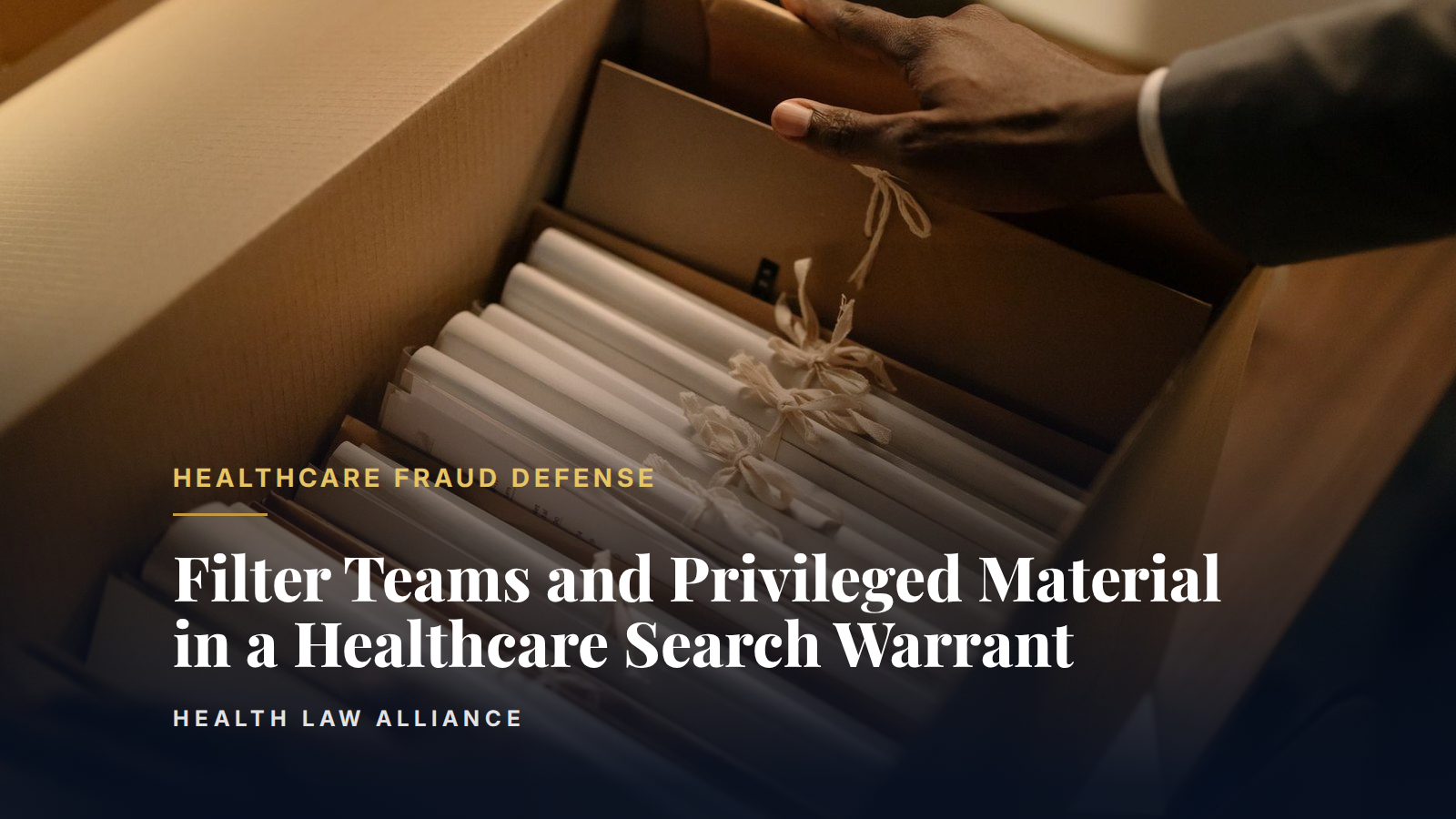
When federal agents execute a search warrant at a medical practice, pharmacy, or healthcare company, the boxes they carry out rarely separate attorney-client privileged material from patient charts and billing records. The government's screening mechanism is a filter team, sometimes called a taint team: agents walled off from the case who review seized material for privilege before investigators see it. Whether that wall holds, and how counsel can test it, decides whether privileged strategy stays protected.
How a Filter Team Is Supposed to Work
The Department of Justice's Justice Manual, at section 9-13.420, directs prosecutors preparing to search the premises of a subject attorney, or a business's in-house legal advisor, to designate a filter team of agents and attorneys with no role in the investigation, briefed in advance on the Department's Guidance on Attorney-Client Privilege and Attorney Work Product Filter Protocols for Search Warrants. The goal is to minimize intrusion into privileged material and keep the filter team from disclosing anything to the case team unless instructed. Prosecutors must also settle, before the search, whether the filter team, a judicial officer, or a special master conducts the privilege review. Healthcare practices face this when outside counsel's file or a compliance attorney's correspondence sits on the same server as everything else being seized.
Where Courts Have Split on the Protocol
Federal appeals courts disagree on who makes that first privilege call. The Fourth Circuit, in In re Search Warrant Issued June 13, 2019, 942 F.3d 159 (4th Cir. 2019), found that an ex parte filter team improperly assigned a judicial function to the executive branch, and required a magistrate judge or special master, not the government's own filter team, to resolve contested calls. The Sixth Circuit flagged the same risk earlier, in In re Grand Jury Subpoenas, 454 F.3d 511 (6th Cir. 2006), later cited by the Fourth Circuit for warning that a government taint team has an inherent conflict deciding a privilege holder's subpoenaed records. The Eleventh Circuit has not gone that far. In United States v. Korf, 11 F.4th 1235 (11th Cir. 2021), it upheld a protocol where the privilege holder's own counsel built the privilege log first, a walled-off filter team could only challenge entries, and unresolved disputes went to the court or a special master.
When a Filter Protocol Breaks Down in Practice
A healthcare case shows how a stated protocol can still fail. In United States v. Esformes, 60 F.4th 621 (11th Cir. 2023), agents searching a Florida medical facility in a healthcare fraud investigation had been warned that an attorney kept an office on site. The government's taint protocol used agents outside the investigation to screen for privileged material, but by its own admission those agents were never given sufficient instructions on identifying privileged material. A substantial portion, at least a hundred, of the privileged documents reached the prosecution team anyway, and no one raised the problem for more than four months, until a prosecutor saw a law firm's letterhead on a scanned memo. A magistrate judge found prosecutorial misconduct and recommended suppressing the tainted material, which the district court adopted. Incomplete instructions to the search team, and a four-month delay before any prosecutor flagged the problem, caused the breakdown.
A filter protocol is only as reliable as the instructions given to the agents who execute it and the restraint of the prosecutors on the other side of the wall.
Challenging the Protocol and Asserting Privilege After Seizure
Counsel does not have to accept the government's filter protocol as given. A motion under Federal Rule of Criminal Procedure 41(g) seeks the return of seized property in the district where it was taken, and a parallel motion can ask the court for a privilege log, a special master, or a Korf-style procedure letting counsel review the material first. Where a circuit already treats a government-run filter team with suspicion, as the Fourth and Sixth Circuits do, that case law is the strongest basis for moving the review out of the prosecution's hands. Where a circuit asks only whether the protocol has enough safeguards, Korf rewards a privilege holder who moves fast: a complete privilege log produced before the filter team finishes its pass carries more weight than an objection raised after the fact. A practice that keeps counsel's files on the same server as patient records should notify the filter team of that fact in writing, promptly after the search.
Why Early Legal Counsel Is Critical
It is critical that healthcare providers promptly retain experienced healthcare defense counsel the moment a search warrant is executed at their practice, particularly where privileged material may be part of what was seized. Early legal intervention can protect the provider's rights, ensure appropriate responses to the filter team and the court, avoid inadvertent admissions, and preserve relevant defenses. Delaying legal representation can significantly affect the outcome of a matter and expose the provider to unnecessary risk.
How Health Law Alliance Can Help
Health Law Alliance's attorneys have overseen 2,000+ audits and handled 5,000+ matters, with 25+ years of experience. If a search warrant at your practice has left privileged material in a filter team's hands, contact Health Law Alliance's criminal healthcare fraud defense attorneys for a free, confidential consultation.