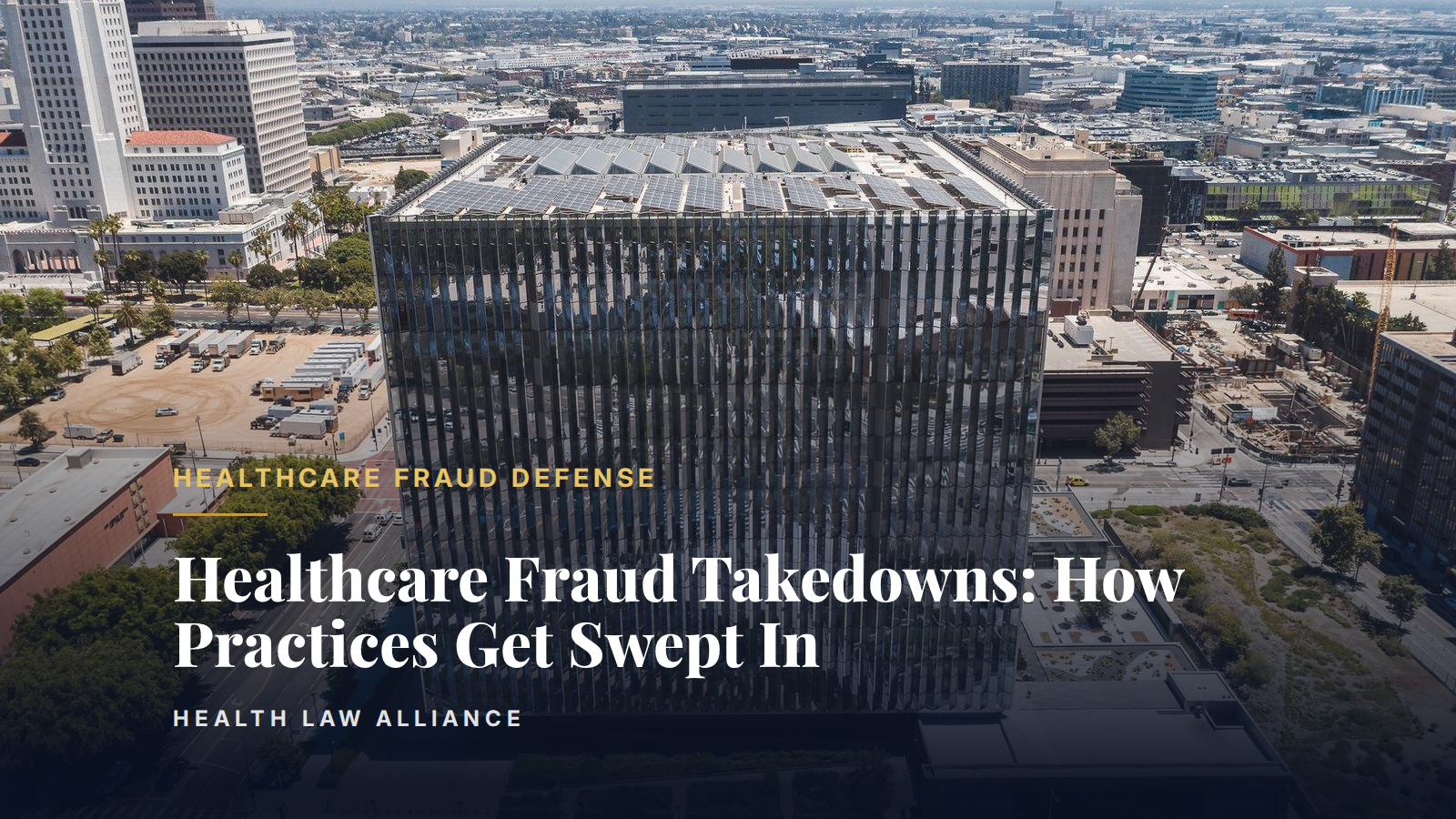
On June 23, 2026, the Department of Justice announced the 2026 National Health Care Fraud Takedown, charging 455 defendants, including 90 doctors and other licensed medical professionals, across 56 federal districts in 45 states and territories in schemes alleged to involve more than $6.5 billion in false claims. The action drew on HHS-OIG, the FBI, the DEA, CMS, and 50 state Medicaid Fraud Control Units, and produced the seizure of more than $182 million in cash and other assets. For most physicians and practice owners named in a takedown, the exposure did not come from organizing a scheme. It came from a marketer, a telehealth vendor, or a billing company that routed orders through the practice, and the same analytics that found the organizers also flagged everyone whose signature sits on the claims.
How the Takedown Is Coordinated
The 2026 takedown was led by the DOJ Health Care Fraud Unit within the Criminal Division's Fraud Section, working with United States Attorneys' Offices, HHS-OIG, the FBI, the DEA, CMS, and dozens of state Medicaid Fraud Control Units and state attorneys general. That coordination is the reason a single announcement can reach across 56 federal districts on one day. It also means a practice's exposure is rarely limited to a single agency or a single count. A referral pattern flagged by CMS claims data can surface in a civil investigative demand from the DOJ Civil Division, a grand jury subpoena from the Criminal Division, and a parallel state Medicaid exclusion proceeding, all drawing on the same underlying billing data.
The Data Fusion Center and Why Practices Get Flagged
The takedown's investigative backbone is the DOJ's Health Care Fraud Data Fusion Center, which combines the Health Care Fraud Unit's data analytics team with HHS-OIG and FBI analysts and a Financial Intelligence Review Team that pairs claims analysis with financial tracing. The center flags statistical outliers: billing that spikes faster than peers, utilization rates that exceed national averages, and referral patterns concentrated among a small group of ordering providers. As one legal analysis of the Fusion Center's methodology put it, the data systems do not distinguish between intentional fraud and legitimate, good-faith variations in care. A physician who orders more of a given service than regional peers, because the patient population warrants it, can be swept into the same analytic flag as a physician who is being paid to sign orders sight unseen.
Why Referring and Ordering Physicians Get Charged
Most peripheral defendants in a coordinated takedown are not accused of designing the scheme. They are accused of taking payment, directly or through a marketing or staffing arrangement, in exchange for referrals or signed orders, which is the conduct the Anti-Kickback Statute and, for physician self-referrals to entities in which the physician has a financial relationship, the Stark Law are built to reach. A physician who signs telehealth orders for durable medical equipment or genetic testing, without personally examining the patient or verifying medical necessity, faces the same statutory exposure as the company that organized the arrangement. The dollar amount attributed to any single physician is often small relative to the headline total; the statutory exposure is not.
A takedown's data analytics identify who to look at. They do not decide who committed a crime, and the record a physician can produce for each flagged claim is what separates a declination from an indictment.
Why Early Legal Counsel Is Critical
It is critical that physicians and practice owners promptly retain experienced healthcare defense counsel upon receiving a grand jury subpoena, a civil investigative demand, an OIG subpoena, or any other government inquiry connected to a coordinated takedown. Early legal intervention can protect the physician's rights, ensure appropriate responses to government requests, avoid inadvertent admissions, preserve every available defense, and allow counsel to communicate with investigators on the physician's behalf. Delaying legal representation can significantly affect the outcome of a matter and expose the physician to unnecessary risk, including administrative payment suspension and licensing consequences that move on a faster timeline than the criminal case itself.
How Health Law Alliance Can Help
Health Law Alliance defends physicians and healthcare practices swept into coordinated healthcare fraud takedowns, including matters arising from Anti-Kickback Statute referrals, Stark Law self-referral exposure, and criminal healthcare fraud charges under the federal healthcare fraud statute. The firm's bench includes a former federal prosecutor who has overseen matters at every stage from subpoena to trial. If your practice has received a subpoena, a civil investigative demand, or any other notice tied to a federal or state healthcare fraud investigation, contact us for a free, confidential consultation.