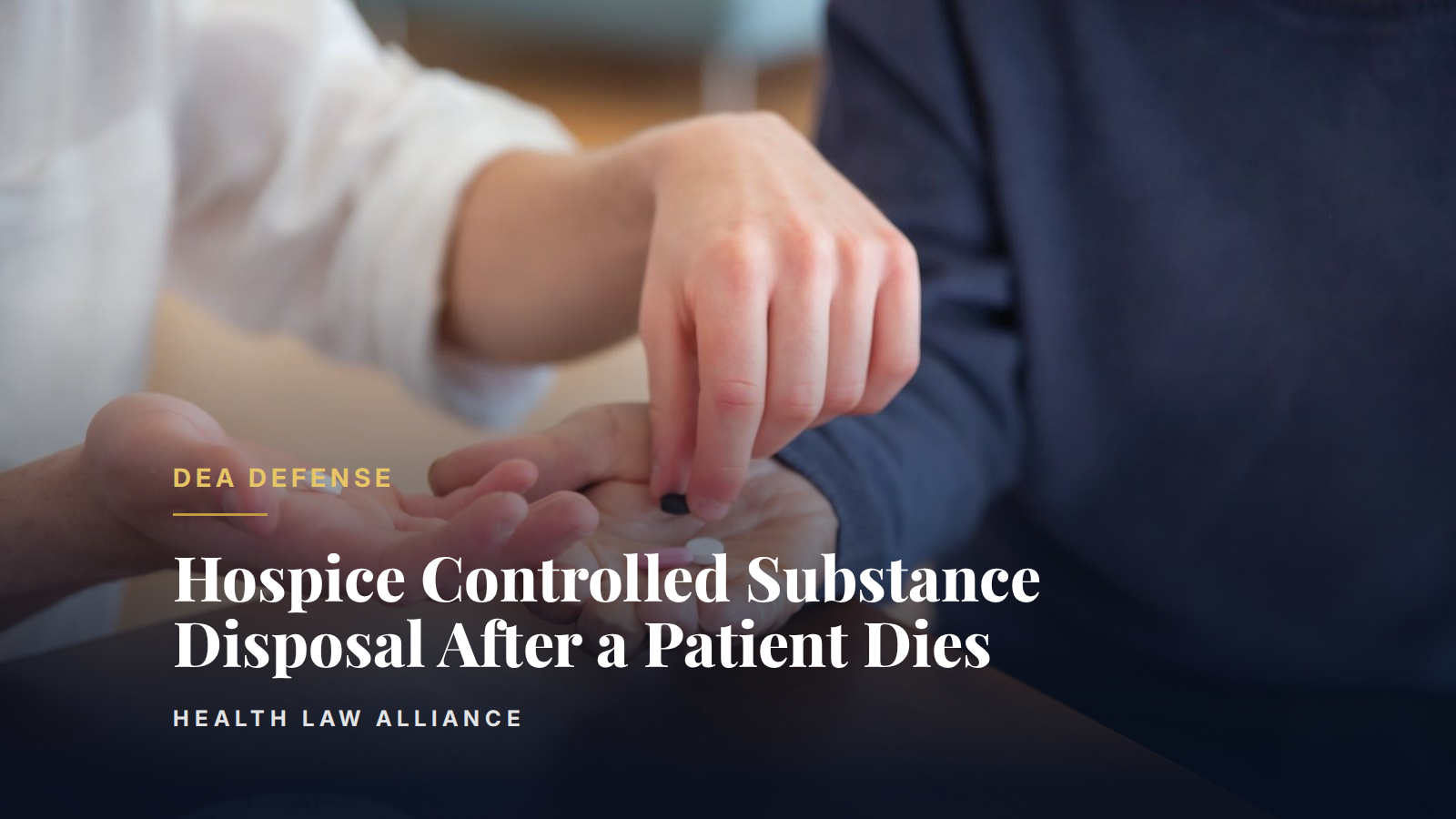
When a hospice patient dies or is discharged, the medications left behind in the home can include Schedule II controlled substances: morphine, oxycodone, fentanyl. Someone has to account for every dose. Who may lawfully handle that medication, how it gets destroyed, and what gets documented along the way determine whether a hospice and its supervising physician have a clean record if DEA opens a diversion inquiry.
Who May Destroy the Medication
Before 2018, federal law let only the patient, or after death a person lawfully entitled to dispose of the patient's property, deliver leftover controlled substances to someone authorized to receive them for disposal; it gave hospice employees no independent authority to handle or destroy those drugs themselves. Congress closed that gap in the SUPPORT Act, Public Law 115-271, enacted in 2018. Section 3222 of that law added a new paragraph, 21 U.S.C. 822(g)(5), letting an employee of a qualified hospice program handle those drugs for disposal without separately registering with DEA. The statute defines that employee narrowly: a physician, physician assistant, nurse, or other person employed by, or working under arrangements made by, the hospice, licensed to perform medical or nursing services, and trained by the hospice on secure, abuse-resistant disposal.
What the SUPPORT Act Changed
The authority Congress created is not open-ended. Section 822(g)(5) permits disposal in three circumstances only: after the patient's death, when the controlled substance has expired, or when the hospice's prescribing physician determines the patient no longer needs it because the plan of care changed. Disposal still must happen onsite, and it still has to comply with every applicable federal, state, tribal, and local law layered on top of the federal permission. A hospice that destroys medication outside those three triggers, or moves it off the premises first, falls outside the statute's protection and is handling a controlled substance without registration.
Documentation and Policy Requirements
The SUPPORT Act also obligates the hospice itself, not only the employee at the bedside. A hospice must maintain written policies and procedures governing disposal, and it must give the patient and family a copy of those policies when the controlled substance is first ordered, not after the fact. After disposal, the hospice must document in the patient's clinical record the type of controlled substance, dosage, route of administration, and quantity disposed, along with the time, date, and manner of disposal. The statute names no witness requirement, which is exactly the gap that turns into a diversion finding when a hospice's inventory reconciliation does not match what the chart says was destroyed.
How Gaps Become DEA Exposure
DEA's own public disposal guidance walks through long-term care facilities and authorized collectors in detail; it says far less about hospice-specific procedure. That silence raises a hospice's exposure rather than lowering it: because the SUPPORT Act lets a hospice employee handle disposal without registering, it is the supervising physician's own registration, not the hospice, that is on the line. An unexplained count discrepancy or an undocumented destruction becomes a predicate fact in a DEA order to show cause, and in the more urgent matters, in an immediate suspension order that halts the physician's authority to handle controlled substances before any hearing occurs. The same public interest factors that govern a new registration application govern a revocation proceeding built on a disposal record that will not reconcile, the kind of recordkeeping gap that is the most common cited basis for a DEA order to show cause. It is the posture Health Law Alliance's DEA defense team defends.
The SUPPORT Act requires a hospice to document the controlled substance's type, dosage, route, and quantity, along with the time, date, and manner of its disposal, and the statute names no witness requirement.
Health Law Alliance's attorneys have overseen 2,000+ audits and handled 5,000+ matters, with 25+ years of experience.
Why Early Legal Counsel Is Critical
It is critical that hospice programs and their supervising physicians promptly retain experienced healthcare defense counsel upon receiving a DEA inquiry, a disposal-related records request, or any other government inquiry touching controlled substance handling. Early legal intervention can protect the provider's rights, can help ensure appropriate responses to government requests, can help avoid inadvertent admissions, can help preserve relevant defenses, and can allow counsel to communicate with investigators on the provider's behalf. Delaying legal representation can significantly affect the outcome of a matter and can expose the provider to unnecessary risk.
How Health Law Alliance Can Help
Health Law Alliance defends hospice and home health agencies, and the physicians whose registrations stand behind them, in DEA and Medicare matters tied to controlled substance handling. If your hospice is facing a disposal-record discrepancy, a DEA inquiry, or an audit of its hospice and home health program, contact us today for a free, confidential consultation.