
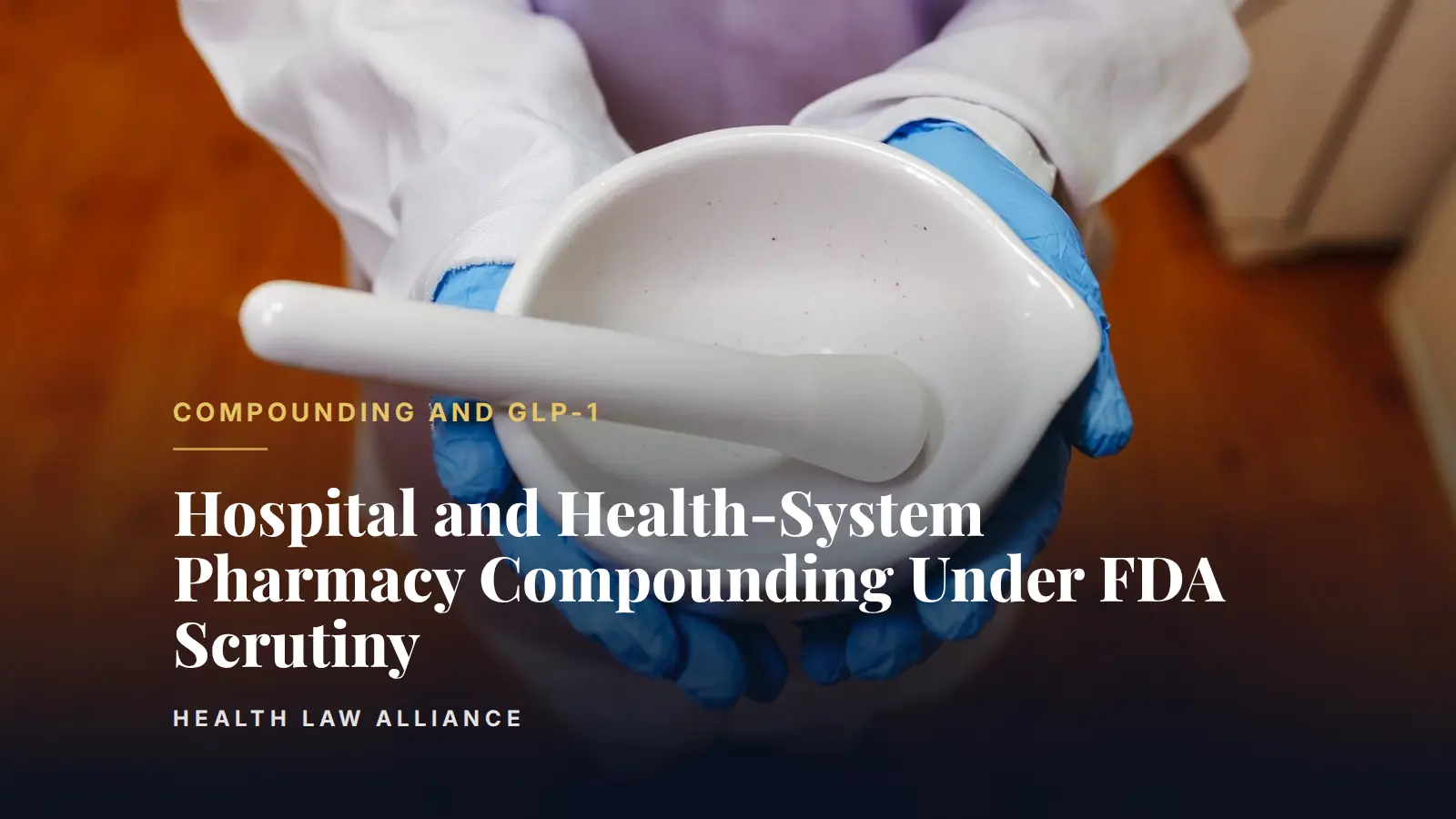
A hospital pharmacy that compounds for its own patients answers to a different test than one filling for satellite clinics, infusion suites, and sister hospitals across a health system. FDA's draft guidance says it generally will not take enforcement action over that distribution under Section 503A, not 503B, if the compounded drug stays inside the hospital or health system and it is used or discarded within 24 hours of leaving the pharmacy, among the guidance's other stated conditions. A health system that compounds ahead of a prescription and distributes the product across multiple facilities, particularly across state lines, moves into the risk-based factors FDA says it will weigh before deciding whether to act.
The 503A Framework for Hospital Pharmacies
Section 503A exempts a licensed pharmacist's compounded drug from federal drug-approval review, labeling rules for adequate directions, and current good manufacturing practice (cGMP) requirements, so long as the pharmacy compounds against a valid prescription for an identified patient. FDA's draft guidance on hospital and health-system compounding applies that framework to a pharmacy connected to a hospital, or to a health system, through common ownership or joint management, regardless of whether the pharmacy physically sits inside the hospital building. The line between a 503A hospital pharmacy and a 503B outsourcing facility, covered in HLA's 503A vs. 503B compounding explainer, runs through that same prescription requirement: an outsourcing facility can compound and ship a drug before a patient is identified because it operates under cGMP, while a hospital pharmacy outside that registration needs the prescription first.
Central-Fill and Satellite Distribution Across a Health System
FDA's draft guidance would tie its enforcement approach to the hospital or health system itself, not to a fixed radius. The 2016 version of that draft had limited distribution to facilities within one mile of the compounding pharmacy; FDA's 2021 revision dropped that limit, citing stakeholder feedback, and did not replace it with another fixed radius. The 2021 draft's test asks whether the drug stays inside the hospital or health system and whether it is used or discarded within 24 hours of leaving the pharmacy. A central pharmacy filling for satellite clinics, infusion centers, or affiliated hospitals fits inside that description. The same pharmacy moves into the risk-based factors FDA says it will weigh once it compounds large, non-patient-specific batches on a routine basis, or distributes across state lines in volume.
When FDA's Guidance Points Toward 503B
FDA's draft guidance names the point where a 503A hospital pharmacy starts to look like something else. The agency says a health-system pharmacy that compounds without patient-specific prescriptions for facilities across its system could function as a manufacturing operation without the cGMP controls that apply to conventional manufacturers. The draft guidance lists risk-based factors it says it will weigh: poor compounding practices or insanitary conditions, non-patient-specific drugs beyond what emergency uses require, large amounts compounded routinely, and routine interstate distribution of large amounts, particularly away from a state border or across several states. A health system that fits several of these patterns is the one FDA is describing when it encourages hospitals to obtain non-patient-specific product from an outsourcing facility, or to register their own pharmacy as one. HLA's pharmacy-or-outsourcing-facility structure explainer walks through that registration decision.
A health system pharmacy that compounds drug products without patient-specific prescriptions for facilities within its health system could function as a large manufacturing operation without the standards that normally apply to conventional manufacturers.
Joint Commission Cross-Pressure on Compounding Operations
FDA's enforcement posture is not the only standard a hospital pharmacy answers to. The Joint Commission's hospital accreditation standards include a dedicated requirement on supervision of sterile medication compounding, and the Joint Commission has told hospitals its compounding reviews are based on the USP 797/800 sterile and hazardous compounding chapters, the same chapter 797 that underlies FDA's own insanitary-conditions guidance. A hospital that structures its central-fill and satellite distribution to fit the circumstances described in FDA's draft 503A guidance can still carry an open survey finding on compounding competency, environmental monitoring, or beyond-use date assignment, because the surveyor checks documented practice against USP, not FDA's prescription-requirement analysis. The two reviews ask related but separate questions.
Why Early Legal Counsel Is Critical
It is critical that hospital and health-system pharmacies promptly retain experienced healthcare defense counsel when an FDA inspection, a Joint Commission survey finding, or a state board inquiry questions how the pharmacy compounds and distributes drugs across its facilities. Early legal intervention can confirm which risk-based factors the pharmacy's practice touches, document the records FDA's draft guidance describes, and address a survey citation before it hardens into a larger finding. Delaying legal review until a warning letter arrives narrows the options to correct course.
How Health Law Alliance Can Help
Health Law Alliance's attorneys have overseen 2,000+ audits and handled 5,000+ matters, with 25+ years of experience.
Health Law Alliance's USP 797/800 compounding defense attorneys review a hospital or health system's prescription records, distribution logs, and compounding documentation before an inspection finding becomes a warning letter. If your pharmacy is facing an FDA inspection or a Joint Commission compounding citation, contact HLA's compounding defense team for a free, confidential consultation.