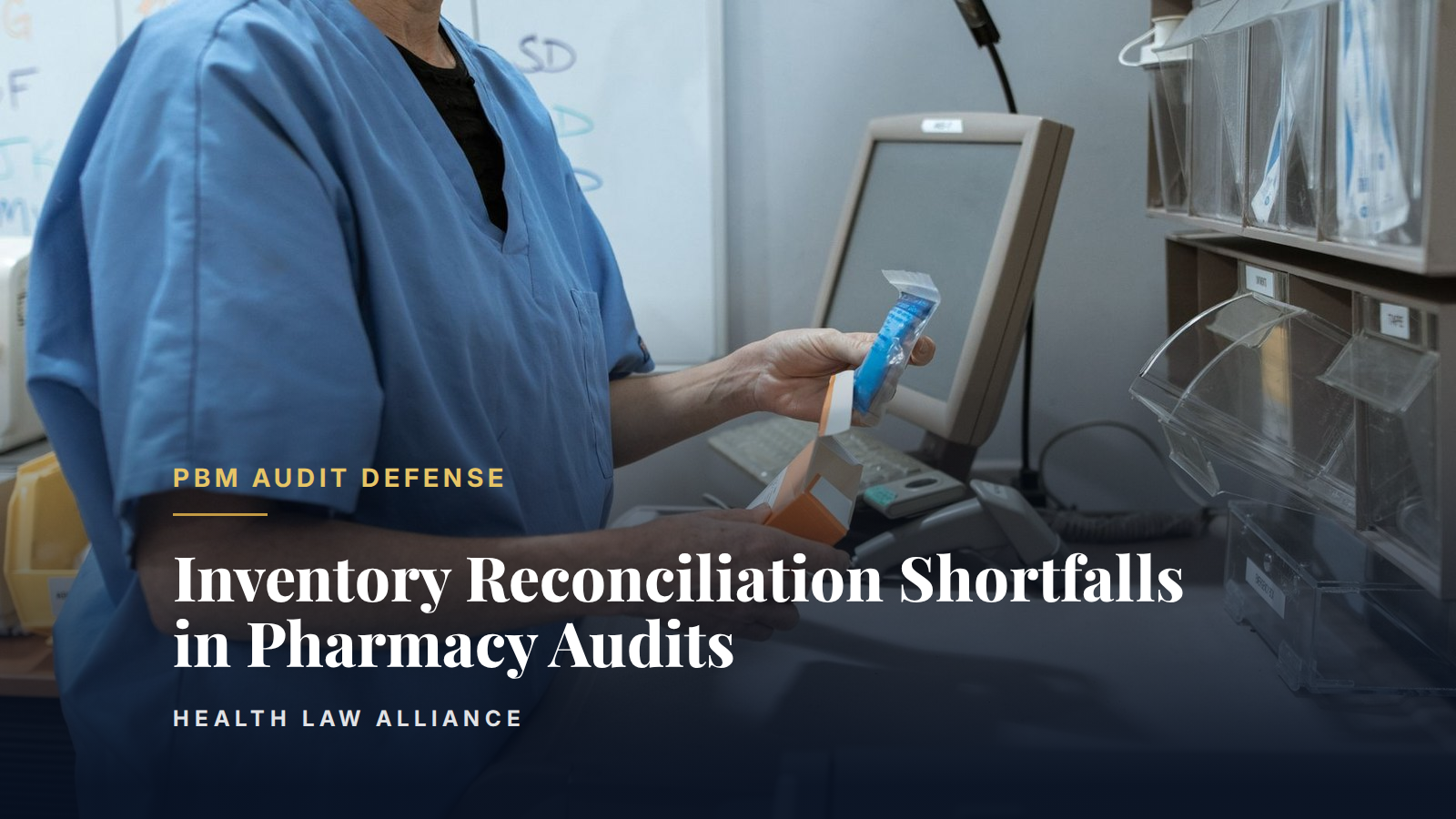
A PBM audit letter alleging an inventory shortfall rarely explains its math. It states a dollar figure, a lookback period, and a thirty-day deadline to produce purchase records the pharmacy has usually already discarded. OptumRx, CVS Caremark, and Express Scripts each run invoice reconciliation audits that compare the units a pharmacy purchased against the units it billed, and treat any gap in the pharmacy's favor as evidence the drug was dispensed without being bought. A pharmacy that filled every claim correctly can still face a six-figure recoupment demand because its purchase records do not line up with the PBM's audit window.
How PBMs Calculate an Inventory Shortfall
An inventory reconciliation audit runs on the same mechanics as any PBM audit: pull the dispensing history for the lookback period, typically twelve to twenty-four months, and request wholesaler purchase invoices covering the same window. Legal analysis from Frier Levitt describes PBM invoice reconciliation as comparing a pharmacy's purchasing records against the claims billed during the same period. Any NDC where billed units exceed purchased units becomes a flagged shortfall, and the burden shifts to the pharmacy to prove sufficient inventory existed rather than to the PBM to prove it did not. Health Law Alliance's PBM audit defense practice handles these findings from the first document request through appeal.
Legitimate Reasons the Numbers Do Not Match
Several ordinary pharmacy operations create an apparent gap without any dispensing the pharmacy did not actually make. Purchases made before the audit's lookback window still supply drugs dispensed inside it. Wholesalers substitute equivalent package sizes under a different NDC than the one billed on the claim. Pharmacy-to-pharmacy transfers and central-fill routing move inventory between locations without generating a matching purchase invoice at the dispensing location. Return credits, breakage, and waste reduce available inventory without a corresponding sale. 340B split-billing arrangements track covered-entity and non-covered-entity inventory separately, and can look commingled to an auditor working from claims data alone. Frier Levitt catalogs several of these patterns as common drivers of shortfall findings that do not involve fraud, and recommends pharmacies keep independent wholesaler documentation rather than relying on the records a PBM's audit portal happens to recognize.
Drug Shortages and the False-Positive Shortfall
Drug shortages compound the problem. When a manufacturer's product is unavailable, a pharmacy fills the prescription with an alternate manufacturer's NDC or a different package size, purchased through a different wholesaler channel than usual. The FDA's drug shortage list changes continuously, and a pharmacy that substitutes NDCs to keep a shortage drug in stock is dispensing correctly even when its purchase and billing records no longer map to the same product code. The GLP-1 audit wave illustrates the pattern directly. The FDA resolved semaglutide's shortage listing in October 2024, but claims dispensed during the shortage period can still surface in inventory reconciliation audits today when the pharmacy purchased and billed under different NDCs while supply was constrained. Our companion piece, GLP-1 PBM Audits in 2026: The Enforcement Playbook, works through how PBMs are treating that claim population now.
Building the Documentation Response
An inventory shortfall finding is a preliminary calculation, and it can be rebutted with records the PBM's audit team did not request or credit: wholesaler purchase histories, proof-of-payment records, inter-pharmacy transfer logs, and manufacturer return or credit documentation. The response also has to reach the PBM's extrapolation methodology, since an unresolved shortfall on a sample of claims gets projected across the full lookback period. Our analysis of What a PBM Audit Really Costs: Extrapolation and Recoupment Explained works through that projection, and CVS Caremark Audit Appeals: Deadlines and Procedural Defenses covers the deadlines that apply once a shortfall finding becomes part of a formal audit appeal.
A pharmacy that dispensed every unit correctly can still owe a six-figure recoupment if its purchase records do not match the PBM's audit window.
Why Early Legal Counsel Is Critical
It is critical that pharmacy owners promptly retain experienced healthcare defense counsel upon receiving a PBM audit notice citing an inventory shortfall, particularly before responding to the PBM's initial document request. Early legal intervention can identify which records actually resolve the discrepancy, prevent the pharmacy from producing incomplete records that appear to confirm the shortfall, and preserve the pharmacy's position on appeal if the recoupment demand is not withdrawn. Delaying representation until after the findings letter arrives can foreclose defenses available at the document-production stage, including exposure to network termination once an unresolved shortfall becomes part of the PBM's broader compliance file.
How Health Law Alliance Can Help
Health Law Alliance defends pharmacies against PBM audit findings built on alleged inventory shortfalls, from the initial document request through recoupment appeal and network termination defense. Our bench includes attorneys with direct experience inside PBM audit and compliance operations, background that shapes which purchase records we prioritize when a shortfall finding does not match how the pharmacy actually operates. If your pharmacy has received an audit notice citing an inventory discrepancy, contact us for a free, confidential consultation.