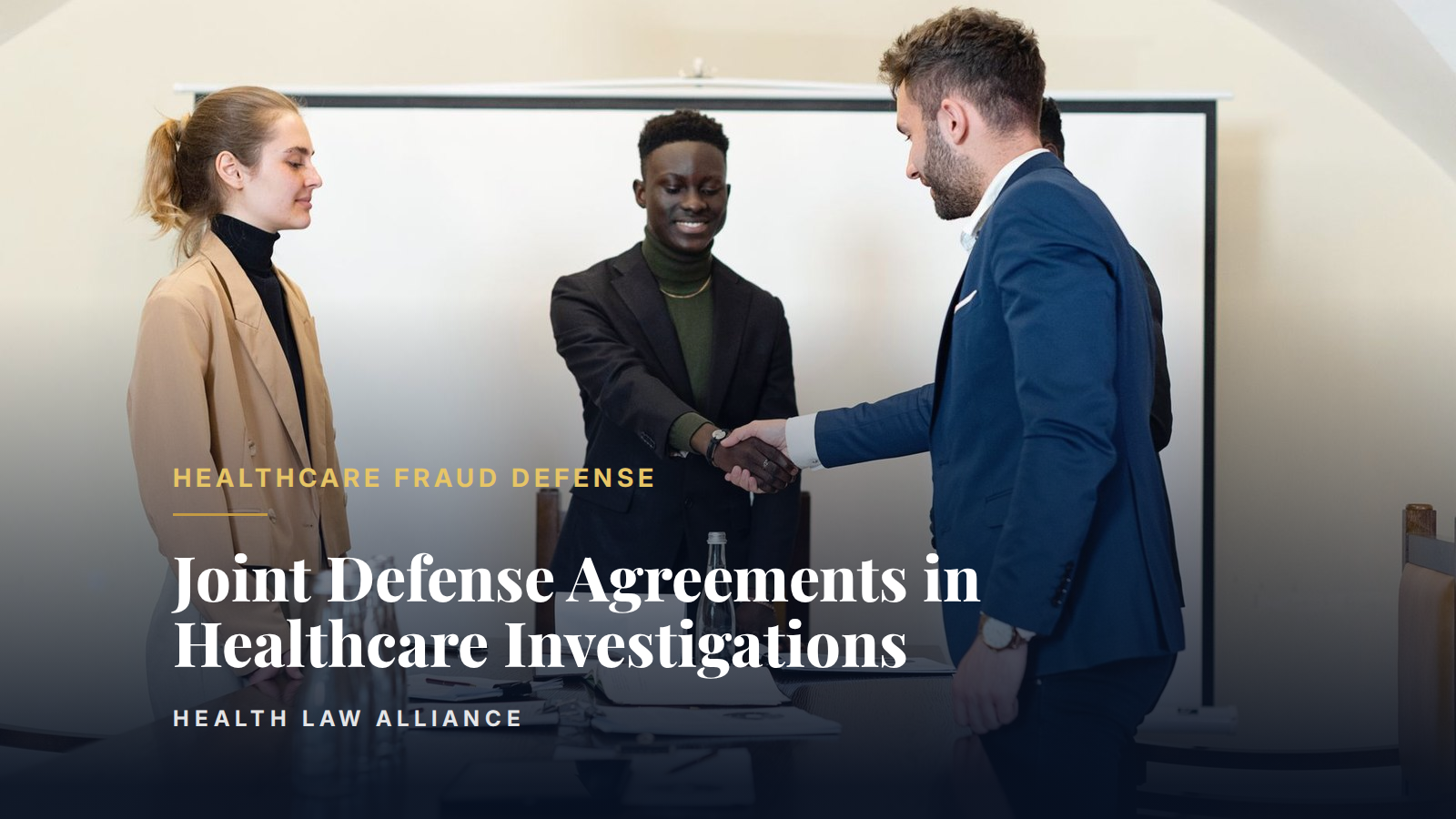
When a federal or state investigation reaches a practice, its employees, and its billing vendor at once, each typically retains separate counsel, and each faces exposure under the Anti-Kickback Statute, the Stark Law, or the False Claims Act. A joint defense agreement lets those separately represented parties share information and strategy through their attorneys without waiving the attorney-client privilege that would otherwise be lost the moment privileged material leaves one lawyer's file. The protection is real, but narrower than most clients assume, and it depends on a common legal interest that is not guaranteed to last the length of the investigation.
What a Joint Defense Agreement Actually Protects
A joint defense agreement, also called a common interest agreement, rests on the common interest doctrine, which extends privilege to communications among separately represented parties sharing a common legal interest in the same investigation. Courts require that the interest be legal, not merely commercial or business, and that a communication be made to obtain or coordinate legal advice, not just exchanged between co-defendants who signed an agreement. In United States v. Krug, 868 F.3d 82 (2d Cir. 2017), the Second Circuit held a hallway exchange between two joint-defense members was not privileged because it conveyed independent research rather than legal advice; membership in the agreement, without more, does not bring a communication within the privilege.
A Genuine Common Legal Interest, Not a Shared Business Relationship
A practice, its billing vendor, and an individual physician can all receive the same civil investigative demand or grand jury subpoena and still have diverging interests. An agreement works when the parties defend the same legal theory, that the billing pattern reflected an error rather than fraud, or that the referral fit within an Anti-Kickback Statute safe harbor. It works poorly when one party's best defense is that another acted without its knowledge, since that defense cannot be built inside a room the other party's lawyer is also sitting in.
Paying for an Employee's Lawyer Does Not Make That Lawyer the Practice's
It is common, and permitted, for a practice under investigation to pay a separately represented employee's legal fees. American Bar Association Model Rule of Professional Conduct 1.8(f) allows a lawyer to accept payment from someone other than the client only with the client's informed consent, no interference with the lawyer's independent judgment, and preserved confidentiality. Paying the bill does not give the practice a say in the employee's strategy, access to privileged communications, or the ability to direct what the employee tells investigators.
A joint defense agreement can fall apart the moment one member decides cooperating with the government serves that member better than defending alongside the group, and the agreement's own terms determine what happens to the information already shared when that happens.
When One Member Decides to Cooperate
A well-drafted agreement anticipates that a member may later withdraw to cooperate, and typically provides that shared information remains subject to the agreement even after withdrawal. A cooperating former member's attorney must take care not to disclose to prosecutors what was learned only through the joint defense, as distinct from what that member independently knew beforehand. The agreement cannot stop a former member from testifying, and most are written so shared material can still be used to cross-examine a member who later testifies against the others.
When an Employee Needs Separate Counsel
A practice's lawyer represents the practice, not any individual employee, a distinction that traces to Upjohn Co. v. United States, 449 U.S. 383 (1981), which confirmed the corporation's privilege belongs to the entity; an employee interviewed in an internal investigation is typically given an Upjohn warning making that explicit. Separate counsel becomes necessary once the employee's exposure is no longer identical to the practice's: when the employee's own conduct is a specific focus, when the practice's defense could implicate the employee, or when the government names the employee individually. Waiting until the government calls the employee a target, rather than a witness, is waiting too long.
Why Early Legal Counsel Is Critical
It is critical that healthcare providers, practices, and their employees promptly retain experienced healthcare defense counsel upon receiving a subpoena, before agreeing to share information with any co-defendant. Early counsel can confirm whether a genuine common legal interest exists, structure a written agreement addressing withdrawal and cooperation before either becomes an issue, and protect each party's individual rights while the parties cooperate with one another.
How Health Law Alliance Can Help
Health Law Alliance represents practices, physicians, and individual employees named alongside each other in the same healthcare fraud investigation, including matters where a joint defense agreement belongs and matters where it is the wrong tool for a client whose interests do not align with a co-defendant's. If your practice or employees have received a subpoena involving multiple targets, contact Health Law Alliance's healthcare fraud defense attorneys for a free, confidential consultation.