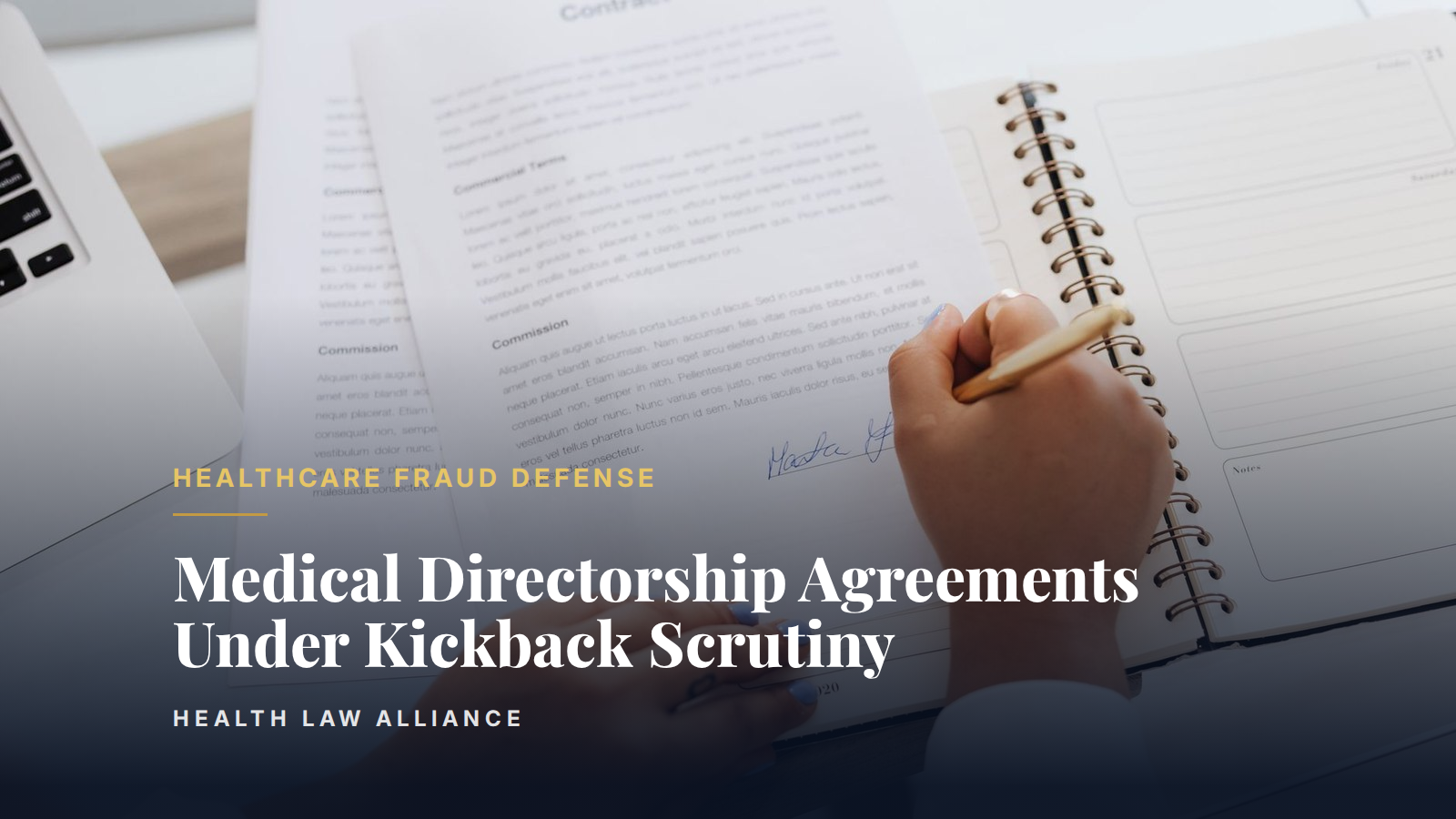
OIG's clearest warning on medical directorship agreements is still its June 9, 2015 Fraud Alert, which announced settlements with 12 individual physicians over medical directorship and office staff arrangements OIG said disguised inducement for referrals. The compensation on those directorships failed the Anti-Kickback Statute for three reasons: it tracked the physicians' referral volume, it exceeded fair market value for the work described, and the physicians never performed the duties called for. A directorship stipend that reads well on paper but does not match work actually performed is liability waiting for an audit to find it.
The Anti-Kickback Statute Test
The Anti-Kickback Statute, codified at 42 U.S.C. 1320a-7b(b), makes it a felony to knowingly and willfully offer, pay, solicit, or receive remuneration to induce referrals of business payable by a Federal health care program, punishable by a fine of up to $100,000 and 10 years of imprisonment per violation. OIG and the courts apply a one-purpose test: an arrangement violates the statute if even one purpose of the compensation is to reward or induce referrals, regardless of any legitimate business reason it also serves. For a directorship, the stipend has to track real duties at a rate a hospital would pay any physician for that work, not the physician's referral volume.
The Personal Services Safe Harbor
A medical directorship that fits the personal services and management contracts safe harbor at 42 CFR 1001.952(d) is protected even though the physician is a referral source. The safe harbor requires a written agreement, signed by both parties, covering all services the physician provides, for a term of at least one year. Compensation must be set in advance under a methodology consistent with fair market value in an arm's length transaction, and the methodology cannot account for the volume or value of referrals. The services contracted for cannot exceed what is reasonably necessary for a commercially reasonable business purpose. Stark Law's parallel personal service arrangements exception imposes the same conditions, but Stark is a strict liability statute that applies without regard to intent.
What OIG's 2015 Settlements Found
The 2015 fraud alert described the pattern that still recurs in medical directorship reviews: stipends that moved with referral volume, rates above fair market value for the described duties, and physicians who never performed the listed duties. In several of the 12 settled matters, OIG alleged that an affiliated health care entity also paid the physicians' front office staff salaries, treating that as improper remuneration because it relieved the physicians of a cost they would otherwise have carried. A directorship invites scrutiny not because the position exists, but because the paper trail behind it, time logs, meeting minutes, board attendance, does not match what the agreement describes.
A medical directorship survives Anti-Kickback Statute scrutiny only when the compensation reflects fair market value for services the physician actually performs, documented as they are performed, not as the agreement describes them.
Documenting Actual Services Rendered
Fair market value and commercial reasonableness are only half the safe harbor. OIG's settlements turned on the other half: whether the physician actually did the work. A directorship agreement should be supported by contemporaneous time logs tied to specific duties, minutes from any committee or quality meetings attended, and a periodic reassessment of whether the stipend still reflects the actual time commitment. An independent fair market value opinion helps on the compensation question, but it does not substitute for records showing the hours were worked. A directorship treated as a fixed monthly payment, rather than compensation for specific, tracked duties, is the file OIG used against the 12 physicians in 2015.
Why Early Legal Counsel Is Critical
It is critical that physicians and practice owners have medical directorship and other compensation agreements reviewed by experienced healthcare defense counsel before signing, and promptly upon receiving a subpoena, a civil investigative demand, or other government inquiry into an existing arrangement. Early legal review can confirm the compensation and documentation actually satisfy the personal services safe harbor, correct gaps before they become a referral-volume allegation, and preserve defenses if OIG or DOJ later examines the arrangement. Waiting until an inquiry begins to assemble the paper trail can significantly affect the outcome and expose the physician to civil monetary penalties, program exclusion, or a felony referral under the Anti-Kickback Statute.
How Health Law Alliance Can Help
Health Law Alliance reviews and defends medical directorship agreements, management contracts, and other physician compensation arrangements under the Anti-Kickback Statute and the Stark Law, from the initial fair market value and commercial reasonableness review through any subsequent OIG or DOJ inquiry. Our bench includes a former federal prosecutor who has overseen 2,000+ audits across the health care fraud landscape. If your practice or hospital has a medical directorship agreement in place or under negotiation, contact us today for a free consultation.