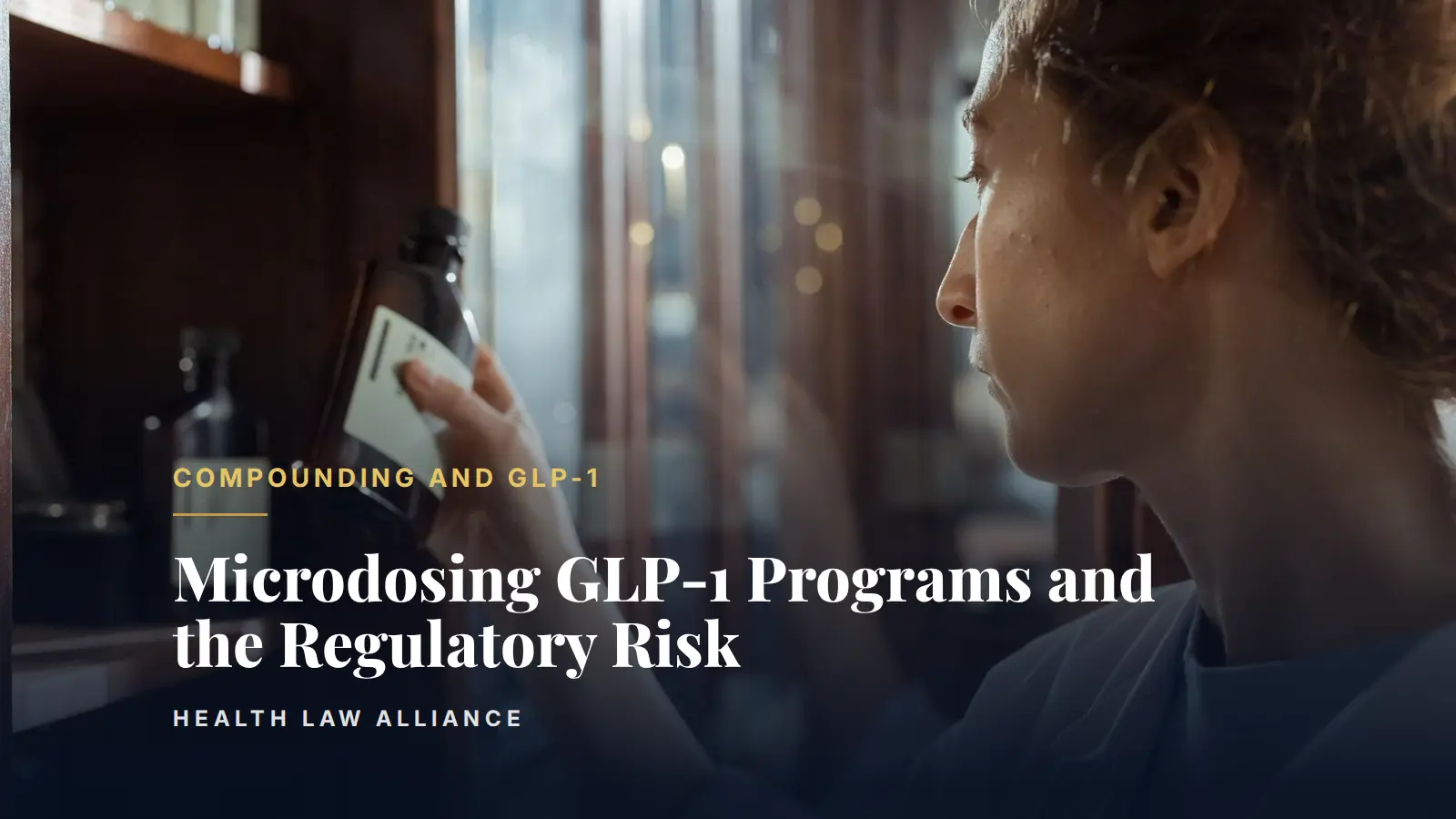
Clinics and telehealth platforms are now advertising microdosing programs that prescribe semaglutide or tirzepatide below the lowest FDA-approved starting strength, pitched as a gentler path to the same result. A lower dose does not move a compounded GLP-1 preparation outside the rules that already govern every other compounded version of these drugs. Compounded semaglutide and tirzepatide still have to clear the same essentially-a-copy test the FDA applies under 503A/503B of the Federal Food, Drug, and Cosmetic Act, and the FDA's most recent warning letter against a major GLP-1 compounder shows how closely regulators now read the paperwork behind a clinical-difference claim.
The Essentially-a-Copy Test Does Not Bend for a Lower Dose
FDA's April 1, 2026 statement on GLP-1 compounding sets out the same three-part test for every compounded version of these drugs, regardless of dose: a compounded product is essentially a copy of an approved drug when it has the same active ingredient, is in the same, similar, or an easily substitutable strength, and can be administered by the same route. Approved tirzepatide runs from a 2.5 mg starting dose to a 15 mg maximum. Semaglutide injection's approved range starts lower, at 0.25 mg, and tops out at 2.4 mg. A microdose below those strengths is not sold as a labeled product, but the strength factor asks whether the dose is easily substitutable, not whether a commercial package matches it exactly.
What Counts as a Documented Clinical Difference
The strength factor is not the only route out of an essentially-a-copy finding. FDA's April 2026 statement repeats the exception the agency has applied for years: a compounded product is not essentially a copy where a prescriber determines and documents a change that produces a significant difference from the approved drug for an identified individual patient. A microdosing claim has to satisfy that same exception, one patient and one prescription at a time, not as a clinic-wide protocol that routes every new patient into a standard microdose tier with identical justification language on every chart.
How Regulators Test the Difference Claim
The FDA's September 18, 2026 warning letter to a large compounding pharmacy shows what that test looks like applied. Following a November 2025 inspection, FDA found that the pharmacy's tirzepatide-niacinamide and semaglutide-cyanocobalamin products appeared to be essentially copies of the approved drugs, writing that "the volume of products you are producing suggests that differences between products you are compounding and the FDA-approved products are pretextual." The letter also found that prescriber statements of a significant difference were repeated verbatim across many records, suggesting they may have been pre-generated for selection rather than written for an identified patient. The same letter cited insanitary conditions and cGMP failures in the pharmacy's sterile operations under Section 501 of the Act.
Microdosing compounds are typically dispensed from a multi-dose vial under USP 797/800 sterile-compounding rules, and that vial carries its own beyond-use date once it is first punctured for a partial draw. Marketing a microdose as equivalent to, or better tolerated than, the approved drug invites a separate kind of scrutiny: brand manufacturers have pursued compounders and telehealth sellers directly over equivalence claims, a track covered in Brand Manufacturer Lawsuits Over Compounded GLP-1 Drugs.
A lower dose is tested against the same three-factor copy analysis as any other compounded GLP-1 product, and the strength factor asks whether the dose is easily substitutable, not whether it is sold in that exact amount.
Health Law Alliance's attorneys have overseen 2,000+ audits and handled 5,000+ matters, with 25+ years of experience.
Why Early Legal Counsel Is Critical
It is critical that compounding pharmacies, clinics, and prescribers promptly retain experienced healthcare defense counsel upon receiving an FDA warning letter, an inspection finding, or a state board inquiry tied to a microdosing or clinical-difference claim. Early legal intervention can document the individualized determination behind each prescription before a regulator reviews the chart, and correct a standing protocol that reads as pretextual before it reaches a warning letter. Delaying representation can be decisive once a regulator has already concluded the paperwork was written for marketing rather than for the patient.
How Health Law Alliance Can Help
Health Law Alliance represents compounding pharmacies, clinics, and prescribers through FDA warning letters, state board inquiries, and manufacturer disputes tied to semaglutide and tirzepatide microdosing programs. Compounders and prescribers facing a clinical-difference question on a microdosing protocol can contact Health Law Alliance through its GLP-1 compounding defense practice for a free, confidential consultation to review the documentation behind their program before a regulator does.