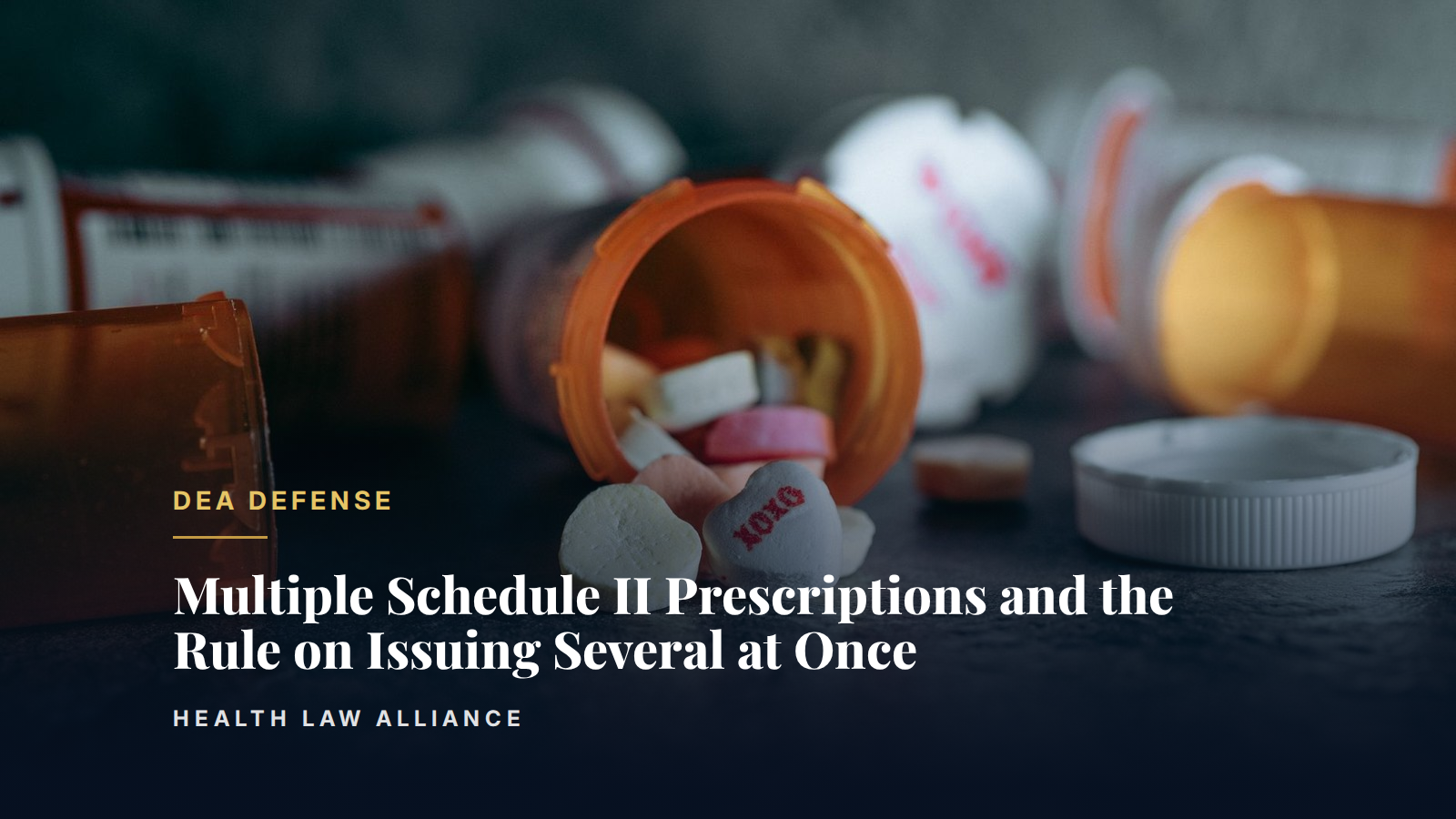
A prescriber issuing Schedule II medication can write multiple prescriptions at a single office visit so a pharmacy fills them in sequence over several months, rather than requiring a new visit before every fill. The Drug Enforcement Administration (DEA) built a narrow exception for this into 21 CFR 1306.12(b), sitting on top of a flat federal rule that Schedule II prescriptions can never be refilled. Get any element of that exception wrong, on the prescribing side or at the pharmacy counter, and the result is not a billing correction. It is a DEA registration inquiry, and for the pharmacist who filled it, a question about corresponding responsibility.
The Baseline Rule Against Refilling
21 CFR 1306.12(a) states plainly that refilling a Schedule II prescription is prohibited. Every fill requires its own original prescription. The multiple-prescriptions exception in subsection (b) sits on top of that refill prohibition rather than replacing it: it lets an individual practitioner write several original prescriptions for the same drug at one visit, each dated and signed that day, so the patient and pharmacy are not forced into a monthly office visit just to get the next fill. Under 21 CFR 1306.12(b)(1), a practitioner may issue multiple prescriptions authorizing up to a 90-day total supply of a Schedule II controlled substance, provided five conditions are met.
The Five Conditions on the Prescriber
Each of the five conditions in 21 CFR 1306.12(b)(1) has to hold for the sequential prescriptions to be lawful. The practitioner must issue each separate prescription for a legitimate medical purpose while acting in the usual course of professional practice. Each prescription must carry written instructions stating the earliest date a pharmacy may fill it, except the first prescription if the practitioner intends it to be filled immediately, and DEA's final rule on the regulation confirms that language can take any clear form rather than a fixed script. The practitioner must conclude that issuing multiple prescriptions this way does not create an undue risk of diversion or abuse. State law must permit the practice, since a DEA registration sits on top of, not instead of, state prescribing authority. And the practitioner must otherwise comply fully with the Controlled Substances Act and every other applicable federal and state requirement.
No pharmacist may fill any prescription before the date specified by the practitioner. The rule contains no exceptions to this requirement.
What the Pharmacist Must Verify
A pharmacist is never a passive party to a sequential Schedule II prescription. Federal law gives every pharmacist a corresponding responsibility, codified at 21 CFR 1306.04(a), to confirm that a prescription was issued for a legitimate medical purpose by a practitioner acting in the usual course of practice, and DEA has called this one of the primary legal bases on which pharmacists are held accountable. Before filling any prescription in a sequential set, the pharmacist should confirm the earliest-fill date written on the prescription, confirm that date has actually arrived, and decline any verbal instruction to move that date earlier. DEA's rulemaking record states the prohibition on early filling has no exception. A pattern of early fills, unexplained quantity changes, or inconsistent dates across the set is also the kind of variance an inventory reconciliation can surface during a later DEA inspection, long after the individual fills are forgotten.
Health Law Alliance has represented 2,500+ clients nationwide.
Why Early Legal Counsel Is Critical
Pharmacies and prescribers should retain healthcare defense counsel as soon as a DEA subpoena, inspection notice, or any inquiry touching sequential Schedule II prescriptions arrives. Counsel can shape the response to DEA's requests, keep an inadvertent admission out of the file, and intervene before that file becomes the basis for a DEA order to show cause proceeding.
How Health Law Alliance Can Help
Health Law Alliance defends pharmacies, prescribers, and pharmacists-in-charge through DEA inspections, registration actions, and the audits that follow a flagged sequential prescription. If your pharmacy or practice is facing a DEA inquiry tied to Schedule II prescribing, contact our DEA defense attorneys for a free, confidential consultation.