Every DEA registrant that handles controlled substances, from a retail pharmacy to a distributor, operates under a fixed set of physical security obligations found at 21 CFR Part 1301, Subpart D. The regulations require effective controls and procedures against theft and diversion, and they set different expectations by registrant type: a pharmacy's storage cabinet is not judged by the same standard as a distributor's vault. A security gap found during a routine inspection rarely stays a paperwork note. It becomes the first line of an inspection report, and in serious cases the opening finding in a DEA order to show cause.
The General Security Standard
Under 21 CFR 1301.71, every applicant and registrant must provide effective controls and procedures to guard against theft and diversion of controlled substances. DEA does not apply a single checklist to every location. It weighs the type and quantity of substances handled, the construction and location of the facility, the storage system in place (vault, safe, or secure enclosure), key and combination control, alarm and detection systems, employee access and supervision, and the procedures covering visitors and delivery personnel. Substantial compliance with these factors, assessed as a whole, is the standard DEA applies when it evaluates whether a registrant's overall system adequately guards against diversion.
Storage Requirements by Registrant Type
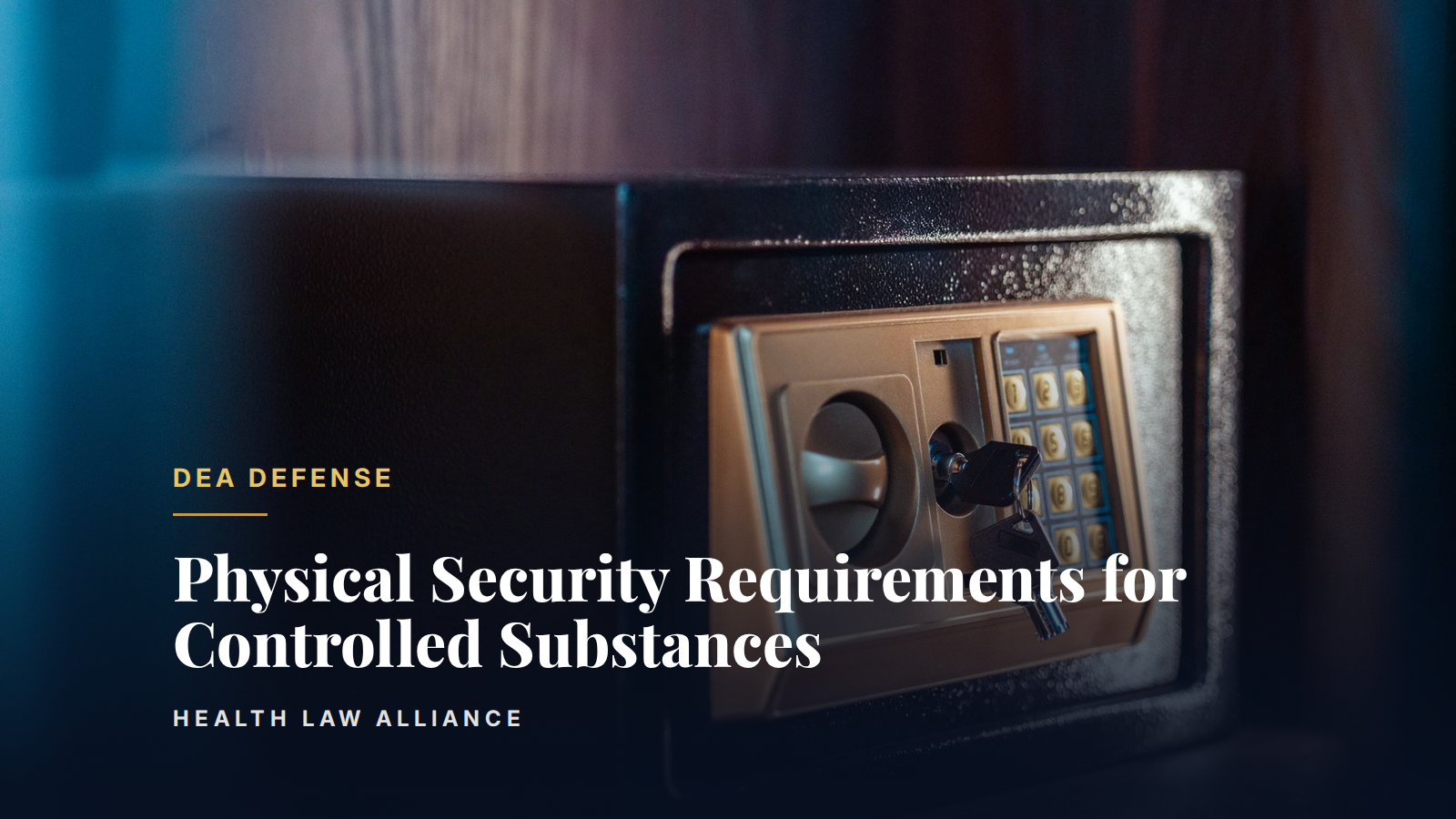
The storage obligation differs by registrant category. Under 21 CFR 1301.75, pharmacies and other practitioners must keep Schedule I through V controlled substances in a securely locked, substantially constructed cabinet, though pharmacies and institutional practitioners may instead disperse those substances throughout their noncontrolled stock in a way that obstructs theft. Manufacturers, distributors, and other non-practitioner registrants face a stricter standard under 21 CFR 1301.72: Schedule I substances generally require a vault or a security cage meeting specified construction standards, and Schedule II through V substances held in bulk require comparable vault, cage, or safe protection scaled to quantity and risk. A retail pharmacy that stores product the way a distributor's warehouse is required to is over-engineering the requirement. A distributor that stores product the way a pharmacy is permitted to is not meeting it.
A locked cabinet that satisfies the regulation on the day of the last inspection can still be the finding that opens the next one, if the registrant cannot show the access log, the employee screening file, and the alarm records behind it.
Employee Screening and Theft Reporting
Physical hardware is only part of the standard. 21 CFR 1301.90 directs registrants to screen prospective employees who will have access to controlled substances, including inquiry into felony convictions, recent misdemeanor convictions, and unauthorized controlled substance use. 21 CFR 1301.76 reinforces that screening obligation by barring registrants from employing, in a position with access to controlled substances, anyone convicted of a felony relating to controlled substances or anyone whose DEA registration was previously revoked, surrendered for cause, or denied. The same section requires notice to the local DEA Field Division within one business day of discovering a theft or significant loss, followed by a DEA Form 106 filed within 45 days. That filing, together with the pharmacy's own inventory reconciliation, is frequently the record DEA reviews first when a security question turns into an inspection.
Why Early Legal Counsel Is Critical
It is critical that pharmacies promptly retain experienced healthcare defense counsel upon receiving a DEA inspection notice, subpoena, or written request tied to a physical security finding. Early legal intervention can protect the pharmacy's rights, ensure appropriate responses to DEA's requests, avoid inadvertent admissions during an inspection, preserve the pharmacy's available defenses, and allow counsel to communicate with the Diversion Group on the pharmacy's behalf. Delaying representation can significantly affect the outcome of a matter, and a security deficiency left unanswered can escalate to a show cause proceeding or an immediate suspension order before the pharmacy has had the chance to correct it.
How Health Law Alliance Can Help
Health Law Alliance represents pharmacies and other DEA registrants through inspections, security-related findings, and the enforcement escalation that can follow, including DEA inspections and show cause proceedings. Our team includes a former federal prosecutor with direct experience on the government side of controlled substance enforcement. If your pharmacy has received a DEA inspection finding, a security-related deficiency notice, or any other DEA inquiry, contact us for a free, confidential consultation.