A dispensed prescription is only half of what a PBM audit now tests. For mail-order and specialty claims, auditors increasingly demand proof that the drug reached the patient, not just proof it left the pharmacy. That proof takes the form of a signed delivery confirmation, a carrier tracking record tied to an actual signature, or an in-pharmacy pickup log, and PBM provider manuals treat it as a condition of payment. When that record is missing, undated, or too thin to satisfy the auditor, the claim is treated as if it were never delivered, and the reimbursement is subject to full recoupment regardless of whether the drug was dispensed correctly and actually reached the patient. A pattern of these findings is also one of the fastest routes to network termination.
Acceptable Proof of Delivery
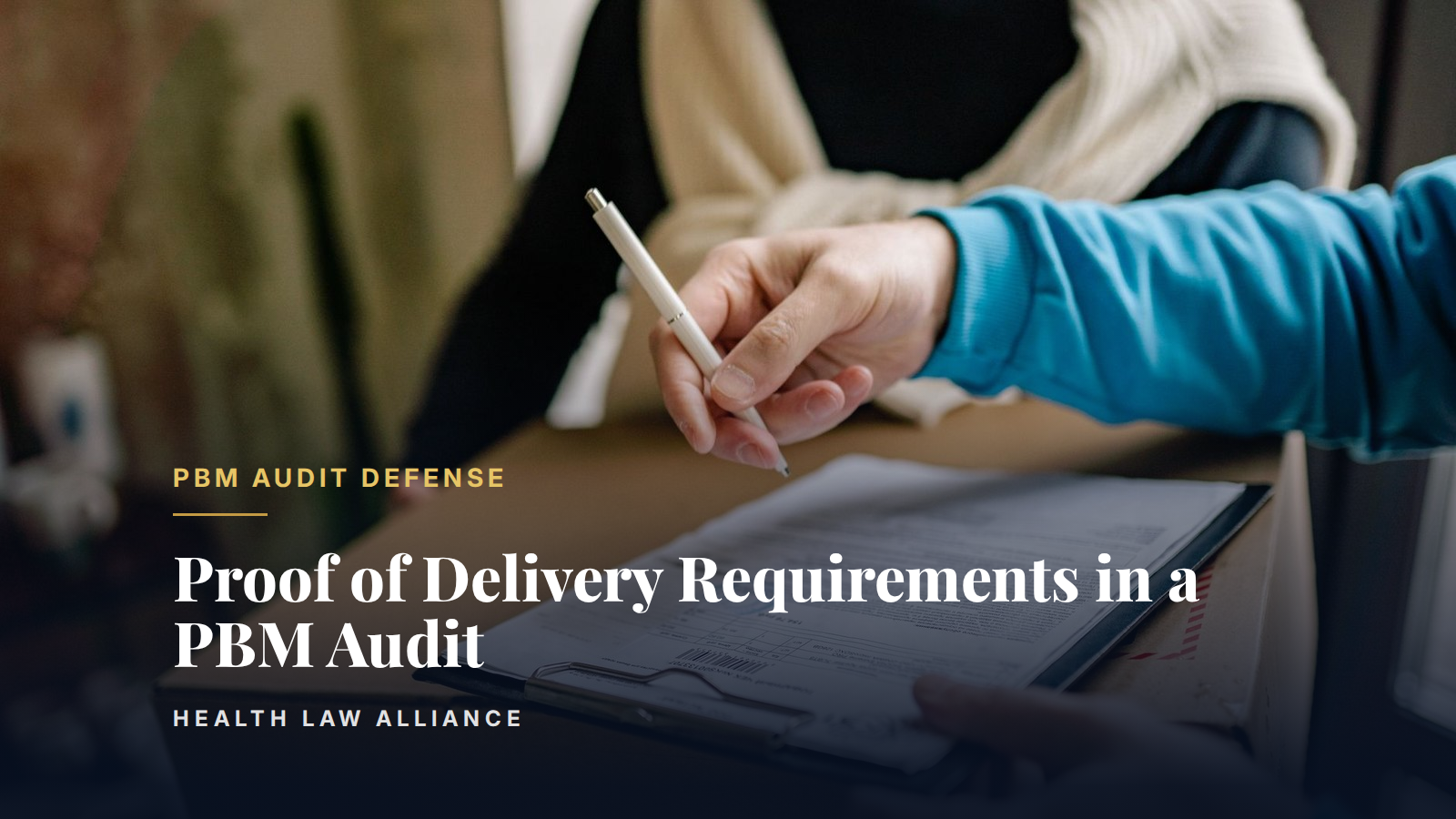
PBM audit standards for delivery documentation have tightened. Legal analysis from Frier Levitt describes a shift away from accepting a bare third-party delivery confirmation showing only a patient name and address. Auditors now look for a record that ties the specific prescription to the specific delivery: a signature captured at the door or by the carrier, a delivery date and time, the recipient's name, and increasingly the Rx number printed directly on the confirmation itself, rather than inferred from a shipping manifest filed separately. For in-store pickup, the equivalent is a dated signature log completed at the counter. Whatever the format, the standard is the same: the document has to stand on its own as evidence the named patient, or someone authorized to act for them, took possession of that fill. NCPA recommends treating that documentation as a routine part of the dispensing file, kept as the fill goes out, rather than something assembled after an audit letter arrives.
Documentation Gaps Auditors Flag
Most delivery findings trace back to a small set of recurring gaps: a signature line left blank or signed illegibly with no printed name, a pickup log with no date or an obviously batch-filled date, a delivery signed by a household member or caregiver with no authorization on file connecting that person to the patient, an electronic signature exception used without the underlying documentation the exception requires, and a delivery address that conflicts with the patient's profile with no explanation in the record. Individually, each looks like a clerical lapse. Under audit, each is treated as a missing element of proof, and Frier Levitt has reported that missing signatures and unsupported signature exceptions are routinely cited as grounds for recouping the full claim.
Under most PBM audit standards, a missing signature is treated as proof the drug was never delivered, and that gap alone is enough to recoup the entire claim.
Recoupment Without Regard to Dispensing Accuracy
This is the distinction pharmacies most often miss. A delivery-documentation finding stands apart from a clinical or dispensing error: the drug can be the correct medication, correctly filled, correctly billed, and still be recouped in full because the proof-of-delivery record fails the PBM's documentation standard. Recoupment on a documentation-only finding is still a documentation-only finding, and it can be challenged on those terms: the auditor's own standard, whether it was disclosed in the provider manual, and whether the record the pharmacy did keep was actually adequate under the contract in effect at the time of dispensing. Left unresolved, an accumulation of delivery findings across an audit sample becomes part of the record a PBM cites to support network termination, turning a documentation gap into the loss of the contract itself.
Why Early Legal Counsel Is Critical
It is critical that pharmacies promptly retain experienced healthcare defense counsel upon receiving a PBM audit notice or recoupment demand tied to delivery documentation. Early legal intervention can protect the pharmacy's rights under its provider agreement, ensure the response addresses the specific standard the auditor is applying rather than the standard the pharmacy assumed applied, avoid conceding a finding that is still open to challenge, and preserve every defense available before the appeal deadline runs. Delaying representation can significantly affect the outcome of a matter and expose the pharmacy to unnecessary financial risk. Pharmacies preparing for a specific PBM's process may also find Humana Pharmacy Audits: What to Expect and How to Respond useful background.
How Health Law Alliance Can Help
Health Law Alliance defends pharmacies against PBM audit findings built on delivery and signature documentation, including recoupment demands that treat a missing record as a failure to dispense. Our team reviews the specific documentation standard the auditor applied, tests it against the provider manual and contract terms in effect at the time, and builds the appeal record where the underlying delivery can still be established. If your pharmacy has received an audit finding tied to proof of delivery, contact us for a free, confidential consultation.