
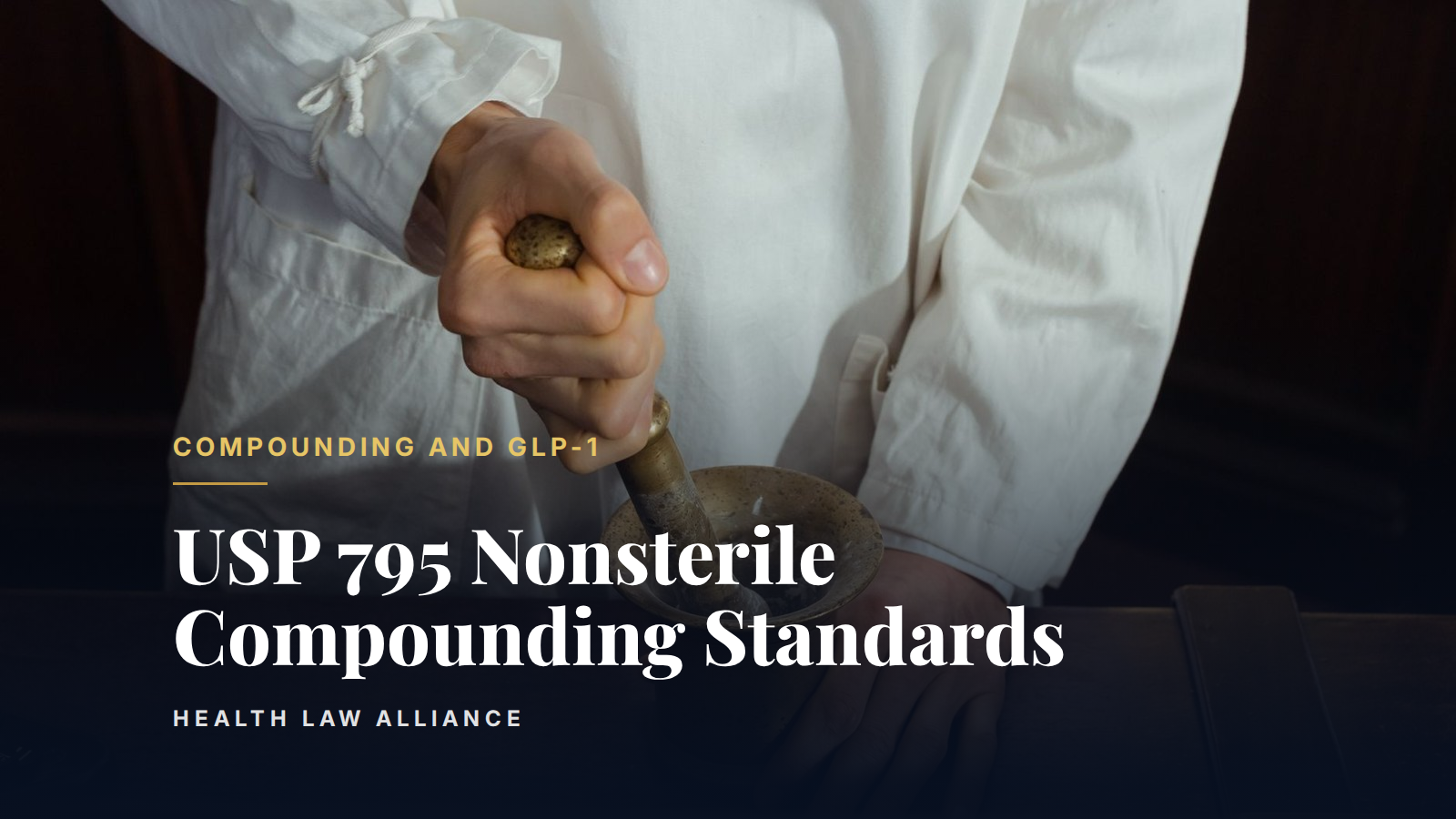
USP General Chapter 795 sets the baseline standard for compounded nonsterile preparations, and it became official on November 1, 2023, the first substantive revision since 2014. State boards of pharmacy build their nonsterile compounding inspection checklists directly off this chapter, and the FDA layers its own cGMP-influenced insanitary conditions guidance on top of it for Section 503A pharmacies. A compounding pharmacist who treats USP 795 as a paperwork exercise, rather than the standard an inspector tests against line by line, is the pharmacist most likely to walk away from an inspection with a Form 483.
What USP 795 Requires
USP 795 governs the compounding process, facility design, equipment, component sourcing, documentation, and personnel training for compounded nonsterile preparations prepared under Section 503A of the Federal Food, Drug, and Cosmetic Act. The chapter sets a strength tolerance of plus or minus 10 percent of the labeled amount and requires a designated, uncluttered compounding area separate from other pharmacy functions. USP's own chapter overview covers nonsterile preparations only; sterile preparations fall under USP 797/800, and any preparation involving a hazardous drug pulls that chapter in regardless of sterility. A pharmacy compounding both nonsterile hormone troches and sterile injectables operates under overlapping chapters at once, and an inspector who finds a gap in one typically checks the others.
Documentation Inspectors Test First
Two records anchor every USP 795 inspection: the Master Formulation Record, created once for each unique formulation, and the Compounding Record, completed for each batch prepared from it. The Master Formulation Record documents the ingredients, quantities, equipment, and process steps. The Compounding Record documents that the specific batch followed it, including lot numbers, the weights actually used, and the assigned beyond-use date. Missing signatures, formulation records that do not match what was actually compounded, and beyond-use dates entered without a documented basis are the fastest way to turn a routine inspection into a Form 483. An inspector who finds one incomplete Compounding Record typically pulls the full batch history, not just the preparation flagged.
Beyond-Use Dating Under the Current Standard
Absent a USP-NF monograph or preparation-specific stability data, USP 795 assigns default beyond-use dates by water activity: 14 days for non-preserved aqueous preparations, 35 days for preserved aqueous preparations, 90 days for nonaqueous dosage forms, and 180 days for solid dosage forms. A pharmacy that assigns a longer beyond-use date without stability data or a monograph citation has created a documentation gap an inspector will flag on sight, a pattern our companion piece, Beyond-Use Dating: Where Compounders Get Cited, walks through in more detail. Extending a beyond-use date past the default requires a validated, stability-indicating analytical method, not a compounder's judgment call.
A Master Formulation Record that does not match the Compounding Record is the fastest route from a routine inspection to a Form 483.
Where FDA and State Board Inspectors Focus
State board of pharmacy inspectors generally test compliance directly against USP 795. FDA inspectors apply a broader standard, the agency's 2020 guidance on insanitary conditions at compounding facilities, which layers cGMP-influenced expectations on top of USP 795 and applies whether or not a facility qualifies for the 503A exemption. Neither 503A nor 503B status exempts a pharmacy from the insanitary conditions provision, and a drug compounded under insanitary conditions is deemed adulterated regardless of exemption status. FDA inspection volume has grown for pharmacies compounding higher-risk preparation types, pharmacies with a documented complaint on file, and pharmacies making specific clinical claims in their marketing. A Form 483 observation carries a 15-day window to submit a corrective action response, a timeline our guide, FDA Form 483 Observations: The 15-Day Response, addresses directly, and an inadequate response is what typically converts a 483 into a warning letter.
Why Early Legal Counsel Is Critical
It is critical that compounding pharmacists promptly retain experienced healthcare defense counsel upon receiving an FDA inspection finding, a Form 483 observation, or a warning letter. Early legal intervention can protect the pharmacy's rights during the inspection itself, shape the corrective action response before the 15-day window closes, avoid statements to inspectors that later read as admissions, and preserve defenses that are foreclosed once a response has been submitted without review. Delaying counsel until after a warning letter issues can significantly narrow the options available to resolve the matter, an escalation our piece, FDA Warning Letters to Compounders: The Response That Closes the File, covers in full.
How Health Law Alliance Can Help
Health Law Alliance defends nonsterile and sterile compounding pharmacies nationwide against USP 795 deficiencies, FDA Form 483 observations, and warning letters, building the documentation record before an inspector arrives and controlling the corrective action response after. The firm's bench includes attorneys who have sat inside the agencies that regulate compounding, background that shapes how we read what an inspector is building toward. If your pharmacy is preparing for a nonsterile compounding inspection or has received a Form 483 or warning letter, contact our compounding pharmacy defense team for a free, confidential consultation.