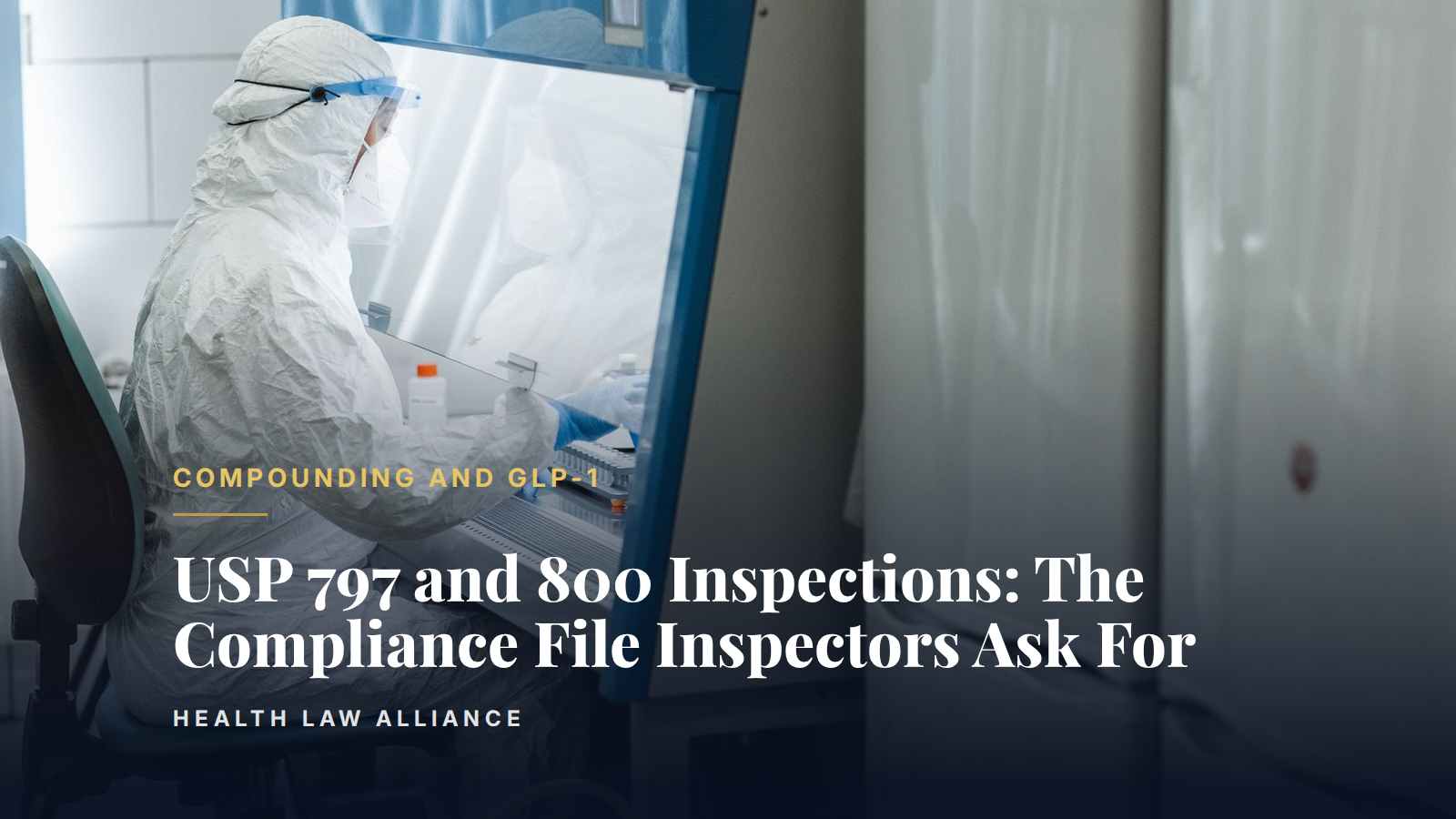
A state board of pharmacy or FDA investigator conducting a sterile-compounding inspection moves fast because the inspection has a checklist behind it, and the checklist maps to a specific paper file. USP <797> and USP <800> set out what a sterile or hazardous-drug compounding pharmacy has to prove it did, and both chapters became officially enforceable on November 1, 2023, under the current revision cycle. The inspector's list runs through environmental monitoring records, personnel garbing and competency files, master formulation records, and beyond-use date logs. A pharmacy unable to produce that file on request faces an FDA Form 483 observation, a state board deficiency notice, or a referral for further action, regardless of how clean the cleanroom looks.
What USP 797 and USP 800 Require
USP <797>, Pharmaceutical Compounding - Sterile Preparations, sets facility design, environmental control, personnel training, and finished-preparation testing standards for every compounded sterile preparation. USP <800>, Hazardous Drugs - Handling in Healthcare Settings, adds requirements on top of that baseline whenever a compounded drug is on the NIOSH hazardous drug list: personnel responsibilities, engineering controls such as negative-pressure rooms and closed-system transfer devices, personal protective equipment, and documented decontamination and spill-control procedures. Both chapters apply whether the pharmacy compounds under a 503A pharmacy license or a 503B outsourcing facility registration, though the agency most likely to inspect, and how often, differs between the two.
The Compliance File Inspectors Request First
Environmental monitoring is usually the first record requested: viable air sampling, surface sampling, and gloved fingertip sampling, performed before a compounder works independently and, for Category 2 and 3 compounding, at least every six months after. Personnel files come next, showing hand hygiene and garbing evaluation and gloved fingertip testing documented for every compounder by name and date. Each preparation needs a master formulation record and a compounding record, and every beyond-use date on file has to carry its storage condition and its documented basis, not just the date itself. Cleaning and disinfection logs for the primary engineering controls and the buffer room complete the core file inspectors work from.
Where Citations Cluster
The citations that recur across sterile-compounding inspections fall into a narrow set of categories: environmental monitoring that has fallen behind the required testing interval, beyond-use dates assigned without the documented basis the 2023 revision requires, and personnel competency files missing a periodic gloved fingertip or media-fill test. The same gaps surface at pharmacies across the compounding spectrum, including those that scaled semaglutide and tirzepatide compounding volume during the period after the FDA shortage delisting. A single missing log rarely closes a pharmacy. A pattern of missing logs across several categories is what turns a routine inspection into a formal enforcement referral.
The compliance file, not the cleanroom, is what decides most USP 797 and USP 800 inspection findings.
Why Early Legal Counsel Is Critical
It is critical that compounding pharmacies promptly retain experienced healthcare defense counsel once a USP <797> or USP <800> inspection turns up a documentation gap, whether the inspection is conducted by a state board of pharmacy or the FDA. Early legal intervention can protect the pharmacy's rights during the inspection, ensure that responses to inspector requests are accurate and complete, avoid inadvertent admissions in a Form 483 response or an inspection interview, preserve the defenses available in a board disciplinary proceeding, and let counsel communicate with the inspecting agency on the pharmacy's behalf. Delaying legal representation can significantly affect the outcome of an inspection and expose the pharmacy to unnecessary risk.
How Health Law Alliance Can Help
Health Law Alliance's compounding pharmacy attorneys defend sterile and hazardous-drug compounding operations through USP 797 and USP 800 inspections, Form 483 responses, and state board disciplinary proceedings. If your pharmacy is preparing for an inspection or has already received a citation, contact us for a free, confidential consultation.