
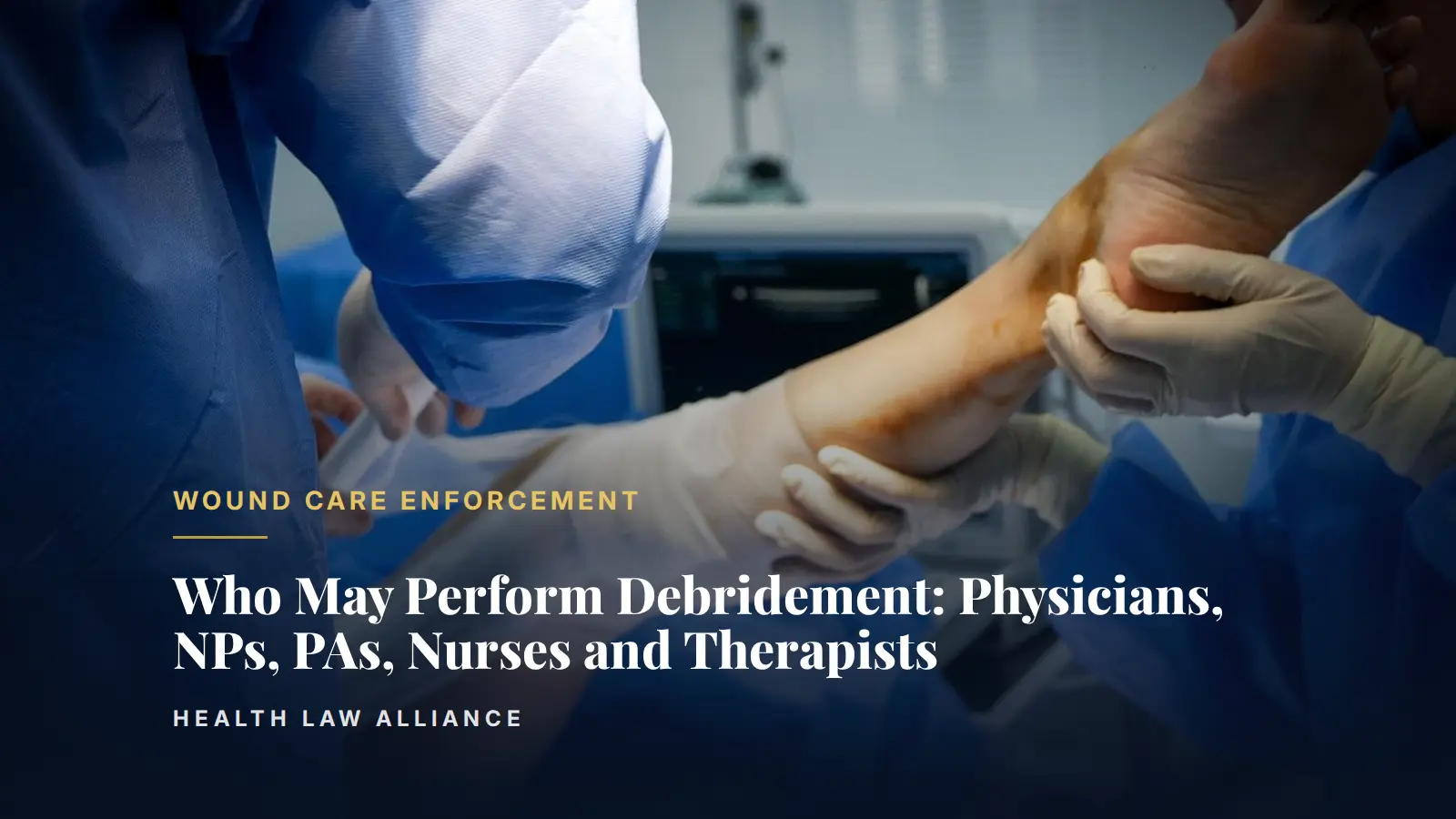
A wound care practice can perform a clean, medically necessary debridement and still lose the claim, because Medicare's payment rules turn on who was licensed and supervised to bill for the service, not on who held the instrument. Physicians, nurse practitioners, physician assistants, registered nurses, and physical and occupational therapists can all work on an open wound in the same clinic on the same day, but Medicare pays only the clinician whose license, supervision arrangement, and billed CPT code all line up with its rules for debridement.
Who May Bill Medicare for Debridement
A physician, or a non-physician practitioner such as a nurse practitioner or physician assistant, may bill Medicare directly for debridement once the practitioner meets the coverage conditions in 42 CFR 410.74 and 410.75: state licensure and a service that would be covered if a physician performed it. A physical or occupational therapist may also bill debridement, but only inside a plan of care a physician or non-physician practitioner has certified and built on the therapist's own evaluation. A registered nurse who is not also a nurse practitioner cannot bill Medicare directly for any debridement code; an RN's hands-on work is payable only when a physician or non-physician practitioner bills the encounter as incident to their own service.
CPT Codes Track the Debridement Technique
Selective debridement, the sharp removal of dead tissue along the margin of viable tissue, is billed under CPT 97597 for the first 20 square centimeters and the add-on code 97598 for each additional 20. Mechanical, enzymatic, and autolytic debridement are classified as non-selective methods under the applicable local coverage determination and billed under CPT 97602. Both selective and non-selective codes sit in a separate family from surgical debridement reaching subcutaneous tissue, muscle, fascia, or bone, billed under the CPT 11042 through 11047 series, and Medicare bars reporting 97597, 97598, or 97602 together with those codes for the same wound.
Incident-To Billing Narrows Who Can Stand In
When office staff, rather than the billing practitioner, perform part of the encounter, Medicare may still let the practitioner bill it as incident to their own service, inside the limits in 42 CFR 410.26. The billing practitioner must have personally started and must still actively manage the course of treatment, and must provide direct supervision of the staff member doing the work. As of 2026, that supervision can be met virtually, through real-time audio and video, for services without a 10- or 90-day global surgery period; audio-only contact does not qualify. Incident-to billing is unavailable for debridement performed during a hospital or skilled nursing facility stay, a gap Wound Care in Skilled Nursing Facilities: Audit Exposure covers in more detail.
Auditors reconstruct the answer from records the practice keeps on its own: scheduling logs, supervision time stamps, and the signature log tying a name to the encounter. A practice that cannot produce that trail for a sampled claim has handed the reviewer an incident-to failure before the reviewer ever reaches whether the debridement itself was medically necessary.
Medicare asks who was licensed, supervised, and entitled to bill for the encounter on the day the debridement happened, not who held the instrument.
State Licensure Adds a Second, Separate Layer
Medicare's billing rules decide who gets paid for a debridement claim. Separately, each state's licensure law decides who may touch the wound at all, and the two frameworks do not always move together. Washington law lets a physical therapist perform sharp debridement only after documented training and only once a referring or consulting health care practitioner is already involved, and bars delegating that task to a physical therapist assistant. Colorado goes further, barring a physical therapist assistant from sharp, selective, or enzymatic debridement outright. Alaska's board of nursing places comparable conditions on a registered nurse's conservative sharp debridement: advanced wound-care certification, a health care provider's order, and documented ongoing competency.
Why Early Legal Counsel Is Critical
A debridement credentialing mismatch rarely surfaces alone. The same chart often carries related exposure, including the manufacturer-relationship questions in Wound Care Kickback Exposure: Manufacturer Relationships, or a downstream skin substitute claim on the same wound, the subject of WISeR Prior Authorization Denied for a Skin Substitute: Next Steps. Wound care providers should promptly retain experienced healthcare defense counsel once a payer questions who performed or billed a debridement service, through a documentation request, a prepayment review, or a full audit. Early legal intervention can protect the provider's rights, help assemble licensure and supervision records before submission, and reduce the risk of inadvertent admissions. Delaying representation can affect the outcome of a matter and expose the provider to recoupment and licensure risk earlier counsel could have limited.
How Health Law Alliance Can Help
Health Law Alliance defends wound care practices and clinics, podiatry groups, and physician practices when a payer challenges who performed or billed a debridement service. Health Law Alliance's attorneys have overseen 2,000+ audits and handled 5,000+ matters, with 25+ years of experience. Contact Health Law Alliance's wound care audit defense team for a free, confidential consultation on a debridement credentialing or incident-to billing question.