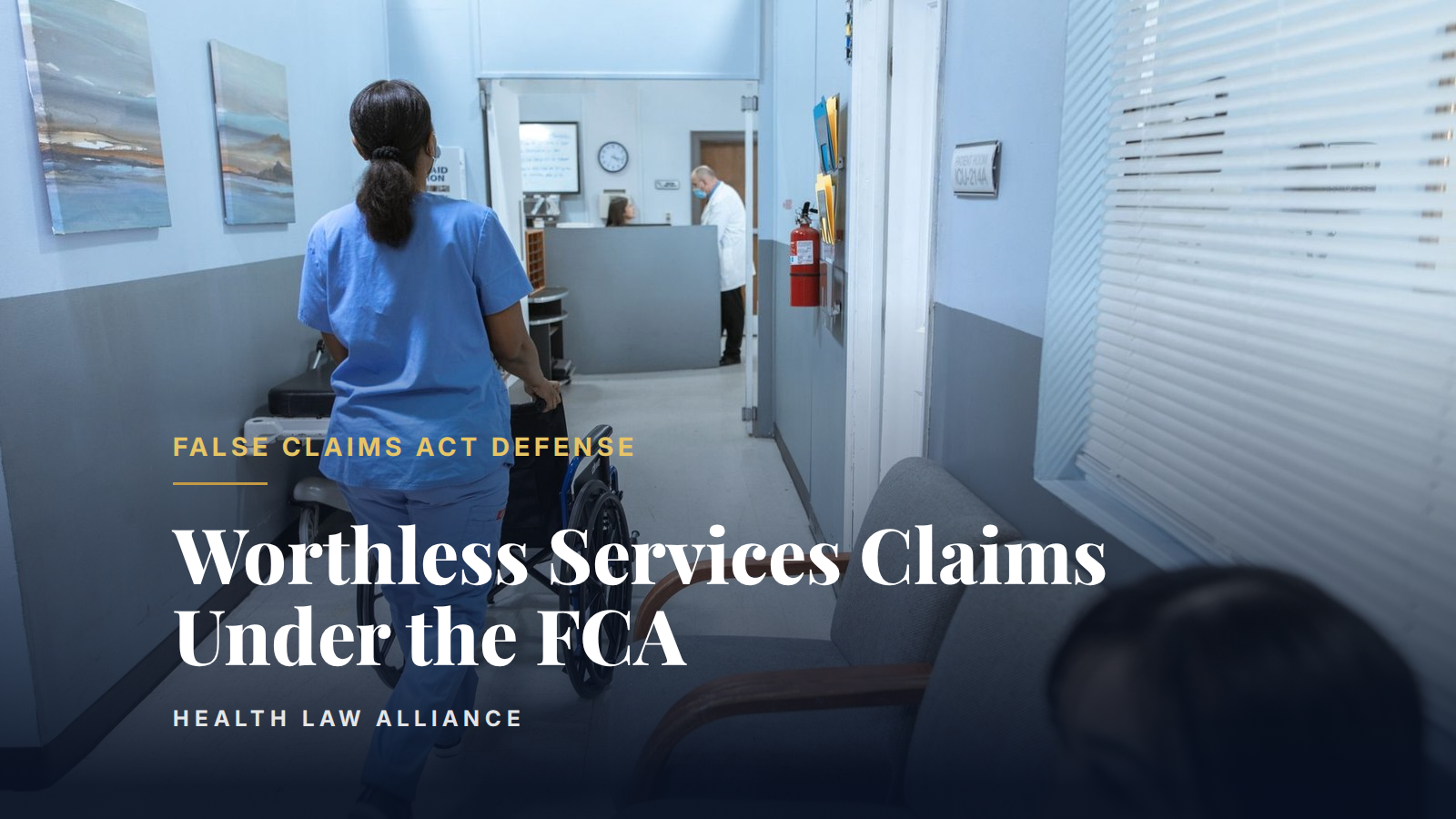
Your facility's staffing ratios, medication logs, and incident reports do more than describe patient care. Under the worthless services theory of False Claims Act liability, they can decide whether a routine survey deficiency becomes a false claim. The theory measures something narrower than billing accuracy or medical necessity: whether the service you billed for was so deficient that the government received no value at all, the practical equivalent of no service being performed. For skilled nursing facilities and other institutional providers, that question can turn chronic understaffing or unaddressed neglect into exposure that reaches administrators and owners as well as the operating company.
What Makes Services Worthless Under the FCA
The controlling framework comes from the Second Circuit's decision in United States ex rel. Mikes v. Straus, which described a worthless services claim as one where performance of the service is so deficient that for all practical purposes it is the equivalent of no performance at all. That standard sits above ordinary negligence: an isolated medication error or a missed vital sign check rarely reaches it, while a sustained pattern, custodial neglect over months, staffing so thin that care plans go unexecuted, or conditions leaving residents with avoidable pressure ulcers and repeated falls, can. Because the claim itself is false rather than merely miscoded, worthless services allegations frequently surface through a qui tam complaint filed by a nurse, administrator, or family member with direct knowledge of what was happening inside the building.
How the Theory Applies in Facility Cases
Nursing homes and skilled nursing facilities carry the deepest track record under this theory, because the elements of a worthless services claim map cleanly onto conditions a state surveyor can already document. In 2023, the owners, an unlicensed operator, and the landlord of a Ballston Spa, New York nursing home agreed to pay $7,168,000 to resolve allegations that the facility billed Medicaid for worthless nursing services between February 2017 and February 2021, while understaffing left residents with medication errors, unnecessary falls, and pressure ulcers, and the building went without reliable hot water and an adequate linen supply. Settlements built on this theory routinely name individual owners and landlords alongside the operating company, and they frequently carry a corporate integrity agreement imposing years of outside monitoring as a condition of staying in the program.
The Quality-of-Care Line Courts Draw
Mikes held that a facility's failure to meet a recognized standard of care does not, by itself, make a reimbursement claim false, because federal law treats conditions of participation in Medicare as separate from the conditions of payment for any specific claim. Isolated clinical shortcomings, a delayed callback to a physician, a documentation gap, a single dosing error, are the ordinary business of survey deficiencies and corrective action plans, not federal fraud liability. What separates a survey citation from an FCA case is scale and knowledge: whether the deficiency was so pervasive that the facility knowingly billed for care that, in substance, residents never received.
A worthless services claim does not punish a bad day of care. It punishes billing the government for care that, taken as a whole, was never delivered.
Compliance Posture That Prevents a Worthless-Services Theory
The exposure is preventable, and prevention looks like ordinary compliance discipline rather than crisis response. Staffing levels that match acuity, and that are documented against shifts actually worked rather than the schedule as planned, close the gap auditors and relators look for first. Incident reports, care plan reviews, and survey corrective action plans should be treated as records a False Claims Act investigator may eventually read, because in these cases they usually are. A facility already cited for repeat deficiencies should assume that any subsequent claim submission draws scrutiny, and individual administrators and owners should understand that a worthless services settlement can carry personal OIG exclusion exposure alongside the corporate penalty. Anyone in that position should read Corporate Integrity Agreements: Terms, Costs, and Negotiation for what a post-settlement monitoring period actually requires.
Why Early Legal Counsel Is Critical
It is critical that healthcare providers promptly retain experienced healthcare defense counsel upon receiving a subpoena, audit notice, investigative request, or other government inquiry touching on quality of care. Early legal intervention can protect the provider's rights, ensure appropriate responses to government requests, avoid inadvertent admissions, preserve relevant defenses, and allow counsel to communicate with investigators on the provider's behalf. Delaying legal representation can significantly affect the outcome of a matter.
How Health Law Alliance Can Help
Health Law Alliance has guided facility operators, administrators, and individual owners through worthless services investigations and the settlements and corporate integrity agreements that can follow, part of more than 5,000+ matters handled and 2,000+ audits overseen across 25+ years defending healthcare providers nationwide. If your organization is facing a worthless services allegation, a qui tam complaint, or a pre-settlement audit, contact Health Law Alliance's False Claims Act defense attorneys for a free, confidential review of your exposure.