A company facing a False Claims Act settlement demand that exceeds its balance sheet has one formal avenue to reduce that number: an inability-to-pay claim submitted to the Department of Justice's Civil Division. The claim is not a position stated on a call. It is a certified Financial Disclosure Form, reviewed by DOJ financial analysts, that has to survive scrutiny before it moves the settlement figure at all. A compliance officer who treats the disclosure as a formality, or who files an incomplete one, risks converting a solvency problem into a second exposure: a certification made to the United States government under penalty of perjury.
How an Inability-to-Pay Claim Enters the Negotiation
DOJ does not raise inability to pay on its own initiative, whether the underlying matter began as a government-initiated investigation or a qui tam suit. The company, through counsel, has to assert the claim affirmatively during civil settlement talks, and it carries the burden of proving it throughout the review. Ability-to-pay assessments apply to civil settlements; DOJ's Civil Division does not extend the same framework to criminal fines or restitution, a distinction covered in FCA Civil Exposure vs Criminal Charges: Keeping Them Apart. The Civil Division evaluates civil claims under the compromise-and-closing framework at Justice Manual § 4-3.200, and under a 2020 Civil Division memorandum, "Assessing an Entity's Assertion of an Inability to Pay," that set out the factors reviewers apply.
The Financial Disclosure DOJ Requires
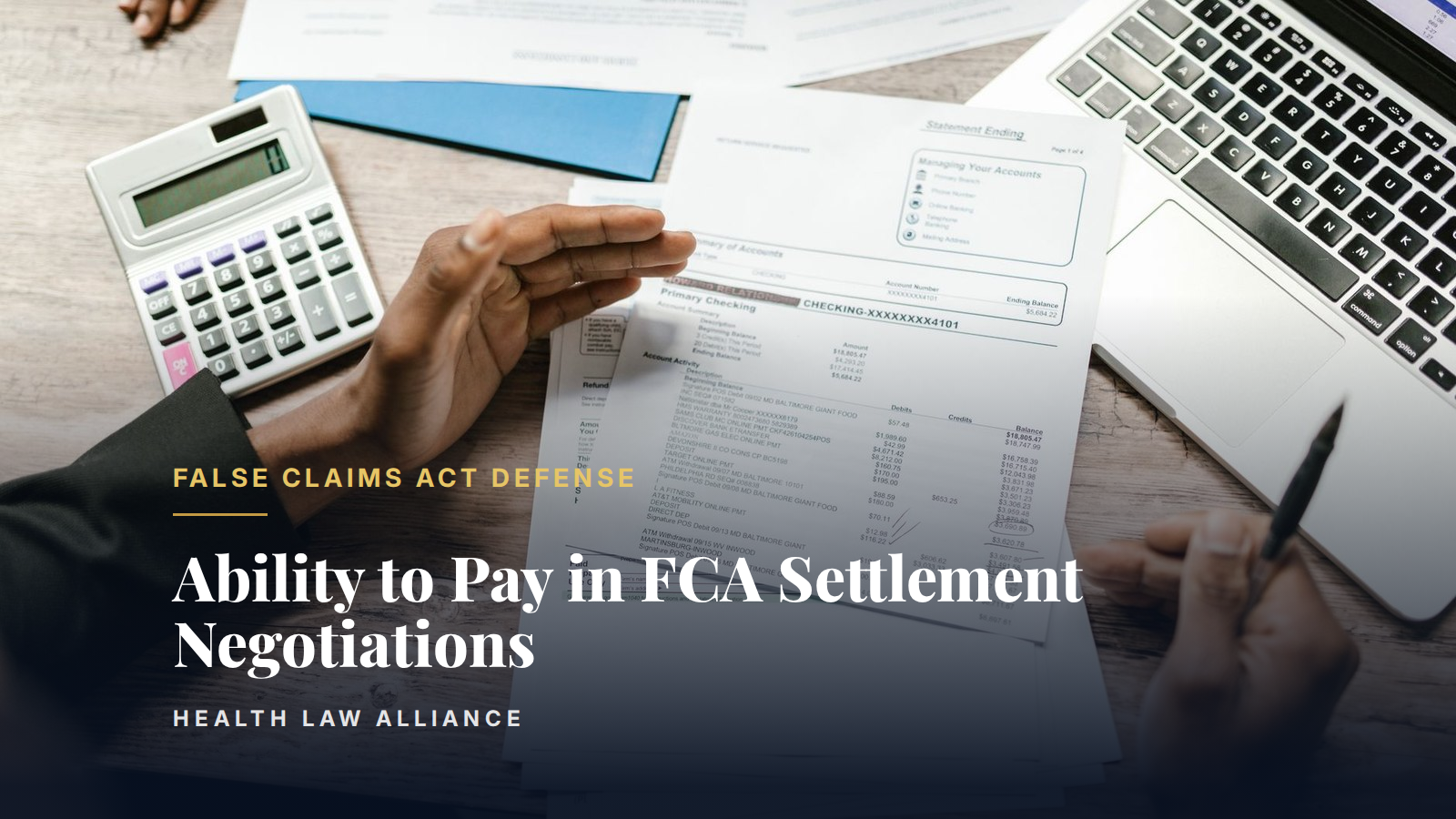
To reduce the settlement demand, the entity must complete DOJ's certified Financial Disclosure Form, which itemizes assets, liabilities, current and anticipated income and expenses, cash flow, and working capital, and has to be signed under penalty of perjury. DOJ typically requests supporting documents alongside the form: several years of tax returns, audited financial statements, and forward-looking financial projections. DOJ Civil Division attorneys may also ask to interview the company's chief financial officer or other personnel with direct knowledge of the numbers.
How DOJ Verifies the Claim
DOJ Civil Division financial analysts review the submission, and in matters with a complex damages theory the government may bring in the forensic accountants already working the underlying fraud allegations. Verification does not stop at the initial filing. An entity claiming inability to pay can be required to provide periodic financial updates until the matter finally settles, and any material change in financial condition affects the number under discussion. The review tests the disclosure. It does not defer to it.
A financial disclosure package only moves the settlement number when it is complete enough for DOJ's own analysts to verify it, not merely assert it.
How a Documented Claim Moves the Settlement Number
When DOJ credits an inability-to-pay claim, the reduction shows up as a lower principal settlement amount, a structured payment plan, commonly three to five years with interest, or both. In healthcare matters, DOJ sometimes pairs the reduced amount with a corporate integrity agreement rather than lowering the dollar figure further, using compliance oversight in place of some of the money the company cannot pay. The Civil Division's published factors include the company's current and projected financial condition, access to alternative capital such as borrowing capacity or asset sales, the tax treatment of the settlement, and the collateral consequences to jobs and ongoing operations.
The Risk of an Incomplete or Misleading Disclosure
The certification is the entity's own sworn representation to the government, and a disclosure that omits an asset, understates income, or fails to reconcile against the tax returns can be treated as a false statement independent of the underlying FCA exposure. A credited inability-to-pay claim also only reaches the civil settlement dollars. It does not touch separate OIG exclusion exposure, which HHS-OIG evaluates on its own terms. Companies with real complexity in their financial records, affiliate transfers, contingent liabilities, are better served disclosing it up front than letting DOJ's analysts find it first.
It is critical that healthcare companies promptly retain experienced healthcare defense counsel once a False Claims Act settlement demand is on the table, particularly before assembling or submitting an inability-to-pay disclosure to DOJ. Early legal intervention can protect the company's rights, ensure the financial disclosure is accurate and complete before it is certified, avoid inadvertent admissions that expand liability beyond the settlement, and allow counsel to manage the negotiation and the disclosure process directly with DOJ. Waiting until after a certification has already gone to the government narrows the options that remain.
Health Law Alliance represents healthcare companies, pharmacies, and physician practices through False Claims Act investigations and settlement negotiations, including the financial disclosure process behind an inability-to-pay claim. If your organization is facing an FCA settlement demand that does not match what the business can realistically pay, contact us for a free, confidential consultation to review the disclosure requirements and the negotiation posture before anything goes to DOJ.