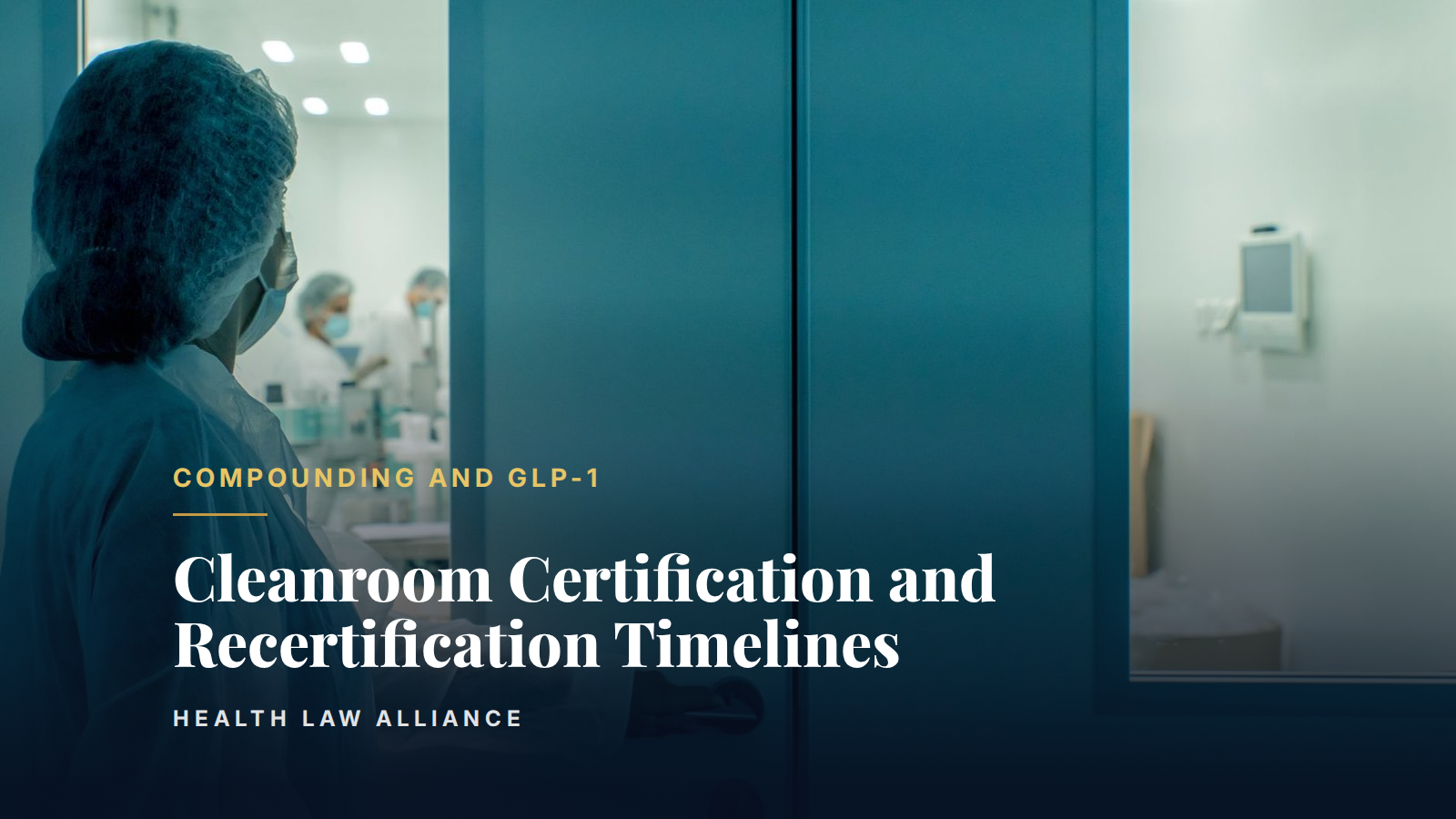
A sterile compounding pharmacy's cleanroom is only as reliable as its most recent certification. USP General Chapter 797 requires every primary and secondary engineering control to be independently certified before compounding begins, and recertified at least every six months afterward. A room that has not been recertified on schedule, or that keeps operating after a failed test, is not a compliant cleanroom, and a pharmacist-in-charge who continues compounding in it is building the record a state board inspector will use against the pharmacy's license.
Certification Before Compounding Begins
Before a facility may compound Category 1, 2, or 3 sterile preparations under USP 797/800, it must independently certify the compounding area using the applicable certification guide, most commonly the Controlled Environment Testing Association's CAG-003 guide for sterile compounding facilities. Certification confirms that the primary engineering control, typically a laminar airflow workbench, biological safety cabinet, or compounding aseptic isolator, maintains ISO Class 5 air cleanliness, that the surrounding buffer room maintains ISO Class 7, and that the ante-room maintains ISO Class 8. A facility that has never completed this baseline certification has no compliant sterile compounding space, regardless of how the room is built or equipped.
The Six-Month Recertification Requirement
Certification is not a one-time event. USP requires recertification at least every six months, and again whenever a change occurs that could affect airflow or air quality, including HEPA filter replacement, relocation of a primary engineering control, or any structural modification to the room. A pharmacy that replaces a HEPA filter and waits for the next scheduled six-month window before recertifying has, in the interim, no documented basis for treating the room as compliant. These logs are among the first records a state board compounding inspection will request, and a gap in the certification file is treated the same as a missed certification altogether.
What Certification Testing Measures
Certification testing is performed under dynamic operating conditions, with the largest number of personnel expected to work in the space present and performing the highest complexity of compounding the facility conducts, including particle-generating tasks such as weighing and mixing powders. Under those conditions, the certifier measures nonviable particle counts against the room's ISO classification limit, verifies HEPA filter integrity through leak testing, confirms airflow velocity and pattern through smoke studies, and records the room's air changes per hour. Viable air and surface sampling are evaluated on a separate schedule, but both that sampling and the beyond-use dates assigned to preparations made in the room depend on the room holding its certified state between tests.
Hazardous Drug Rooms Under USP 800
A pharmacy that compounds hazardous drugs carries a parallel certification obligation under USP General Chapter 800. The hazardous drug compounding room must maintain negative pressure between 0.01 and 0.03 inches of water column relative to adjacent areas, and at least 12 air changes per hour for nonsterile hazardous drug compounding, rising to 30 air changes per hour where the hazardous drug room connects to a sterile compounding area. These parameters are confirmed on the same certification and recertification schedule as the facility's other classified areas. The distinction tracks the line between 503A/503B status, since a 503A pharmacy compounds under state board oversight while a 503B outsourcing facility operates instead under FDA's cGMP framework, which carries its own, separate environmental monitoring obligations.
A cleanroom without a current certification is not a compliant cleanroom, no matter how well it performed six months ago.
Why Early Legal Counsel Is Critical
It is critical that compounding pharmacists retain experienced healthcare defense counsel promptly upon learning of a failed certification test, an expired recertification window, or a state board inquiry tied to cleanroom compliance. Early legal intervention can help the pharmacy document corrective action in the form a board investigator will credit, avoid statements made during an inspection that later read as admissions, and preserve defenses before a finding hardens into a formal disciplinary action. Waiting until a notice of violation arrives narrows the options that were available when the deficiency was first identified.
How Health Law Alliance Can Help
Health Law Alliance represents compounding pharmacies in state board investigations and enforcement actions tied to cleanroom certification gaps and USP 797/800 deficiencies, as part of the firm's compounding pharmacy defense practice. If your pharmacy has received a citation tied to certification records or needs its cleanroom compliance file organized before an inspection, contact us for a free, confidential consultation.