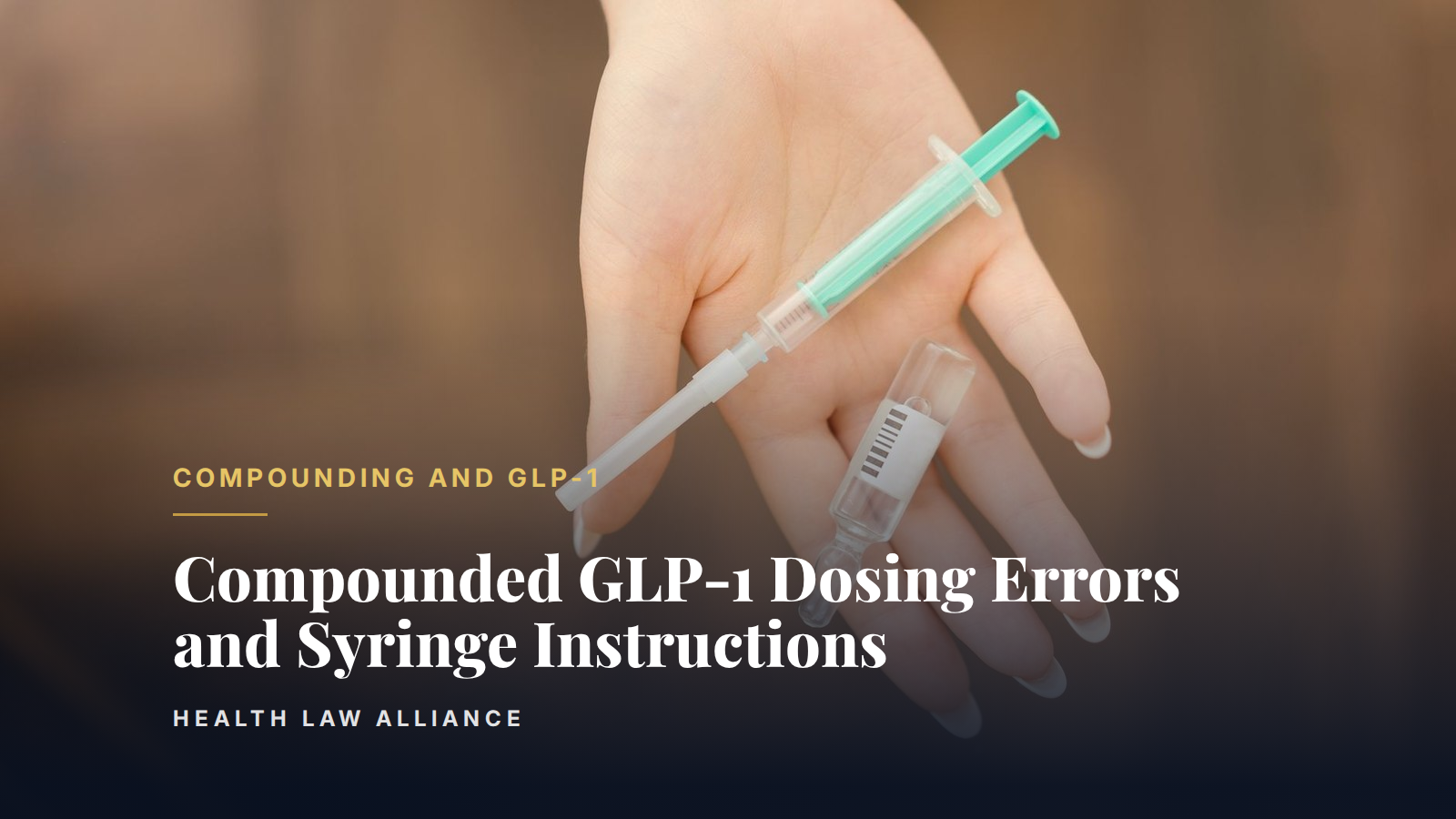
The FDA has told compounders, prescribers and patients that dosing errors involving compounded injectable semaglutide have put patients in the hospital. In a July 26, 2024 safety communication, the agency described patients instructed to draw 5 units from a multi-dose vial who instead drew 50 units, and a provider who meant to prescribe 0.25 milligrams, or 5 units, but wrote 25 units on the prescription instead. The reported harm ranged from gastrointestinal distress and fainting to acute pancreatitis and gallstones. For the compounding pharmacy that filled the prescription and the prescriber who wrote it, an error of that scale is the record a board investigator or a plaintiff's lawyer asks for first.
FDA's Dosing Error Alert for Compounded Semaglutide
The alert followed reports that patients self-administered five to twenty times the intended dose. In one cluster, a provider meant to write 2 units but wrote 20 units, a tenfold overdose that reached three patients from the same prescription. FDA said confusion among milliliters, milligrams and syringe units contributed to the errors, and most of the reports involved patients who found it hard to measure the dose on a syringe. The agency's adverse event list includes nausea, vomiting, abdominal pain, fainting, headache, migraine, dehydration, acute pancreatitis and gallstones. Tirzepatide is also compounded, and FDA says compounded GLP-1 drugs may be dispensed in a multi-dose vial for the patient to self-administer, which carries the same measurement risk.
How Unit and Milligram Confusion Happens at the Vial
FDA-approved semaglutide ships in a prefilled pen dosed only in milligrams; the patient clicks to a marked dose and injects. Compounded semaglutide ships in a multi-dose vial at a concentration the compounding pharmacy sets, and the patient or caregiver must draw the correct volume on a U-100 insulin syringe marked in units, not milligrams. Two conversions have to happen correctly before the needle touches skin: the prescriber's intended milligram dose has to become a unit count on that specific vial's concentration, and the patient has to read the right line on a syringe many have never used before. A labeling or counseling gap at either step is what turns a vial into an overdose.
The FDA's own case examples show a fivefold overdose from one prescriber's milligram-to-unit conversion and a tenfold overdose reaching three patients from another, the same error appearing on both sides of the counter.
The Label That Shows the Dose, the Concentration and the Device
A compounding label that can defend itself in a board inquiry states the vial's exact concentration, the prescribed dose in both milligrams and the corresponding unit mark on the syringe dispensed with it, and the beyond-use date assigned under the pharmacy's USP 797/800 protocol. The syringe itself should match the prescribed dose rather than being left for the patient to select from whatever is on hand. A 503A/503B compounding pharmacy filling a patient-specific semaglutide or tirzepatide prescription controls every one of those variables at the point of dispensing.
The Counseling Record That Shows the Patient Could Measure the Dose
FDA's own recommendation to compounders and prescribers is to supply the syringe sized for the intended dose and to counsel the patient on how to measure it before the first injection happens unsupervised. That counseling session is also the pharmacy's and the prescriber's defense. A dated note of what was demonstrated, what the patient repeated back, and the written instructions handed over turns a self-injection into a documented act rather than a guess. Without that note, a dosing error reads as a labeling failure instead of a patient misunderstanding, and the pharmacy that can produce the record starts a board inquiry in a materially different position than one that cannot.
Why Early Legal Counsel Is Critical
Compounding pharmacies and prescribers should retain healthcare defense counsel as soon as a patient complaint, a state board inquiry, or a demand letter references a GLP-1 dosing error. Counsel can organize the labeling and counseling record before a regulator or opposing lawyer asks for it, and help keep an informal explanation from becoming an admission used against the pharmacy later.
Health Law Alliance has represented 2,500+ clients nationwide.
How Health Law Alliance Can Help
Health Law Alliance's compounding pharmacy attorneys defend pharmacies and prescribers through FDA inspections, state board inquiries and the civil claims that follow a reported GLP-1 dosing error. If your pharmacy or practice is responding to a semaglutide or tirzepatide dosing complaint, contact our GLP-1 compounding defense team today for a free, confidential consultation.