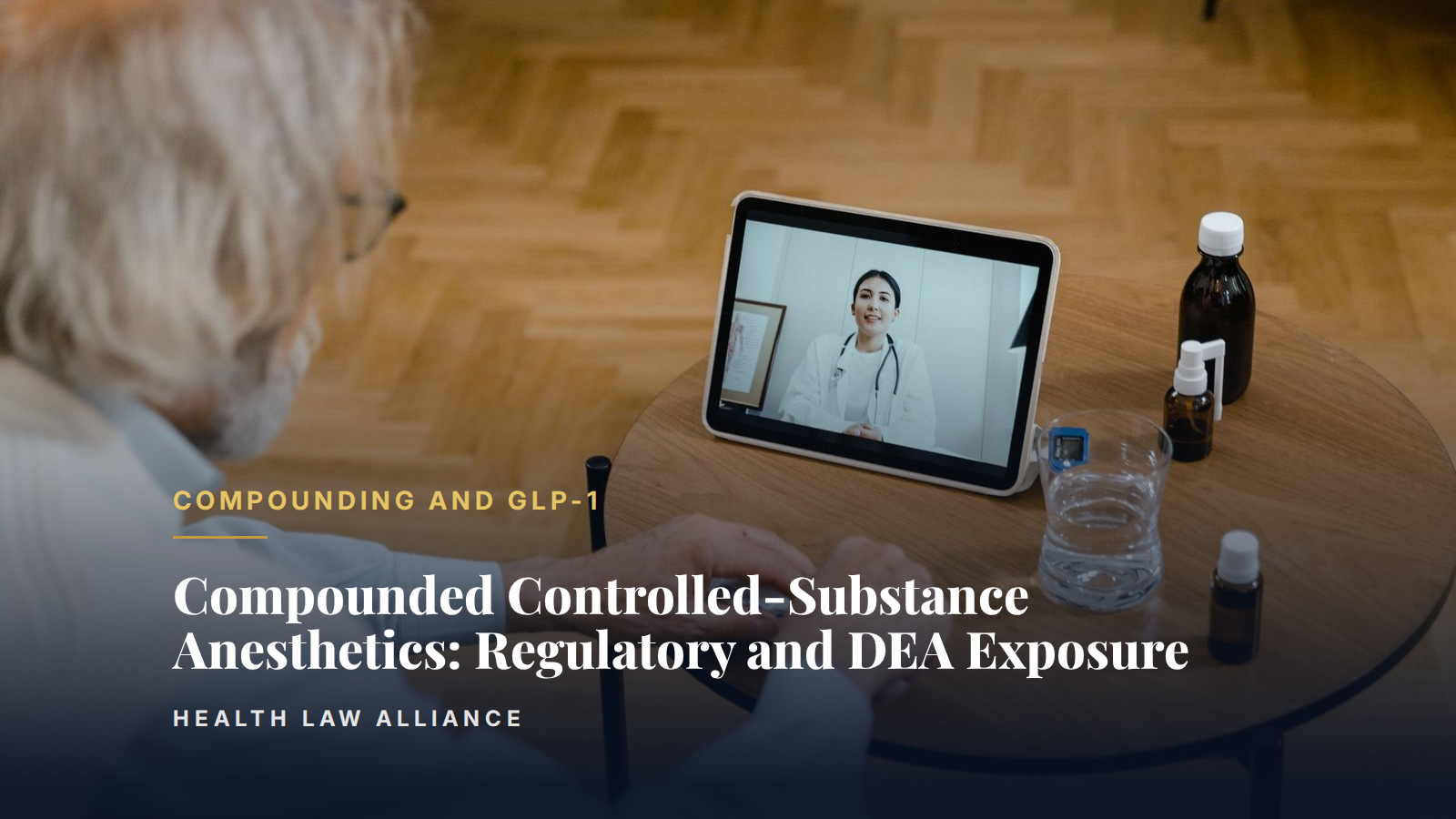
Telehealth platforms and compounding pharmacies are dispensing compounded controlled-substance anesthetic formulations directly to patients for at-home psychiatric use, without a clinician present at the time of administration. The Drug Enforcement Administration places this anesthetic in Schedule III of the Controlled Substances Act, and the Food and Drug Administration has twice warned that at-home administration of a compounded formulation carries risks the agency has not evaluated for safety or effectiveness. A compounding pharmacist who fills these prescriptions is exposed on two fronts at once, a DEA registration action tied to controlled substance handling and an FDA compliance action tied to compounding status, and the two can move independently of each other.
At-Home Compounded Anesthetic Models
The models drawing regulatory attention share a common structure: a telehealth platform conducts an intake questionnaire or a brief video visit, a prescriber affiliated with the platform issues a prescription for an oral, sublingual, or injectable compounded formulation, and a compounding pharmacy ships the product directly to the patient's home. These arrangements follow the same telehealth compounding structure regulators are already scrutinizing in GLP-1 arrangements, and the same registration exposure attaches to it. The DEA placed the anesthetic, including its salts and isomers, into Schedule III of the Controlled Substances Act in 1999, under 21 CFR Part 1308, and that classification carries Schedule III controls and criminal sanctions under 21 U.S.C. 801 et seq. across manufacture, distribution, dispensing, importation, and exportation. A pharmacy filling into this model is not exempt from those controls because the prescription originated through telehealth.
Controlled Substance Obligations
A pharmacy's DEA registration carries obligations that do not change because a prescription arrives through a telehealth platform. Under the Ryan Haight Online Pharmacy Consumer Protection Act of 2008, a prescriber generally may not issue a controlled substance prescription by telemedicine without at least one in-person medical evaluation of that patient. The DEA and the Department of Health and Human Services have extended a temporary exception to that requirement four times since the COVID-19 public health emergency; the current extension runs from January 1, 2026 through December 31, 2026, and it does not relax the requirement that every prescription be issued for a legitimate medical purpose in the usual course of professional practice. A pharmacy should confirm the prescriber falls within the exception or has satisfied the in-person evaluation requirement, because the DEA can act against the dispensing pharmacy's registration independent of any case it brings against the prescriber. Because compounded formulations are not FDA-approved, a 503A/503B pharmacy compounding for an identified patient must also track its beyond-use date assignment and, for a sterile injectable formulation, its USP 797/800 compliance, on top of the controlled substance recordkeeping the DEA requires.
FDA Statements on Compounded Formulations
The FDA has issued two public alerts specific to compounded formulations of this anesthetic. In February 2022, the agency warned of risks tied to compounded nasal spray formulations, and in October 2023 it broadened the warning to other compounded forms marketed for psychiatric conditions including depression, anxiety, post-traumatic stress disorder, and obsessive-compulsive disorder, none approved as an indication for this anesthetic. The agency's concern centers on the home setting, where no health care provider monitors for sedation, dissociation, elevated blood pressure, or respiratory depression; the FDA received a report in April 2023 of a patient who developed respiratory depression after taking a compounded oral formulation outside a health care setting. Because compounded drugs are not FDA-approved, an FDA Form 483 observation tied to an at-home dispensing model can follow directly from that gap.
A Schedule III registration does not travel with the prescription. It stays with the pharmacy that fills it, regardless of where the patient administers the dose.
Why Early Legal Counsel Is Critical
It is critical that a compounding pharmacist retain healthcare defense counsel as soon as a DEA diversion investigator opens an inquiry into an at-home dispensing model, or an FDA finding names the compounding process behind it. Early legal involvement can shape how the pharmacy responds to a records request, distinguish the pharmacy's own recordkeeping and registration compliance from the telehealth platform's marketing and intake practices, and prevent a finding tied to an FDA warning letter from being read across into a separate DEA registration action. Waiting until an order to show cause or a warning letter arrives narrows the options that were available when the gap was first identified internally.
How Health Law Alliance Can Help
Health Law Alliance represents compounding pharmacies and pharmacists in DEA registration matters and FDA compounding inquiries connected to at-home dispensing models for controlled-substance anesthetics, as part of the firm's compounding pharmacy attorneys practice. If your pharmacy is filling prescriptions from a telehealth platform and needs its controlled substance recordkeeping and compounding documentation organized before a DEA or FDA inquiry begins, contact us for a free, confidential consultation.