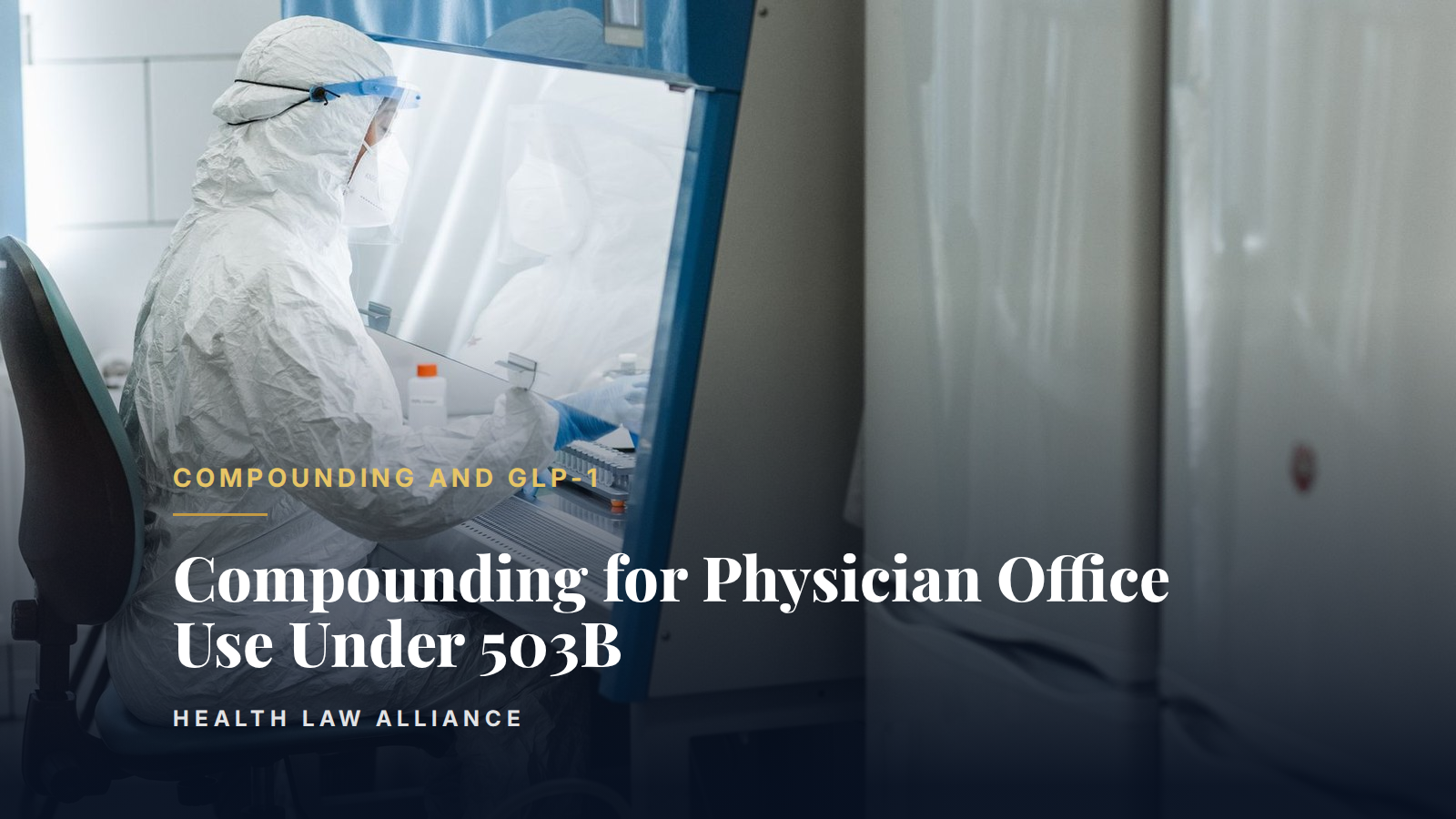
A physician practice that keeps compounded drugs on hand for in-office use, rather than filling a prescription for one named patient, is relying on a 503B outsourcing facility, not the 503A pharmacy down the street. Section 503B of the Food, Drug and Cosmetic Act lets a registered outsourcing facility supply office stock without a patient-specific prescription, but that permission comes with labeling rules and FDA reporting duties a 503A pharmacy never has to meet. Treating the two pathways as interchangeable risks a mislabeled-drug finding or a missed report, and either one can draw an FDA inspection.
Office Stock Compounding Under Section 503B
Under 21 U.S.C. § 353b, an outsourcing facility is a facility that compounds sterile drugs, has elected to register with the FDA under Section 503B, and complies with that section's conditions. Unlike a 503A pharmacy, an outsourcing facility is not required to be a licensed pharmacy, and the statute specifies it "may or may not obtain prescriptions for identified individual patients." That is the legal basis for supplying a physician's office with compounded drugs as stock inventory rather than one prescription at a time; the firm's 503A/503B glossary entry distinguishes the two pathways in more detail. Section 503B(a)(8) permits the compounded drug to be administered in a health care setting, so long as the outsourcing facility that compounded it is the only entity that sells or transfers it; a physician office that resells compounded stock to another practice falls outside that protection. The bulk drug substances in that compound must also appear on an FDA list of substances with clinical need or on the drug shortage list, the threshold our Bulk Drug Substance Sourcing and the Section 503A Lists analysis covers for 503A sourcing.
Labeling Requirements for 503B Office Stock
Section 503B(a)(10) requires an outsourcing facility to label every compounded drug with the statement "This is a compounded drug," the facility's name and contact information, the lot number, the established name, dosage form and strength, the compounding date, an expiration date, storage instructions, the NDC number, and the active and inactive ingredients. The label must also say "Not for resale," and when the drug is dispensed other than under a prescription for a named patient, the statement "Office Use Only." That single line is the labeling difference between 503B office stock and a 503A patient-specific compound, and a label missing it, or carrying it when a prescription did exist, is the kind of discrepancy an FDA investigator may flag during an inspection.
Reporting Duties That Apply Only to Outsourcing Facilities
Registering as an outsourcing facility carries reporting duties a 503A pharmacy does not have. Under Section 503B(b)(2), every outsourcing facility must report to the FDA, upon initial registration and again each June and December, which drugs it compounded over the prior six months, including the active ingredients, source, NDC number, strength, dosage form, and units produced. Under Section 503B(b)(5), the facility must also submit adverse event reports to the FDA in the format set out at 21 C.F.R. § 310.305. Facilities must also re-register annually between October 1 and December 31, and the FDA schedules inspections on a risk basis, weighing compliance history and whether the facility compounds shortage-list drugs. A facility that compounds sterile drugs also operates under current good manufacturing practice standards, the subject of the firm's cGMP glossary entry, and the sterile-compounding standards in USP 797/800, a bar a 503A pharmacy does not face in the same form.
The "Office Use Only" label is what turns a 503B-compounded drug into lawful physician office stock. Without it, dispensing that drug outside a patient-specific prescription is the kind of mismatch between label and practice that an FDA inspection is built to catch.
Why Early Legal Counsel Is Critical
It is critical that a 503B outsourcing facility or physician practice promptly retain experienced healthcare defense counsel upon receiving an FDA Form 483, a warning letter, or any inquiry about office-use labeling or reporting compliance. Early legal intervention can protect the facility's rights, help shape appropriate responses to FDA requests, avoid inadvertent admissions, and allow counsel to communicate with investigators on the facility's behalf. Delaying representation can affect the outcome of an inspection and expose the facility to unnecessary risk.
How Health Law Alliance Can Help
Health Law Alliance represents 503B outsourcing facilities, 503A compounding pharmacies, and physician practices in FDA inspections, warning letter responses, and labeling and reporting compliance reviews as part of its compounding pharmacy defense practice.
Health Law Alliance's attorneys have overseen 2,000+ audits and handled 5,000+ matters, with 25+ years of experience.
If a 503B outsourcing facility or physician practice has received an FDA Form 483, a warning letter, or a reporting deficiency notice, contact Health Law Alliance's compounding pharmacy defense team for a free, confidential consultation.