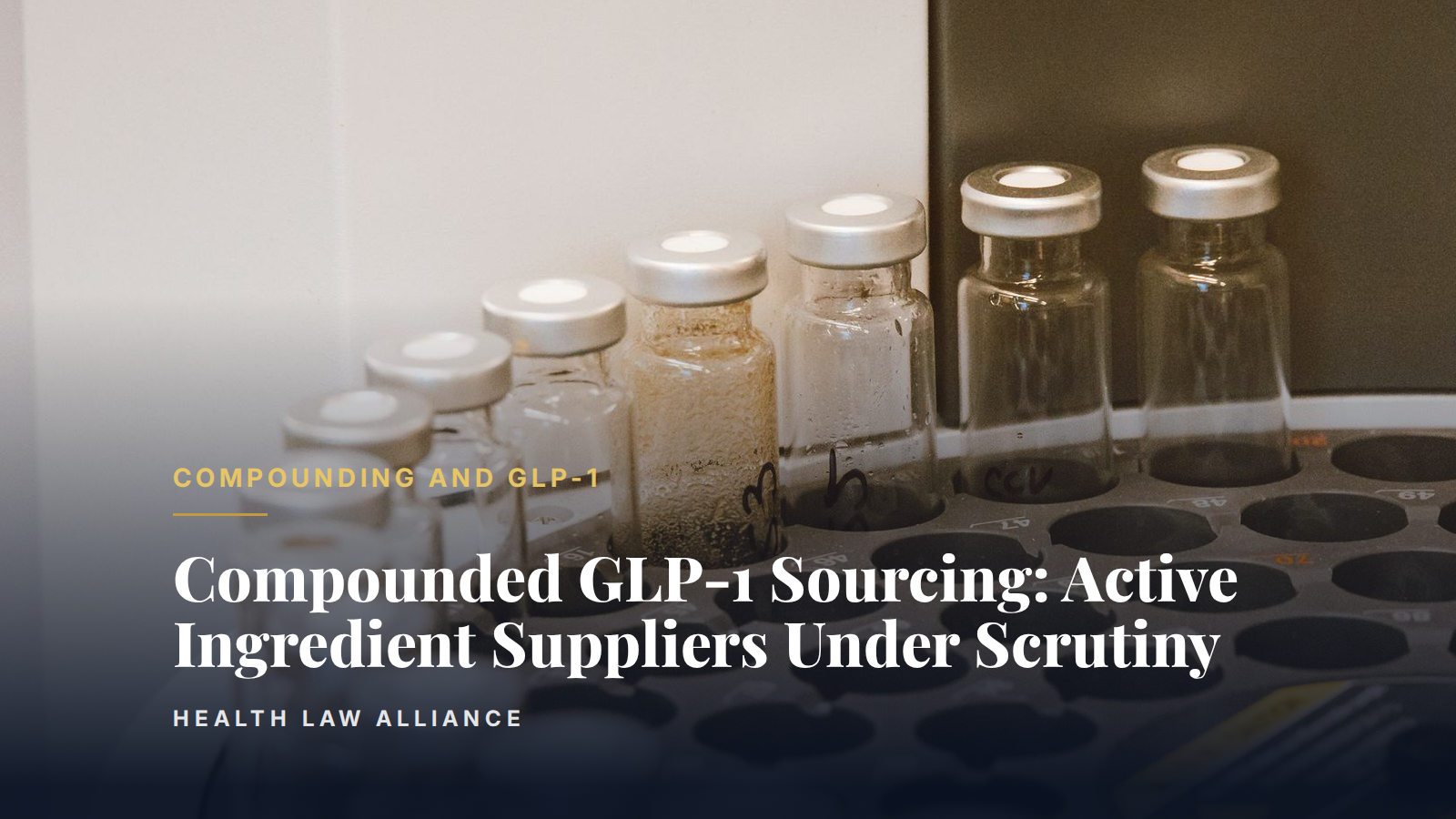
A compounding pharmacist who buys semaglutide or tirzepatide active pharmaceutical ingredient (API) from an unregistered supplier risks losing the narrow federal exemption that lets a 503A pharmacy compound those drugs without New Drug Application approval or current Good Manufacturing Practice (cGMP) compliance. The Food and Drug Administration published a revised Import Alert 66-80 on October 9, 2026, after evaluating 48 GLP-1 active pharmaceutical ingredient manufacturing sites and finding 21% out of compliance with federal drug manufacturing standards. For a compounding pharmacy, the supplier's registration and paperwork, not only the finished preparation, are now squarely inside the audit and enforcement picture.
The 503A Sourcing Conditions for Bulk Drug Substances
Section 503A of the Federal Food, Drug, and Cosmetic Act lets a state-licensed pharmacy compound a drug for an identified patient without FDA approval of the finished product, but only if the bulk drug substance behind it clears the three conditions in 21 U.S.C. § 353a(b)(1)(A). The substance must comply with an applicable United States Pharmacopeia monograph, be a component of an FDA-approved drug, or appear on FDA's 503A Bulks List. It must come from a manufacturer registered with FDA, including a registered foreign establishment. And each lot must arrive with a valid certificate of analysis. A pharmacy that compounds from an unregistered supplier, or without a current certificate of analysis, has not met the condition that keeps the exemption in place, regardless of how the finished preparation later tests.
Those three conditions govern the active ingredient. A pharmacy's own compounding controls sit beside them: USP 797/800 environmental and personnel standards, and a beyond-use date supported by actual stability testing rather than a default ceiling. Our companion guide on documenting certificates of analysis covers lot-level verification in more detail.
FDA's GLP-1 Import Alert and the Green List
Revised Import Alert 66-80, published October 9, 2026, covers semaglutide, tirzepatide, and other GLP-1 bulk drug substances. FDA evaluated 48 registered GLP-1 API manufacturing sites and found 21% out of compliance, either from evidence of noncompliance with cGMP recordkeeping and testing requirements or from failing to respond to an FDA records request in a timely manner. The agency also found a recurring pattern: sites register as GLP-1 API manufacturers, offer semaglutide or tirzepatide API for import, refuse FDA's requests for records, then deregister within a short period. Under the alert, FDA may detain without physical examination any foreign GLP-1 API shipment unless the manufacturer and product appear on the Green List, which FDA builds from a supplier's own submitted certificates of analysis, batch records, and stability data, not from a blanket approval of a country or company.
When a Green-List Supplier Still Fails
FDA's May 1, 2026 warning letter to Harbin Jixianglong Biotech Co., Ltd. shows how fast a Green List entry can outlive its accuracy. The firm was added to the Green List on September 5, 2025, the day FDA launched it, based on quality information it had submitted for semaglutide API. By October 3, 2025, the firm had shipped a relabeled semaglutide batch to the United States manufactured at a site not registered with FDA, carrying an altered manufacturing date and retest date. The firm also failed to submit the drug listing information required under 21 U.S.C. § 360(j). The Green List reflected the firm's earlier submissions, not the lot that crossed the border on October 3, 2025.
A Green List entry describes what a supplier proved about an earlier shipment, not what is actually inside the drum arriving at the compounding pharmacy's loading dock today.
Why Early Legal Counsel Is Critical
It is critical that a compounding pharmacy promptly retain experienced healthcare defense counsel upon receiving an FDA Form 483, a warning letter, a state board of pharmacy inquiry, or any other government request tied to its GLP-1 active ingredient sourcing. Early legal intervention can protect the pharmacy's rights, help verify supplier registration and certificate-of-analysis records before they are produced to investigators, preserve relevant defenses, and allow counsel to communicate with FDA or the state board on the pharmacy's behalf. Delaying representation can affect the outcome of a matter and expose the pharmacy to risk that a prompt, documented response could have avoided.
How Health Law Alliance Can Help
Health Law Alliance represents compounding pharmacies, physicians, and healthcare businesses in GLP-1 compounding defense matters, including FDA warning letter response, state board of pharmacy inquiries, and supplier documentation review tied to semaglutide and tirzepatide active ingredient sourcing.
Health Law Alliance has represented 2,500+ clients nationwide.
If a supplier's registration or certificate of analysis has come into question, contact Health Law Alliance's compounding pharmacy attorneys for a free, confidential consultation.