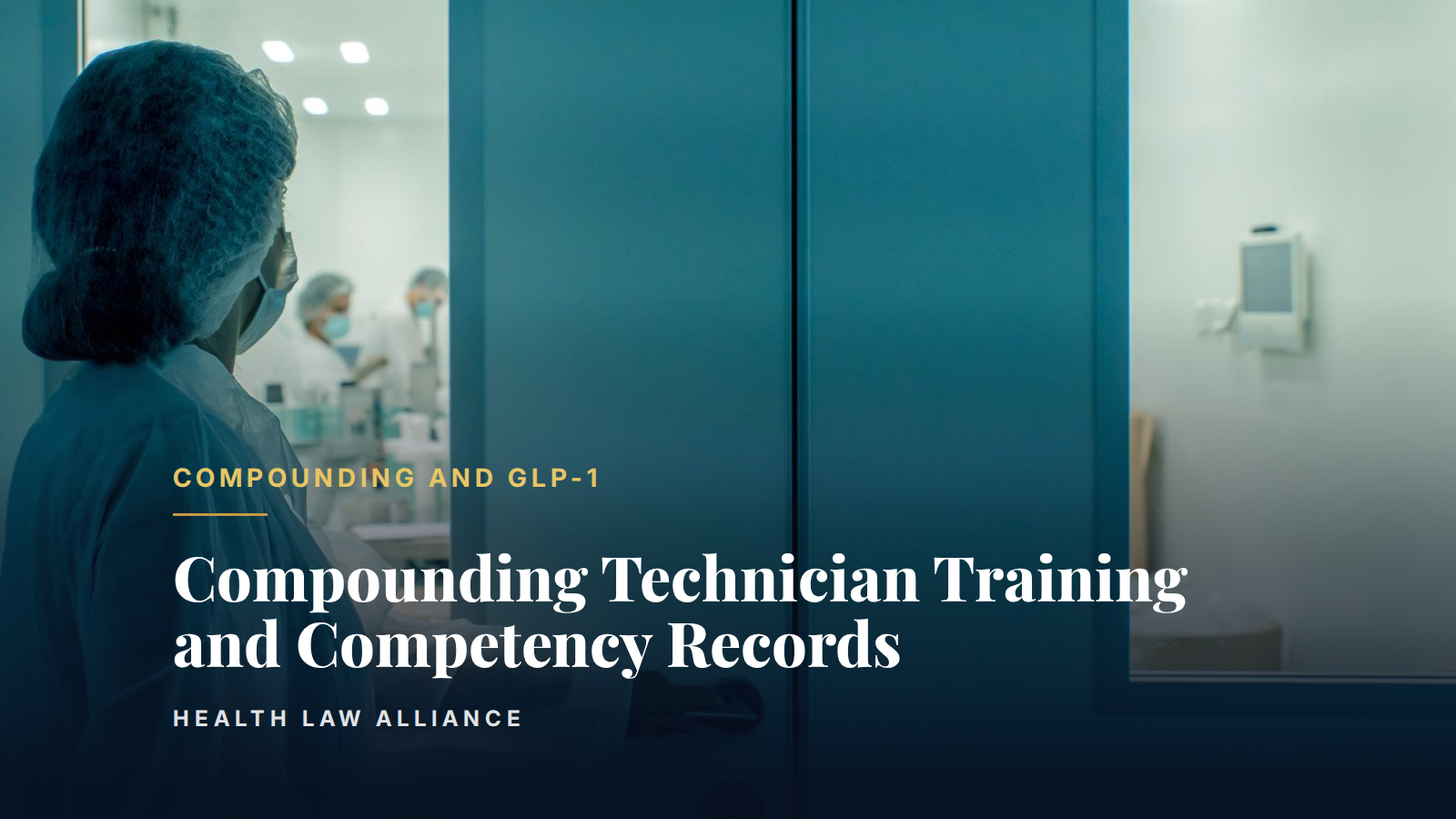
When a state board of pharmacy or an FDA investigator walks into a compounding pharmacy, the first document requested is rarely the formulation record. It is the competency evaluation file for every technician who touched the preparation. A pharmacy that cannot produce dated, signed competency records for each technician performing sterile or hazardous compounding faces a finding regardless of how the compounded product itself tested, and that finding can support a Form 483 observation, a warning letter, or a state board complaint.
Competency Evaluation Under USP 797 and USP 800
Sterile compounding personnel must demonstrate competency in hand hygiene, garbing, cleaning and disinfection, calculations, measuring and mixing, and aseptic technique before compounding independently, and again at least every 12 months after that, under USP 797/800. Garbing competency is verified through direct observation and gloved fingertip and thumb sampling; aseptic technique is verified through media-fill testing, a simulated compounding run using microbiological growth medium in place of the drug. A technician who has not passed both within the required interval is not qualified to compound sterile preparations. USP 800 imposes an equivalent requirement for personnel who receive, store, compound, or dispose of hazardous drugs: each employee's competency for hazardous-drug tasks must be demonstrated before independent handling and reassessed at least every 12 months.
Retraining Triggers
Three events restart the clock outside the routine 12-month cycle. A failed competency check, whether a garbing observation, a gloved fingertip and thumb sample, or a media-fill test, removes the technician from independent sterile compounding until retraining occurs and the test is repeated successfully. Under USP 800, a new hazardous drug or new equipment entering the pharmacy triggers task-specific retraining before an employee handles it. A significant change in process or standard operating procedure does the same, whether the change comes from a new USP revision, a corrective action plan, or the pharmacy's own SOP update. None of these triggers wait for the annual cycle. Each is documented the day it occurs, not retrofitted before the next inspection.
The Documentation Inspectors and Boards Request
Inspectors and state boards of pharmacy do not accept a class roster as a competency record. What they request is a personnel file showing, for each technician, what was tested, the date it was tested, the result, and, where a test failed, the corrective action taken and the date of the passing re-test. For sterile compounding, that means garbing checklists, gloved fingertip and thumb sampling results, and media-fill logs tied to a specific technician and a specific date. For 503B outsourcing facilities, 21 CFR 211.25 requires cGMP training documented per employee and conducted on a continuing basis by qualified individuals, and supervisory personnel must have documented education, training, and experience commensurate with their role. Both 503A/503B facilities carry this documentation burden, though the source of the requirement differs by facility type. A pharmacy that receives a Form 483 citing missing or incomplete training records should treat the response the way it treats any other observation, as addressed in FDA Form 483 Observations: The 15-Day Response.
A training record that lists a class name and a date is not a competency record. It has to show what was tested, and what the technician actually demonstrated.
Why Early Legal Counsel Is Critical
It is critical that compounding pharmacies promptly retain experienced healthcare defense counsel upon receiving a Form 483, a warning letter, or a state board inspection finding involving personnel training records. Early legal intervention can protect the pharmacy's rights, structure the corrective action plan before the response deadline closes, avoid submissions that concede more than the facts support, and preserve the defenses available on appeal. A training-record finding that goes unaddressed, or a response drafted without counsel, can escalate from a warning letter toward the consequences described in FDA Warning Letters to Compounders: The Response That Closes the File.
How Health Law Alliance Can Help
Health Law Alliance represents compounding pharmacies and 503B outsourcing facilities in FDA inspections, warning letter responses, and state board investigations involving personnel training and competency documentation, as part of the firm's compounding pharmacy defense practice. The firm reviews training files against USP 797/800 and cGMP requirements before an inspector does, and builds the corrective action record a Form 483 response needs. If your pharmacy has received an inspection finding involving technician training records, contact us for a free, confidential consultation.