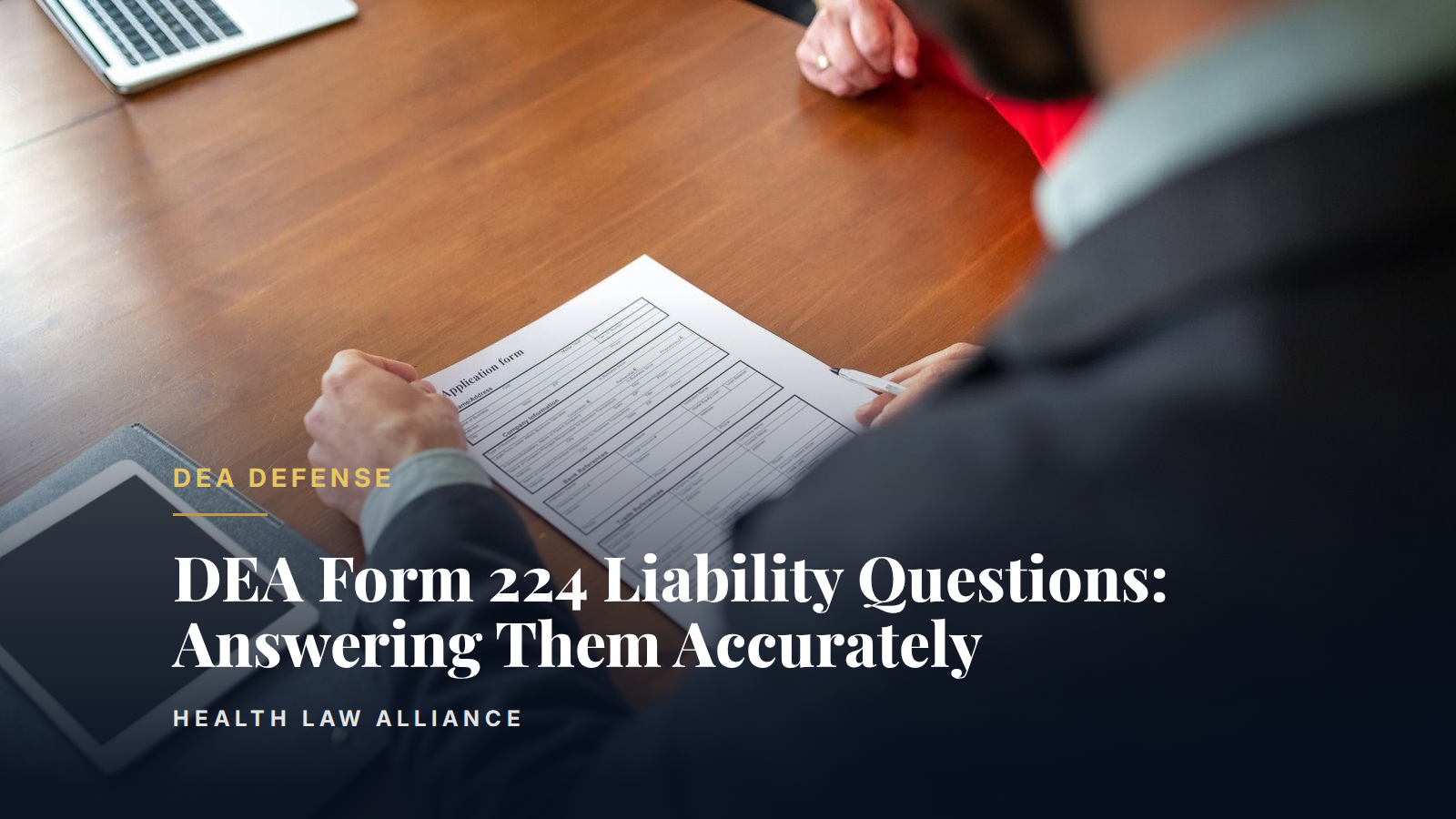
A pharmacy or physician applying for a new DEA registration answers a set of liability questions on DEA Form 224 before any inspection or audit ever reaches the location. Those questions ask whether the applicant has been convicted of a controlled substance offense, excluded from Medicare or a state health care program, or had a federal or state controlled substance registration or professional license surrendered for cause, revoked, suspended, restricted, or denied. A materially false or incomplete answer can become an independent ground to deny the application, separate from whatever the underlying history actually was.
Form 224, Form 224a, and Form 223 Are Three Different Documents
DEA uses three separate forms for the same registration, and applicants routinely confuse them. Form 224 is the application filed for a new DEA registration. Form 224a is the application filed to renew a registration that already exists. Form 223 is the Certificate of Registration DEA issues once an application is approved, the document a pharmacy or practice keeps on file and produces on inspection. The liability questions sit on the application and the renewal, not on the certificate, and DEA now requires both to be filed through its online registration system rather than on paper.
What the Liability Questions Reach
The liability section reaches well beyond criminal history. It covers program exclusion findings under Medicare or a state health care program, and it covers administrative history on both the federal and the state side: whether the applicant has ever surrendered a federal controlled substance registration for cause, or had one revoked, suspended, restricted, or denied, and separately whether a state professional license or state controlled substance registration has been surrendered for cause, revoked, suspended, denied, restricted, or placed on probation. Each question asks about pending matters as well as past ones, so a revocation, suspension or exclusion action that is still pending has to be disclosed even though nothing has been finally decided. A fourth question asks about the convictions, registrations and licenses of the officers, partners, stockholders and proprietors when the applicant is a pharmacy, a partnership or a privately held corporation.
Disclosing a Surrender for Cause or a Board Consent Order
A surrender for cause is defined, in the DEA rule on whom a practitioner may employ, as a surrender in place of, or as a consequence of, a federal or state administrative, civil or criminal action resulting from an investigation of the person's handling of controlled substances, and the federal and state liability questions both ask about it by name. A state board consent order counts as a state license action when it imposes one of the actions the question lists, such as a suspension, restriction or probation, even when the order is written as a settlement. The safer disclosure names the specific registration or license affected, the state or federal agency involved, the approximate date, and the current status instead of a general reference to a prior matter. DEA's published decisions show the agency checking an applicant's answers against state board actions the applicant left out, and a disclosure that already matches the record reads differently than one DEA has to extract through follow-up questions.
Correcting an Earlier Answer Before DEA Finds It
An applicant or registrant who answered a liability question incorrectly, whether from a misunderstanding of what the question covered or a surrender that happened after the form was filed, is generally in a stronger position correcting the record before DEA's own review surfaces the discrepancy than after. Under 21 U.S.C. 824(a)(1), a materially falsified application is its own ground for suspension or revocation, and DEA's decisions apply the same ground to deny an application, independent of the underlying conduct the question asked about. A written correction to DEA's registration unit, identifying the specific question, the accurate answer, and the reason for the earlier error, is a sensible first step.
When DEA does act on a liability-question problem, it typically proceeds through a DEA order to show cause, the standard pre-revocation proceeding that allows a hearing before any registration is lost. An immediate suspension order is a narrower step served with or after an order to show cause, reserved for registrations DEA considers an imminent danger to public health or safety, and it removes registration privileges before any hearing occurs.
A materially false answer on a DEA registration application is an independent ground for denial, separate from whatever the question itself was asking about.
Why Early Legal Counsel Is Critical
It is critical that providers promptly retain experienced healthcare defense counsel before submitting a DEA registration application that raises a liability question, or before correcting an answer already on file. Early legal intervention can help frame a disclosure accurately, avoid inadvertent admissions, preserve relevant defenses, and allow counsel to communicate with DEA's registration unit on the applicant's behalf. Delaying legal review can significantly affect the outcome and expose the applicant to unnecessary risk, including a falsification finding that the underlying history alone would not have caused.
How Health Law Alliance Can Help
Health Law Alliance represents pharmacists and physicians through DEA registration applications, renewals, and the liability disclosures that come with both, including surrenders for cause, state board consent orders, and corrections to an answer already on file with DEA. If a liability question on your DEA Form 224 or Form 224a raises a disclosure you are unsure how to frame, contact us for a free, confidential consultation.