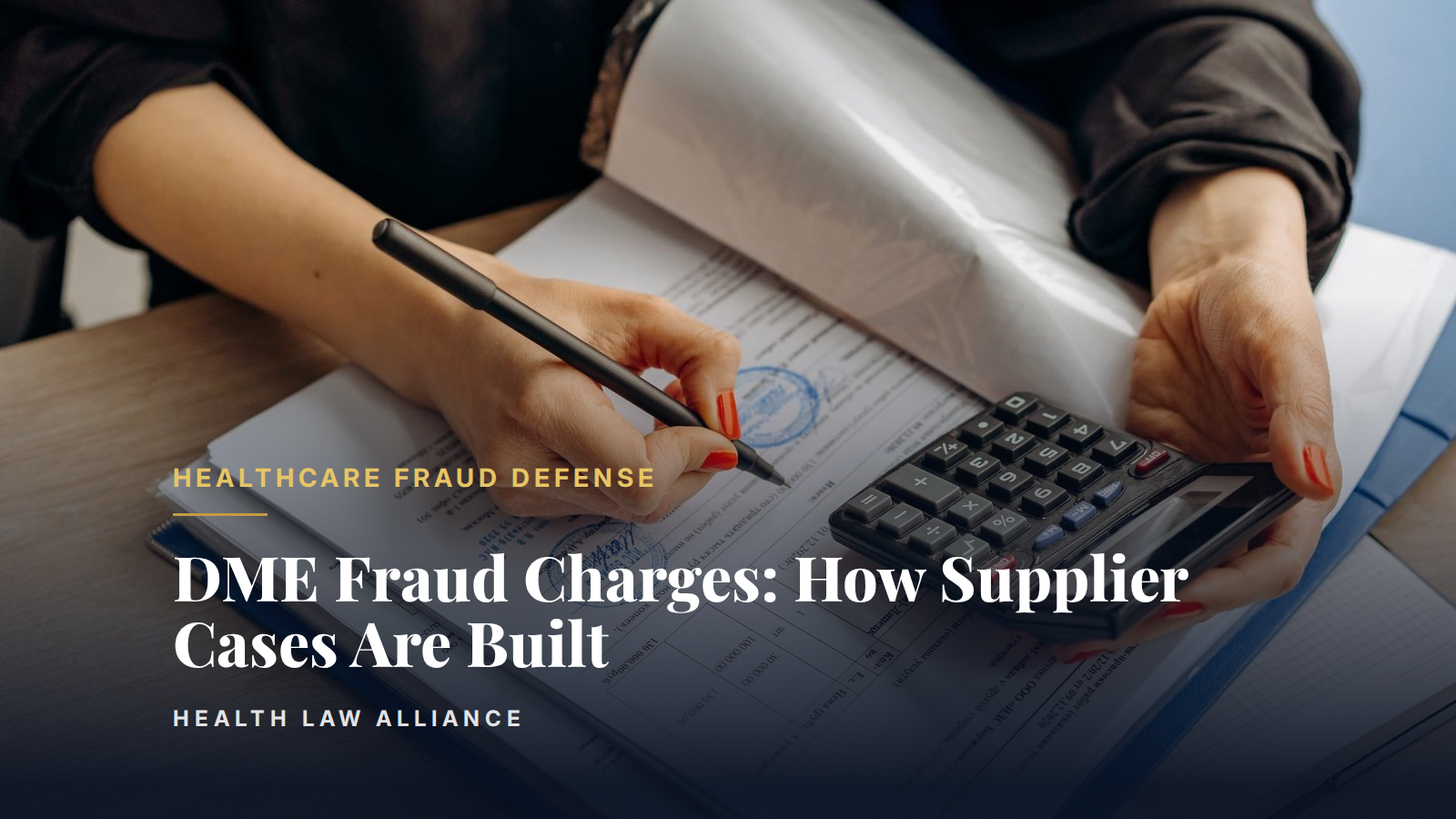
A durable medical equipment supplier facing a criminal referral rarely gets there from one bad claim. Federal prosecutors build DME fraud cases around a pattern: who actually owns and controls the enrolled supplier, what the enrollment paperwork said about that ownership, and whether the supplier kept billing after a patient said no. Call-center leads and orders signed without a hands-on exam have their own documentation history and their own defense posture; this guide covers the ownership, enrollment, and billing conduct that turns a Medicare contractor audit into a referral to HHS-OIG and the Department of Justice.
Nominee Ownership and Enrollment Misstatements
Every DME supplier enrolls in Medicare on CMS Form 855S, which requires disclosure of every person or entity with an ownership or managing-employee interest. HHS-OIG's reporting on DMEPOS fraud identifies the straw owner, a person listed as the enrolled owner who in fact takes direction from someone else, as a recurring method used to control supplier numbers while keeping the real owner's identity off the file. One HHS-OIG exclusion action involved a supplier whose application omitted a managing employee and failed to disclose a prior felony conviction. Misstating who owns or manages a supplier is a false statement on its own, apart from anything billed afterward.
Billing After Refusal or Return
Accurate ownership disclosure does not protect a supplier that keeps billing after a patient refuses delivery or returns an item. HHS-OIG describes this pattern directly: suppliers bill Medicare or Medicaid for equipment beneficiaries never receive. CMS's September 2026 action against a group of DMEPOS suppliers cited claims for equipment beneficiaries never requested and claims for deceased beneficiaries among the conduct it was stopping. A supplier whose delivery log, return log, and claims data do not match tells an auditor the same thing an investigator would conclude: it billed Medicare for equipment a named patient never accepted.
How Claims Data and Complaints Start a Case
Most DME fraud matters do not start with a whistleblower. They start with claims data. CMS and its program integrity contractors run a supplier's billing against regional and national utilization patterns, and Unified Program Integrity Contractors separately develop leads from beneficiary and provider complaints. A beneficiary who calls Medicare to report equipment never ordered creates a complaint record the contractor can match against that supplier's billing history. One complaint rarely moves a case alone; a cluster matched to a flagged billing pattern does.
A document request from a Medicare contractor is not the end of the exposure. It is the point where the file the contractor is building decides whether the matter stays administrative or becomes a referral.
The Audit-to-Referral Path
CMS's program integrity contractors handle the administrative side of a DME audit: requesting records, sampling claims, and recommending payment suspensions or the revocation of billing privileges, which CMS decides. Those are administrative tools CMS can use without any criminal referral. The contractor refers a matter to HHS-OIG, and through OIG to the Department of Justice, when the findings show intent administrative tools cannot address: enrollment misstatements, billing for refused or undelivered equipment, or claims that only make sense if the supplier knew the item was never provided. From there the matter can run as a civil False Claims Act case, a criminal referral, or both at once.
What To Preserve and Who May Decline an Interview
A supplier that receives a document request, a civil investigative demand, a grand jury subpoena, or a site visit should put a litigation hold in place the same day, covering paper and electronic records: every version of the supplier's CMS Form 855S filings, ownership and management records, delivery confirmations and return and refusal logs, physician orders, and all correspondence with the Medicare contractor.
Investigators may approach any employee, owner, or officer directly. Each individual may decline an interview until they have retained their own counsel; that choice belongs to the person, not the company. The business and its leadership must not direct, instruct, or pressure any employee to refuse an interview, which can itself look like obstruction of the investigation. What the business can do is tell employees they are entitled to their own lawyer before answering questions, and tell investigators that the company is represented by counsel, who is the contact for requests made to the company.
Why Early Legal Counsel Is Critical
It is critical that a DME supplier promptly retain experienced healthcare defense counsel on receiving a subpoena, audit notice, document request, or any other government inquiry. Early legal intervention can protect the business's and each individual's rights, shape how records are produced, help avoid inadvertent admissions, and let counsel communicate with the contractor or investigators on the supplier's behalf. Delaying representation narrows these options and can move an audit toward a criminal referral faster than the facts alone would require.
How Health Law Alliance Can Help
Health Law Alliance attorneys have overseen 2,000+ audits and handled 5,000+ matters over 25+ years, including DME suppliers facing a contractor audit or a referral to HHS-OIG and the Department of Justice. If your supplier has received an audit notice, a subpoena, or an investigator's call, contact Health Law Alliance's healthcare fraud defense attorneys for a free, confidential consultation.