
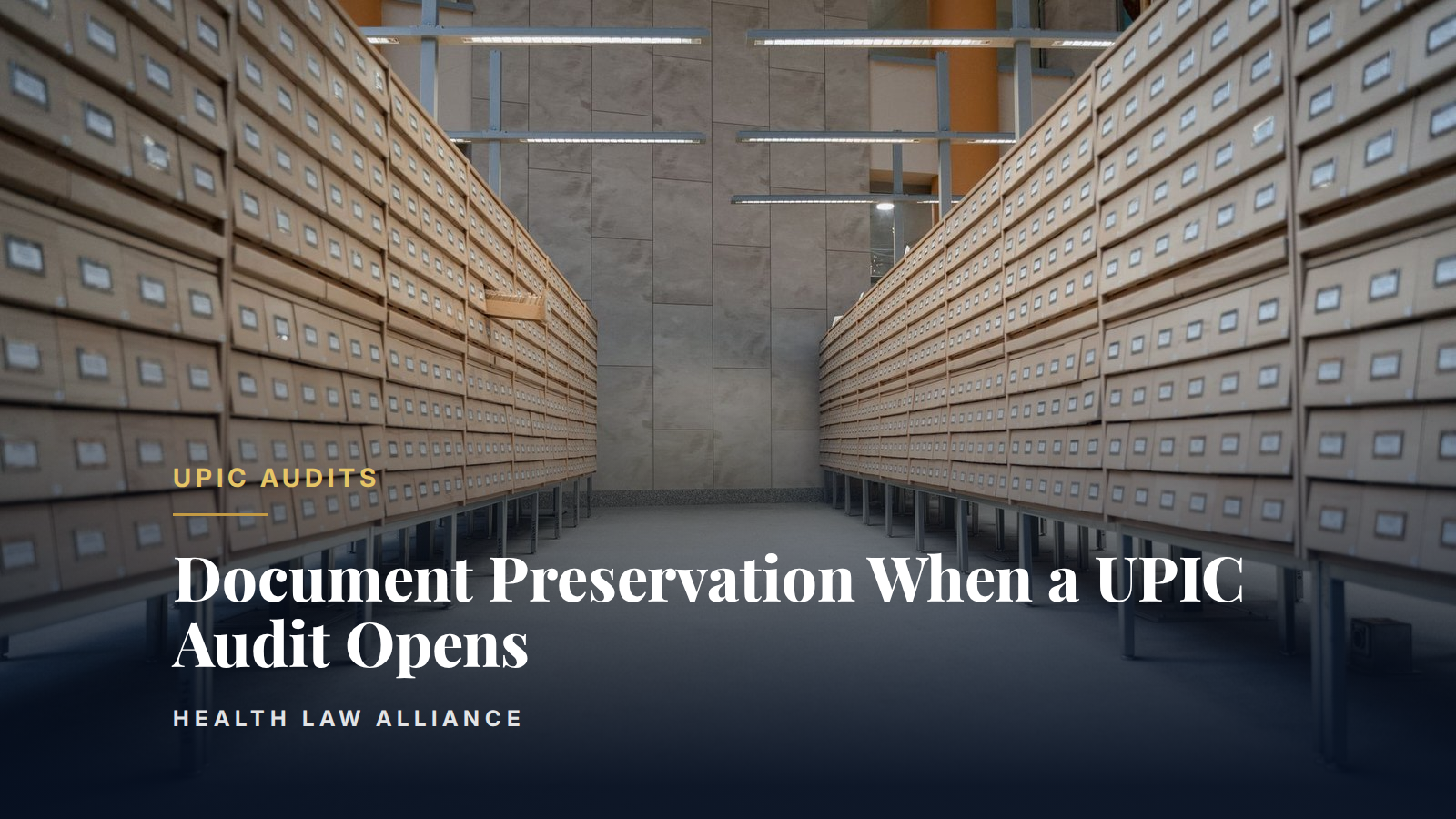
A UPIC audit notice is a document-preservation trigger, not merely a records request. The moment CoventBridge, Qlarant, SafeGuard Services, or Health Integrity opens a Unified Program Integrity Contractor (UPIC) audit, the provider's duty to preserve every record tied to the claims at issue begins, even if no lawsuit or indictment ever follows. A provider that leaves routine email deletion running past that point, or that lets a signature log get overwritten, risks more than a worse audit outcome. Federal Rule of Civil Procedure 37(e) and 18 U.S.C. § 1519 both punish the loss of that evidence on their own terms, apart from whatever the audit itself finds.
When the Duty to Preserve Begins
Courts have long held that the duty to preserve arises once a party reasonably anticipates litigation or a government proceeding, not when a complaint is filed or an indictment returns. A UPIC audit notice, an additional documentation request, or a target letter carries that same weight: notice of a specific, credible inquiry into identified claims, enough to start the hold on its own. Waiting to see whether the audit becomes a recoupment demand or a Department of Justice referral is waiting too long. The hold should cover the claims named in the notice and any records likely to be requested as the review expands.
What the Preservation Scope Must Cover
A UPIC preservation hold is broader than the claims folder. It should include the claim adjudication log, the prior authorization chain, delivery and proof-of-service documentation, and the signature log for every claim inside the audit's lookback period. It should also include internal correspondence, billing-vendor communications, and any compliance memo that discusses the claims at issue, material an auditor or a later prosecutor can request even though it never appears on an invoice. CoventBridge, Qlarant, and SafeGuard Services each define document requests slightly differently by jurisdiction, so the hold should track the specific contractor's request letter rather than a generic checklist.
EHR Audit Trails and Spoliation Risk
The EHR audit trail is often the most consequential preservation item and the easiest to lose. It is a running log of who accessed, modified, or deleted a record and when, generated automatically by the EHR system. That log can show whether clinical notes were entered at the time of care or added and backdated later, exactly what a UPIC auditor or OIG investigator looks for when documentation seems too clean. The trail needs to be pulled and preserved in its native format, since many EHR systems retain only a rolling window of log data before it ages out.
A UPIC audit notice starts the preservation clock before any lawsuit is filed or any charge is brought. Routine auto-deletion that continues past that point is spoliation, not an oversight.
The Cost of Getting Preservation Wrong
Under Federal Rule of Civil Procedure 37(e), a court that finds a party failed to take reasonable steps to preserve electronically stored information can order curative measures once the loss causes prejudice, and can go further, including an adverse-inference instruction or dismissal, only on a finding of intent to deprive the other side. Willfully destroying or altering records during a pending federal audit is separately chargeable under 18 U.S.C. § 1519, punishable by up to 20 years in prison. Medicare's Conditions of Participation set a 5-year floor for hospital records under 42 CFR § 482.24(b)(1), but a hold is not capped by that floor and runs as long as the matter stays open. A UPIC review compounds the risk: 42 CFR § 405.929 allows only 30 days to produce documentation, far short of the 45 days most other Medicare contractors give.
Why Early Legal Counsel Is Critical
It is critical that providers promptly retain experienced healthcare defense counsel upon receiving a UPIC audit notice, additional documentation request, or other government inquiry. Early legal intervention can protect the provider's preservation obligations, ensure the hold covers the EHR audit trail and every record category the auditor is likely to request, avoid inadvertent admissions in a rushed response, and let counsel communicate with the UPIC's audit team on the provider's behalf. Delaying representation until after the 30-day response window has passed can significantly affect the outcome and expose the provider to spoliation claims a timely hold would have avoided.
How Health Law Alliance Can Help
Health Law Alliance defends providers against UPIC audits nationwide, from the first document request through the preservation hold, the response, and any recoupment appeal that follows. Our bench includes a former federal prosecutor and attorneys who have handled the CoventBridge, Qlarant, and SafeGuard Services jurisdictions directly, shaping how a preservation hold and an audit response are built to withstand the scrutiny that follows. If your practice has received a UPIC audit notice, contact us today for a free consultation.