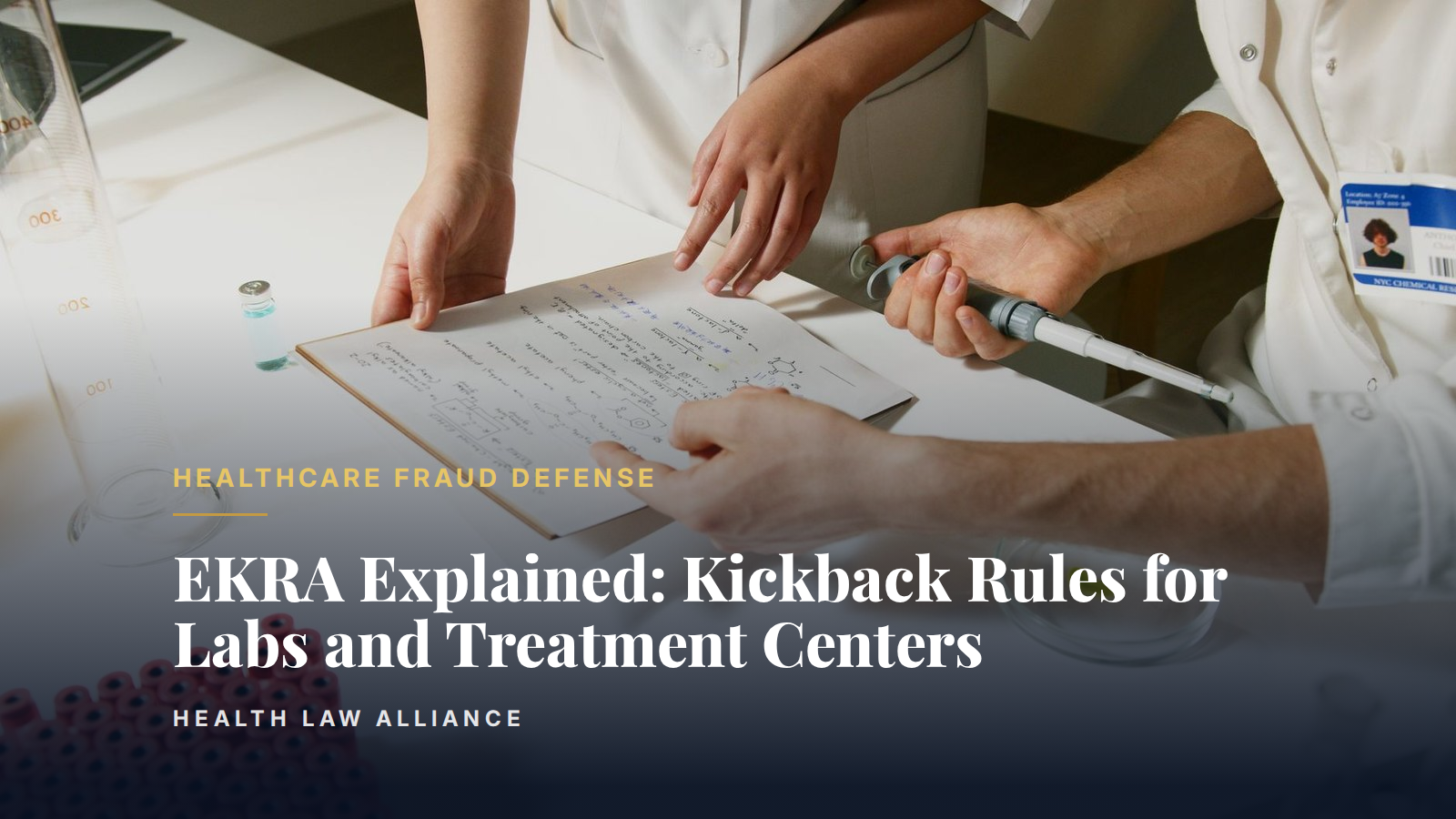
The Eliminating Kickbacks in Recovery Act, or EKRA, is a federal criminal statute governing referral payments to laboratories, recovery homes, and clinical treatment facilities. Congress passed it in 2018 to curb patient brokering. A violation carries a fine of up to $200,000 and up to 10 years in prison per occurrence, under 18 U.S.C. Section 220. An existing Anti-Kickback Statute compliance program leaves EKRA exposure unaddressed: EKRA reaches commercial insurance and self-pay business the Anti-Kickback Statute never touches, and its exceptions are not the Anti-Kickback Statute's familiar safe harbors.
Three Provider Types EKRA Reaches
EKRA covers three categories the statute defines directly: laboratories, recovery homes, and clinical treatment facilities. A recovery home is a shared living environment that is, or holds itself out as, free of alcohol and illicit drug use and centered on peer support for sustained recovery from substance use disorder. A clinical treatment facility is a non-hospital setting providing detoxification, risk reduction, outpatient care, residential treatment, or rehabilitation for substance use under state licensure. Laboratory carries the definition used elsewhere in federal law, reaching toxicology and reference labs well outside the addiction-treatment space. A pain-management practice that owns an in-office lab can fall inside EKRA's reach without treating substance use disorder at all. Physicians who refer specimens also face Stark Law's separate self-referral rules.
The Commercial-Insurance Feature That Surprises Owners
The feature that catches owners off guard is scope. The Anti-Kickback Statute applies only to referrals paid for by a federal health care program such as Medicare or Medicaid. EKRA applies to any health care benefit program, public or private, including commercial insurance plans and self-pay patients. A toxicology lab billing a commercial payer sits inside EKRA's reach even though none of those claims touch Medicare. A compliance review that stops at the Anti-Kickback Statute and never checks EKRA separately leaves that exposure unaddressed.
How EKRA's Exceptions Differ From the Anti-Kickback Statute's Safe Harbors
EKRA relies on statutory exceptions rather than safe harbors, and the two frameworks protect different conduct. The Anti-Kickback Statute's own bona fide employee exception expressly lets an employer pay a true employee on a commission basis tied to the federal program business they generate, with no restriction in that statutory exception on how the amount is calculated. EKRA's bona fide employee exception is narrower: it protects compensation only if it does not vary with the number of individuals referred, the number of tests performed, or the amount billed. A commission structure that is safe under the Anti-Kickback Statute's employee exception can fall outside EKRA's employee exception entirely. A separate EKRA exception for personal services arrangements tracks the Anti-Kickback Statute's own personal services safe harbor, which also bars compensation tied to the volume or value of referrals, so a contractor marketer gets no more latitude there than an employee gets under EKRA's employee exception. EKRA's other exceptions are far fewer in number than the Anti-Kickback Statute's regulatory safe harbors.
What the Courts Have Said About Commission-Based Sales Pay
Whether commission-based pay to a lab's or treatment center's own marketing staff violates EKRA was unsettled until 2025, when the Ninth Circuit Court of Appeals became the first federal appeals court to rule on the question. The court held that a percentage-based compensation structure for marketing agents, without more, does not violate EKRA, but that paying a marketing agent a commission to unduly influence a referring physician through false or misleading representations about the covered services does violate the statute. No other federal appeals court has yet addressed the question, so a lab or treatment center outside the Ninth Circuit cannot assume the same reasoning will apply.
What to Review in Marketer and Sales Contracts
Every lab, recovery home, and clinical treatment facility with a marketing or sales function should have counsel review three things against EKRA specifically, not only against the Anti-Kickback Statute. First, the compensation formula: does it vary with referral volume, test count, or the amount billed? Second, the worker's classification: EKRA's bona fide employee exception, by its own text, can cover a W-2 employee or a 1099 contractor who has a genuine employment or contractual relationship with the business, so job classification alone does not decide which exception applies. Third, the marketing conduct itself, since deceptive representations to referring physicians can turn a defensible structure into unlawful undue influence. Review any Anti-Kickback Statute-compliant contract again under EKRA's narrower text before it is signed.
EKRA reaches commercial insurance and self-pay business the Anti-Kickback Statute never touches, and a commission structure that is lawful under the Anti-Kickback Statute can still fall outside EKRA's narrower bona fide employee exception.
Why Early Legal Counsel Is Critical
It is critical that laboratories, recovery homes, and clinical treatment facilities promptly retain experienced healthcare defense counsel before entering or renewing a marketing or sales-compensation arrangement, and immediately upon receiving a grand jury subpoena, a civil investigative demand, or a target letter touching referral relationships. Early intervention can protect the provider's rights, shape compensation structures to fit EKRA's narrower exceptions, avoid inadvertent admissions, and let counsel communicate with investigators on the provider's behalf.
How Health Law Alliance Can Help
Health Law Alliance has represented 2,500+ clients nationwide. If your lab, recovery home, or clinical treatment facility needs marketer or sales-compensation agreements reviewed against EKRA, or has received a government inquiry touching referral arrangements, contact Health Law Alliance's healthcare fraud defense attorneys for a free, confidential consultation.