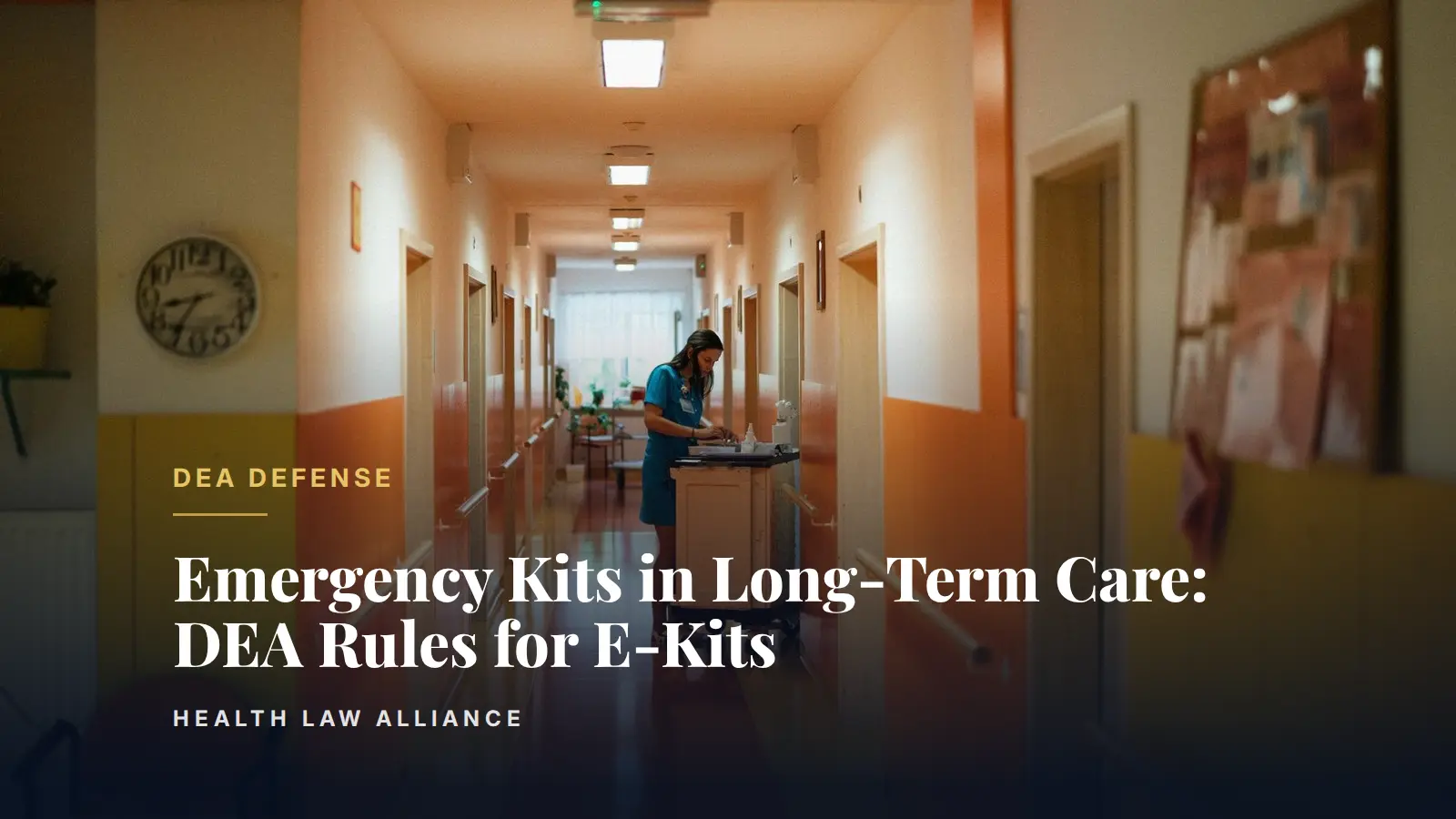
A long-term care pharmacy that places a controlled-substance emergency kit, or e-kit, inside a nursing facility is extending its own Drug Enforcement Administration registration into a locked box the pharmacy does not staff around the clock. DEA does not require the facility or the kit to carry a registration of its own, but every dose that moves into or out of that kit is still governed by the pharmacy's existing registration, inventory records, and loss-reporting duties. When a kit's contents, access, or restocking fall outside those rules, the exposure lands on the supplying pharmacy, not the nursing home.
How DEA Treats the Emergency Kit Itself
DEA has permitted pharmacies to place emergency kits inside long-term care facilities since 1980, when the agency's policy on the practice first appeared at 45 FR 24128 (April 9, 1980). DEA treats the kit as an extension of the supplying pharmacy, controlled under that pharmacy's own DEA registration rather than any registration held by the facility. A long-term care facility is not itself DEA-registered, so the kit's legal footing depends on the pharmacy that stocked it. The valid-prescription requirement still applies to the kit: a prescription still has to reach the pharmacy before a dose pulled from the kit counts as properly dispensed.
Emergency Kits Versus Automated Dispensing Systems
Long-term care facilities also use a second device, the automated dispensing system, and the two are regulated differently. Under 21 CFR 1301.27, adopted at 70 FR 25465 (May 13, 2005), a retail pharmacy that installs and operates an automated dispensing system at a long-term care facility must hold a separate DEA registration for that facility. An emergency kit carries no such separate-registration requirement. A pharmacist-in-charge who assumes the two answer to the same rule can misstate the facility's registration posture before an investigator asks a single question.
What Federal Rules Leave to the State Board
Federal law establishes that an e-kit can exist as an extension of the pharmacy's registration. It does not set the kit's contents, lock type, or the staff roles permitted to open it. DEA's own 2010 notice asked the public what rules already govern a kit's contents and who may open it, leaving each state to set and explain its own answer. Each state must still keep the kit's inventory accurate and close off new diversion opportunities, since the kit sits inside a facility DEA does not itself register.
A nursing facility's emergency kit carries no DEA registration of its own, so every dose inside it is dispensed under the supplying pharmacy's registration, inventory records, and recordkeeping duties.
What DEA Checks When a Kit Is Involved
Because the kit is part of the pharmacy's registration, an inspector reviewing the pharmacy's long-term care business reaches the kit directly: the records of what was placed into the kit, what was removed and under what prescription, who had access, and whether the kit's physical count matches those records. If controlled substances go missing from a kit, 21 CFR 1301.76(b) puts the reporting duty on the supplying pharmacy, not the facility: written notice to the DEA field division within one business day of discovery, followed by a DEA Form 106 within 45 days.
A pharmacy that cannot complete an inventory reconciliation between a kit's physical count and its dispensing records is exposed in the same inspection as a pharmacy that cannot reconcile its own shelf stock, and a kit discrepancy raises the same red flags in controlled substance dispensing that DEA looks for everywhere else in the pharmacy. An unresolved discrepancy tied to a kit can become the basis for a DEA order to show cause against the supplying pharmacy's registration, and, in matters DEA treats as an imminent danger, an immediate suspension order.
Why Early Legal Counsel Is Critical
It is critical that long-term care pharmacies and pharmacists-in-charge promptly retain experienced healthcare defense counsel upon receiving a DEA document request, an inspection finding tied to an emergency kit, or any other government inquiry. Early legal intervention can protect the pharmacy's rights, help shape appropriate responses to government requests, avoid inadvertent admissions, preserve relevant defenses, and allow counsel to communicate with investigators on the pharmacy's behalf. Delaying legal representation can significantly affect the outcome of a matter and expose the pharmacy to unnecessary risk.
How Health Law Alliance Can Help
Health Law Alliance's attorneys have overseen 2,000+ audits and handled 5,000+ matters, with 25+ years of experience. The firm defends long-term care pharmacies through DEA inspections and registration actions tied to emergency kits and controlled-substance recordkeeping. If your pharmacy supplies an emergency kit to a nursing facility and needs its registration posture reviewed, contact us for a free, confidential consultation through our long-term care pharmacy audit defense page.