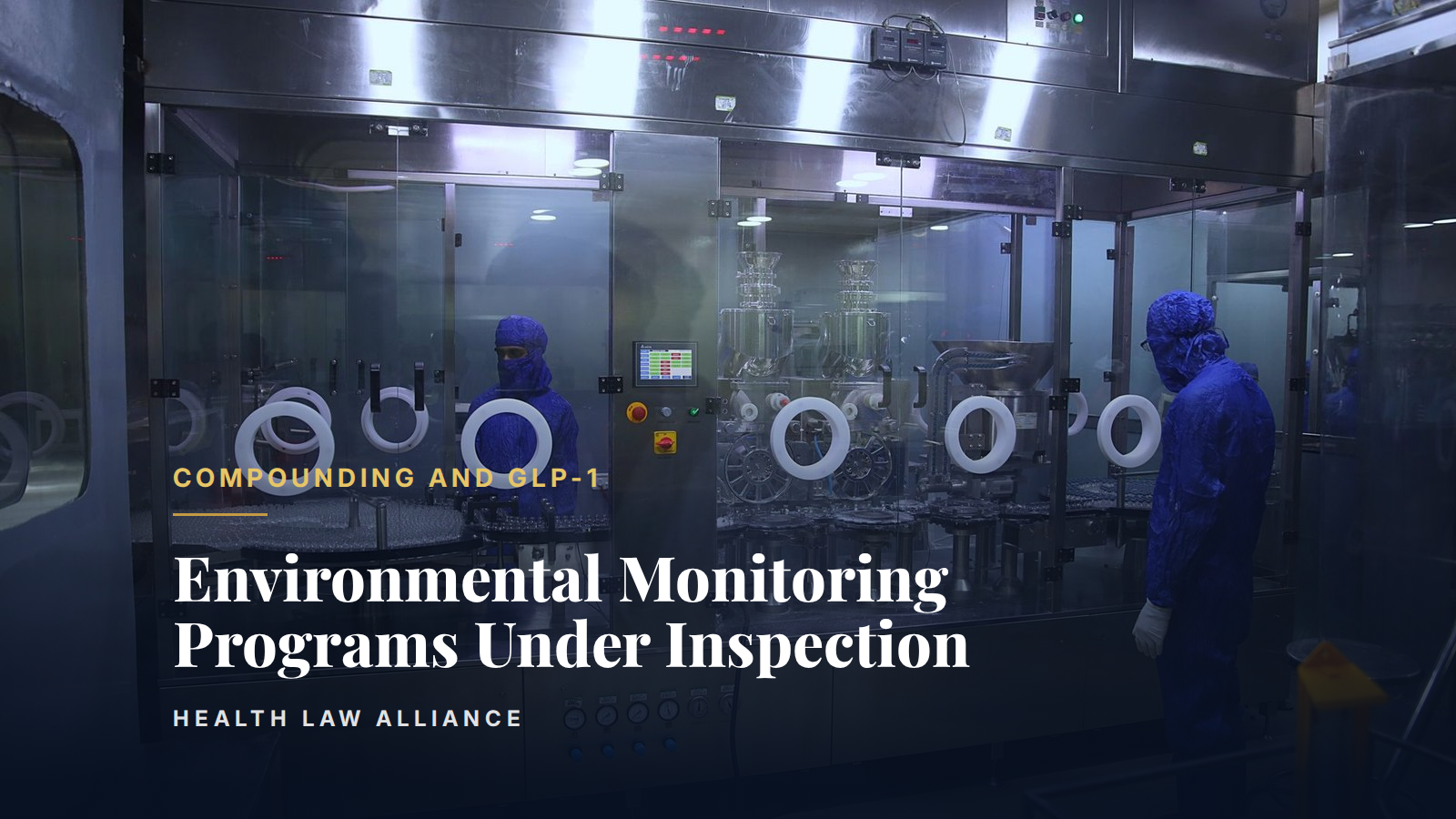
Every pharmacy that compounds sterile preparations must operate a documented environmental monitoring program under USP <797>, and a facility whose sampling log does not match its own standard operating procedure faces immediate exposure on inspection. The program requires scheduled viable air sampling, surface sampling, and periodic nonviable particle counts in every ISO-classified compounding area, measured against action levels the facility must define and defend before the first sample is ever pulled. An inspector who finds a gap between the SOP and the sampling record does not treat it as a clerical lapse. The gap becomes the finding.
The Environmental Monitoring Program Requirement
USP <797>, the compounding standard most state boards of pharmacy have folded into their practice acts, requires a documented environmental monitoring program for every facility compounding Category 1, 2, or 3 sterile preparations. The program covers three classified spaces: the ISO 5 primary engineering control where compounding actually happens, the ISO 7 buffer room, and the ISO 8 anteroom, and it applies the same way to a 503A pharmacy compounding patient-specific prescriptions and a 503B outsourcing facility compounding in anticipation of orders. The facility's own standard operating procedure has to name the sampling locations, the method, the frequency, and the action level that triggers a response, and the beyond-use date assigned to every preparation compounded in that environment rests on the assumption that the monitoring data supports it, an assumption FDA tests against cGMP at 503B outsourcing facilities and state boards test against the practice act at 503A pharmacies.
Sampling Frequency and Action Levels
Category 1 and 2 CSPs require viable air and surface sampling at least monthly in every classified area. Category 3 CSPs, the highest-risk preparations, require weekly sampling. Nonviable particle counts run under dynamic conditions at least every six months, and again whenever a primary engineering control is recertified after a repair or a filter change. The action level differs by ISO classification and by sample type. For viable air sampling, the action level is more than 1 CFU at ISO 5, more than 10 CFU at ISO 7, and more than 100 CFU at ISO 8. For surface sampling, the action level is more than 3 CFU at ISO 5, more than 5 CFU at ISO 7, and more than 50 CFU at ISO 8. The requirement applies the same way to oncology preparations and to semaglutide injectables compounded under the post-shortage landscape. A single result above the applicable number is not a target missed. It is the action level, and it obligates the facility to respond.
Responding to an Excursion
USP <797>'s 2023 revision sharpened what has to happen once a sample crosses the action level. The facility must investigate the excursion, and any organism recovered above the action level must be identified to at least the genus level, not logged as a positive result and left there. The investigation has to trace a probable source: a garbing breach, a disinfection gap, or a failure in the primary engineering control itself, and the facility must determine whether preparations compounded in the affected space during the excursion window may have been compromised. Those preparations can require quarantine pending that determination. Before compounding resumes in the affected space, repeat sampling has to confirm the corrective action worked. Each step, the investigation, the genus-level identification, the quarantine assessment, and the confirmatory resample, has to be documented, because the documentation is what an inspector reads first.
An excursion above the action level is not resolved by a clean sample the following week. It is resolved by a documented investigation, a genus-level identification, and confirmatory resampling before compounding resumes in the affected space.
Why Early Legal Counsel Is Critical
It is critical that compounding pharmacies promptly retain experienced healthcare defense counsel upon receiving a Form 483 observation, a state board of pharmacy deficiency citation, or any other inspection finding tied to an environmental monitoring excursion. Early legal intervention can protect the pharmacy's rights, ensure appropriate responses to government requests, avoid inadvertent admissions, preserve relevant defenses, and allow counsel to communicate with investigators on the pharmacy's behalf. Delaying legal representation can significantly affect the outcome of a matter and expose the pharmacy to unnecessary risk.
How Health Law Alliance Can Help
Health Law Alliance represents compounding pharmacies in inspection findings, deficiency citations, and enforcement matters tied to environmental monitoring programs, as part of the firm's compounding pharmacy defense practice. The firm reviews the sampling record against the facility's own SOP before an inspector does, and builds the investigation and corrective action file an excursion requires. If your pharmacy has received an inspection finding tied to environmental monitoring, contact us for a free, confidential consultation.