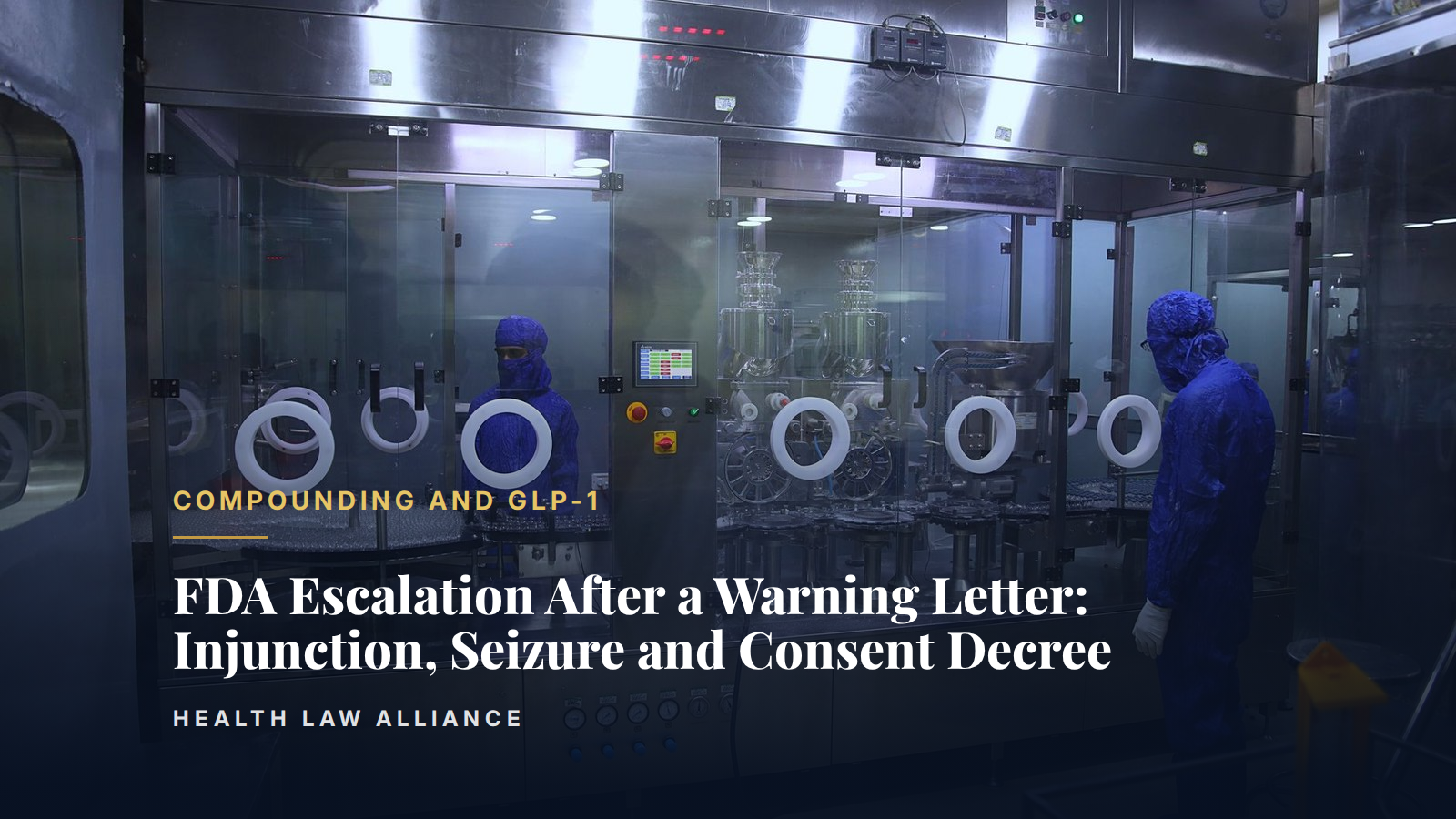
A compounding pharmacy's FDA warning letter response either closes the matter or it does not. When compliance staff decide a corrective action plan is not credible, or a reinspection does not confirm the fix, the matter leaves the warning-letter track. FDA Warning Letters to Compounders: The Response That Closes the File and Writing an FDA Warning Letter Response That Works cover that response; this article starts where they end: request a voluntary recall, seize product already in commerce, seek a federal civil injunction, and, in most cases that reach a courtroom, negotiate the consent decree that lets the facility keep operating under court-ordered conditions. A criminal referral remains possible at any stage.
A Request for Voluntary Recall
FDA has no general authority to order a drug recall. Outside a few categories such as infant formula and tobacco, it asks the firm to recall voluntarily, under the procedures at 21 CFR Part 7, Subpart C. The request typically follows a warning letter where the underlying finding, a contamination result, a potency failure, or a beyond-use date the records do not support, means the same risk is already on a pharmacy shelf. FDA classifies the recall by health risk. Declining a recall FDA considers warranted moves the agency toward its next option.
Seizure of Product Already in Commerce
Where a recall request is refused, or the risk is too immediate to wait, FDA can ask the Department of Justice to seize the product. Seizure under 21 U.S.C. § 334 is a civil action against the drug, not the pharmacy; U.S. Marshals take custody of the identified lots while the misbranding or adulteration claim is litigated. A seizure reaches only the named product, not ongoing operations, which is why FDA pairs it with an injunction when the underlying conditions persist.
The Civil Injunction Action
An injunction addresses the facility, not a single lot. Under 21 U.S.C. § 332, the Department of Justice can ask a federal court to restrain ongoing or repeated violations of the FDCA, typically insanitary conditions, cGMP departures, or compounding outside the bounds of the facility's 503A or 503B status. The complaint names the pharmacy and often its owners and pharmacist-in-charge. FDA's injunction authority reaches both, though its routine inspection reach differs. Contested injunction trials are rare; most cases resolve before verdict through a negotiated consent decree.
The Consent Decree: Restrictions, Audits and a Path Back
A consent decree of permanent injunction is the settlement of the injunction action, entered as a court order rather than litigated to a verdict. Its terms follow a consistent pattern: the facility stops the operations at issue until it demonstrates cGMP compliance, including its USP 797/800 controls where those apply; a third-party auditor with no ongoing relationship to the facility certifies the fix; FDA, not the facility, authorizes the return to production; and reinspections continue for the life of the decree, sometimes for years. Violating its terms adds contempt exposure on top of the underlying violation.
Criminal Referral Remains a Separate Possibility
None of the civil steps above rule out a criminal referral. The FDCA's misdemeanor provision does not require proof an owner or pharmacist-in-charge knew about a violation; a person in a position to prevent or correct it can be charged on that responsibility alone. Felony exposure attaches where the government can show intent to defraud or mislead, or a violation following an earlier conviction. Whether a matter draws a referral depends on facts specific to it, not the civil track alone.
A consent decree does not end when it is signed. It becomes the operating manual a compounding pharmacy has to follow for years, with FDA, not the pharmacy, deciding when the facility has earned its way back to full production.
Why Early Legal Counsel Is Critical
It is critical that a compounding pharmacy promptly retain experienced healthcare defense counsel once a warning letter response is rejected or a reinspection goes badly, before FDA chooses between a recall request, a seizure and an injunction referral. Early legal involvement can shape the record FDA and the Department of Justice will rely on, position the facility to negotiate consent decree terms rather than contest an injunction outright, and flag where an officer's own exposure needs separate counsel. Waiting until a complaint is filed narrows the options available earlier.
How Health Law Alliance Can Help
Health Law Alliance advises 503A pharmacies and 503B outsourcing facilities across FDA's enforcement ladder, from the warning letter response through recall requests, seizure, injunction litigation and consent decree negotiation. Our compounding pharmacy defense attorneys work to keep a facility's options open before FDA refers a matter to the Department of Justice. Health Law Alliance has represented 2,500+ clients over 25+ years. If your facility received a warning letter that was not closed out, contact us for a free, confidential consultation.