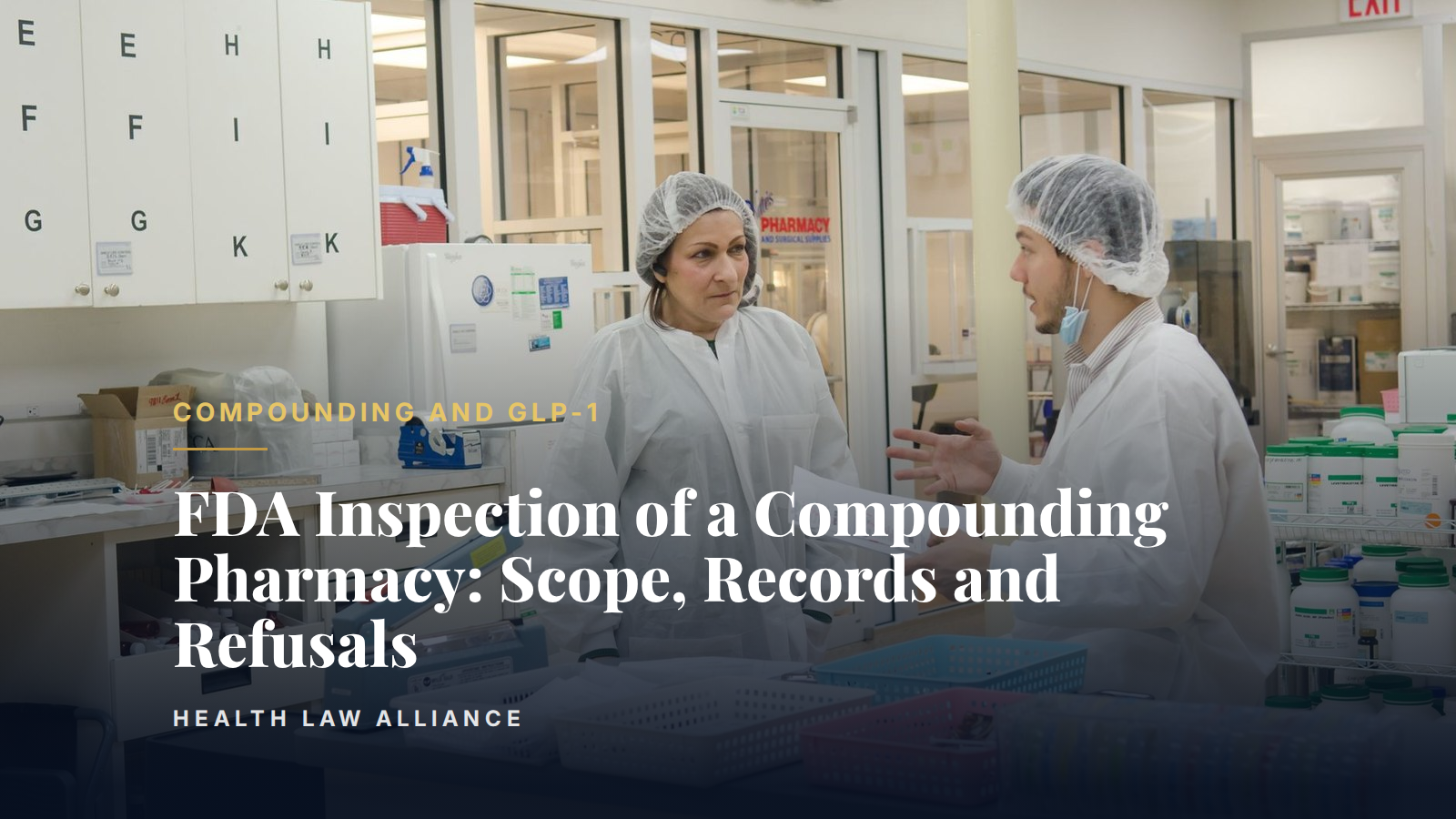
An FDA inspector who arrives at a compounding pharmacy hands over Form FDA 482, the Notice of Inspection, and the visit runs on a different notice, authority, and records regime than a state board of pharmacy inspection. FDA's power comes from federal statute, not the state pharmacy practice act, and how far it reaches depends on whether the pharmacy compounds under Section 503A for patient-specific prescriptions or is registered as a Section 503B outsourcing facility. The distinction decides what records an inspector can demand and what happens when the pharmacy limits what the inspector sees.
The Form 482 Notice Of Inspection
FDA investigators present Form FDA 482 at the start of an inspection conducted under the entry and inspection authority in 21 U.S.C. section 374. The visit can be announced or unannounced, and FDA proceeds on the Form 482 and the pharmacy's consent or, if consent is withheld, on an administrative warrant. That is a different notice and authority chain than a state board inspection, which runs on the state pharmacy practice act and a board inspector's state-law entry authority, not on federal process.
Scope At A 503A Pharmacy Versus An Outsourcing Facility
Section 374(a)(2)(A) exempts a pharmacy operating under state pharmacy law and filling patient-specific prescriptions from the full manufacturer-style inspection FDA runs at a drug facility. On its face, that exemption limits a 503A inspection to the premises, equipment, and the finished and unfinished materials, containers, and labeling on site, not the pharmacy's complete business records. FDA has asserted broader records access at 503A pharmacies than the exemption's text describes, arguing the records are needed to determine whether the exemption applies at all, an assertion challenged in litigation rather than settled. A 503B outsourcing facility gets none of the exemption: it is inspected as a drug manufacturer, records included, with cGMP compliance as the standard.
Sampling, Photography And Employee Interviews
An investigator who removes a preparation for testing issues Form FDA 484, a receipt for samples. Photography is different: the statute gives FDA no explicit right to photograph, but its manual tells investigators not to ask permission first, and its 2024 guidance treats restricting photography as restricting the inspection. Employee interviews are voluntary, FDA cannot compel a pharmacist or technician to sit for one, though blocking staff from speaking with FDA carries its own exposure under that same guidance.
Limiting Or Refusing Access
Under the Food, Drug, and Cosmetic Act, a drug is deemed adulterated when the pharmacy delays, denies, or limits an inspection, or refuses entry. FDA's June 2024 guidance, "Circumstances That Constitute Delaying, Denying, Limiting, or Refusing a Drug or Device Inspection," lists restricting access to areas or employees, restricting photography, and interfering with a records review among the conduct it treats as limiting. An adulteration finding on that basis can support an injunction, a seizure, or a criminal referral, exposure with no direct counterpart in a state board inspection, where resisting entry is governed by the state practice act instead.
FDA's claim to a 503A pharmacy's full business records rests on an assertion the agency has made in litigation, not on the plain text of the exemption it is inspecting under.
The Close-Out Meeting And The Form 483
FDA's inspection ends with a close-out meeting, where the investigator reads through each observation with pharmacy management and gives management a chance to provide context before the visit concludes. Observations that in the investigator's judgment may indicate a violation go on Form FDA 483, issued to management at the close of the inspection. A Form 483 is a field observation, not a final agency determination, and FDA recommends a written response within 15 business days for it to factor into what happens next.
Why Early Legal Counsel Is Critical
It is critical that a compounding pharmacy retain experienced healthcare defense counsel before an FDA inspector presents a Form 482, not after the close-out meeting. Early legal involvement can confirm whether the pharmacy qualifies for the 503A records exemption, shape what gets produced when FDA's request goes beyond equipment and labeling, and make sure any decision to limit part of the inspection is a documented legal position rather than an undocumented refusal FDA can cite as adulteration.
How Health Law Alliance Can Help
Health Law Alliance represents 503A compounding pharmacies and 503B outsourcing facilities through FDA inspections, from the Form 482 notice through any Form 483 that follows. Our compounding pharmacy defense attorneys draw on the firm's coverage of 503A vs 503B compounding frameworks, adverse event reporting for compounded preparations, and allergenic extract compounding rules to defend a pharmacy's records-access position. Health Law Alliance has represented 2,500+ clients over 25+ years, including compounding pharmacies navigating FDA's inspection authority. If your pharmacy has received a Form 482 or a Form 483, contact us for a free, confidential consultation.