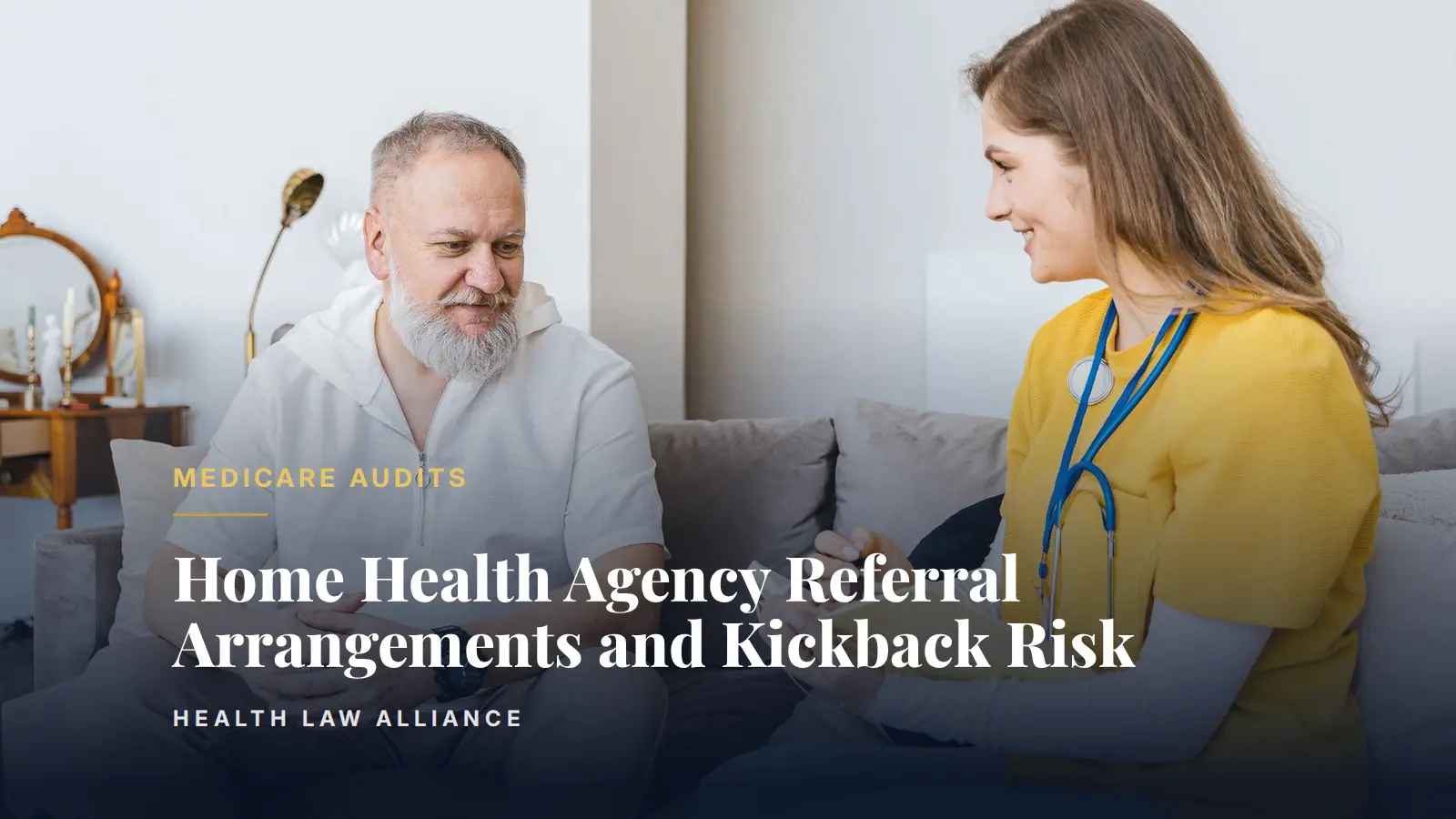
Home health agencies routinely pay marketers, liaisons, physicians, and referral sources to build a patient census, and a growing share of those arrangements cross into Anti-Kickback Statute territory. The HHS Office of Inspector General flagged payments to physicians, discharge planners, and marketing vendors as a recurring fraud pattern in its 1995 Special Fraud Alert. An agency that gets the structure wrong faces felony exposure under 42 U.S.C. 1320a-7b(b), program exclusion, and civil liability for every claim tied to the referral.
The Anti-Kickback Statute's Reach
The federal Anti-Kickback Statute, codified at 42 U.S.C. 1320a-7b(b), makes it a felony to knowingly and willfully offer, pay, solicit, or receive remuneration, in cash or in kind, to induce referrals reimbursable under Medicare or Medicaid. A conviction carries a fine of up to $100,000 and up to 10 years in prison per violation, separate from any civil False Claims Act exposure the same conduct can create. Under the one-purpose standard the Third Circuit announced in United States v. Greber and other circuits have since adopted, a payment violates the statute if inducing referrals is even one purpose behind it, regardless of any legitimate business reason it also serves.
Referral Payments That Draw OIG Scrutiny
The OIG's 1995 Special Fraud Alert on home health fraud catalogued kickback patterns investigators still pursue: a fee paid to a physician for each plan of care certified on an agency's behalf, referral fees disguised as salaries for services not rendered, free services to beneficiaries who switch home health providers, hospital discharge planners or liaisons supplied free to induce referrals, and free staffing given to facilities in exchange for referrals. These same patterns extend to technology arrangements, where the referral services safe harbor requires that any fee for routing referrals be assessed equally against every participant and based only on the cost of operating the service, not on referral volume.
Safe Harbors That May Apply
This section covers three safe harbors that can apply to home health referral arrangements. The personal services and management contracts safe harbor, 42 CFR 1001.952(d), protects a written agreement of at least one year where the compensation methodology is set in advance, consistent with fair market value, and not adjusted for referral volume. The employees safe harbor, 1001.952(i), protects payments to a bona fide employee under 26 U.S.C. 3121(d)(2), a status a commissioned independent contractor cannot claim. The referral services safe harbor, 1001.952(f), protects a referral-routing arrangement only if it admits any qualified participant and charges a fee assessed equally, based only on the cost of operating the service.
Where These Arrangements Fail
Safe harbor protection is lost the moment one condition is missed. A referral-routing arrangement that charges one participant a different rate than another, or that builds in volume-based discounts rather than assessing the fee equally and tying it only to the cost of operating the service, falls outside the referral services safe harbor. A medical director agreement that lacks a written methodology, runs under a year, or pays more during higher-referral months loses the personal services and management contracts safe harbor the same way. A marketer paid commission as an independent contractor, rather than as a bona fide employee, cannot rely on the employees safe harbor.
Overlap With Medicare Audit Exposure
Claims connected to a referral arrangement under Anti-Kickback Statute scrutiny do not stay isolated. A RAC or UPIC reviewing those claims under our Medicare audit defense practice can test whether services meet the applicable local coverage determination's medical necessity criteria, then use extrapolation to project an error rate across the claims lookback period. The resulting recoupment demand, of the kind addressed in Medicare Overpayment Demand Letters: Reading Yours Correctly, compounds the referral-arrangement exposure. Where the audit itself follows RAC review and appeal procedures, the two matters are best defended together.
A home health referral arrangement does not need to involve cash to violate the Anti-Kickback Statute. Free staffing, discounted software access, and below-value compensation all count as remuneration.
Why Early Legal Counsel Is Critical
It is critical that home health agencies and the physicians who work with them retain experienced healthcare defense counsel before entering a referral-based compensation arrangement, and immediately upon receiving an OIG subpoena, a Medicare audit notice, or any government inquiry touching on referral payments. Early legal intervention can test an arrangement against the safe harbors and preserve defenses that are harder to raise once claims have been paid.
How Health Law Alliance Can Help
Health Law Alliance represents home health agencies, physicians, and marketing vendors in Anti-Kickback Statute matters, from the government inquiry or audit that raises the referral arrangement through any resulting investigation, as part of its hospice and home health audit defense practice.
Health Law Alliance's attorneys have overseen 2,000+ audits and handled 5,000+ matters, with 25+ years of experience.
If your agency is structuring or defending a referral arrangement, contact us for a free, confidential consultation.