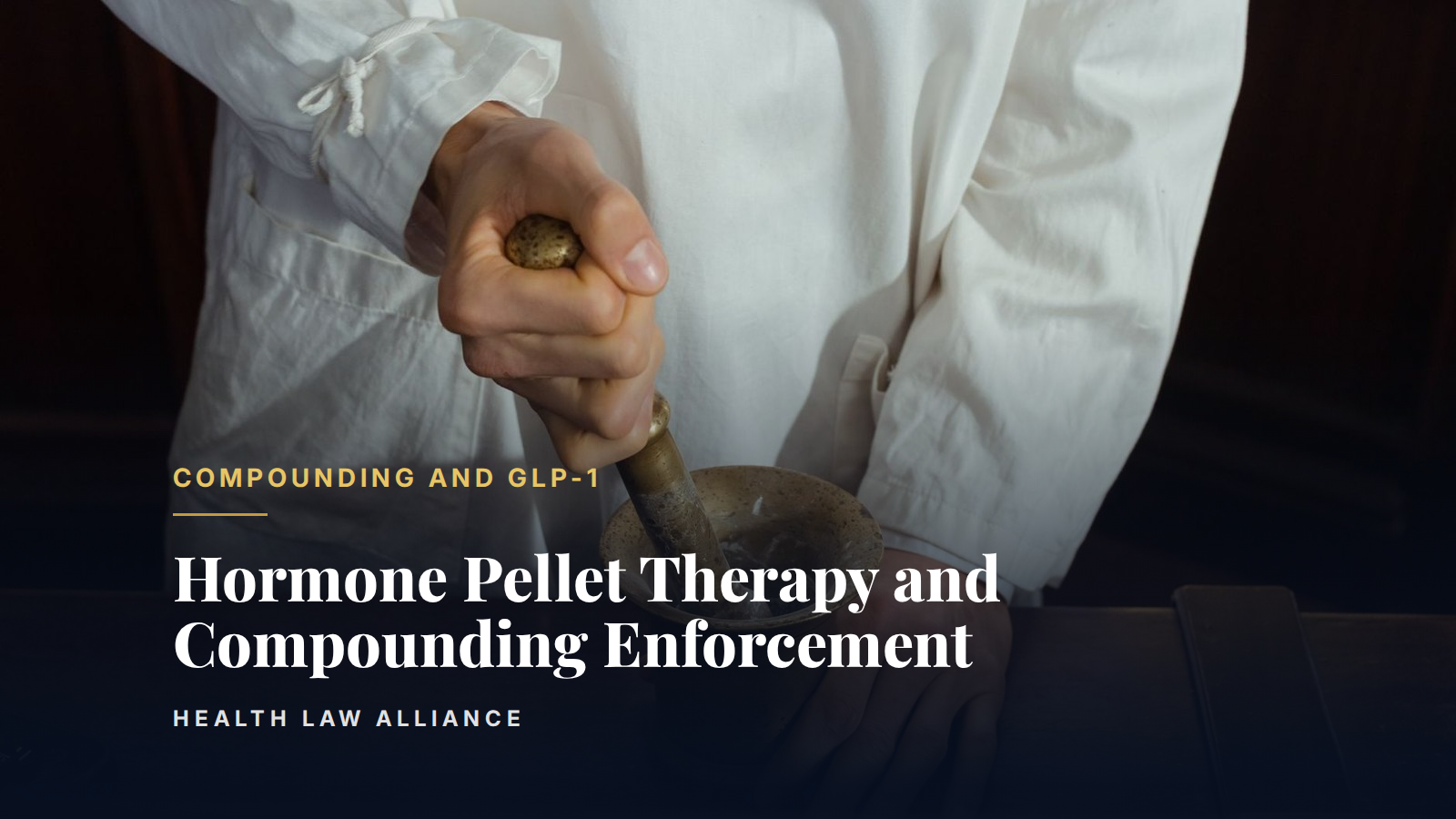
Hormone pellet therapy, the in-office insertion of compounded testosterone or estradiol pellets, has become a steady line of business for compounding pharmacies that supply physician offices and medical spas. The practice carries two separate compliance risks. The first is whether the pellets qualify for the 503A compounding exemption at all, which turns on whether the pharmacy compounded against a patient-specific prescription or shipped them as office stock. The second is what the pharmacy or the physician's office says when marketing the pellets. Getting either one wrong can draw FDA, state board of pharmacy, and Federal Trade Commission (FTC) scrutiny on the same pellets.
Pellet Insertion Models and the 503A Prescription Requirement
Pellet insertion is typically an in-office procedure: a physician or supervised clinical staff member implants pellets that release hormone over three to six months. One testosterone pellet product, Testopel, holds FDA approval; no estradiol pellet product does, so compounded estradiol pellets fill a gap the branded market does not reach. Pellets are sterile preparations, so compounding them also has to satisfy USP 797/800 sterile and hazardous-drug standards.
That gap is where the prescription question matters. Section 503A exempts a compounding pharmacy from FDA's manufacturing and approval requirements only when it compounds against a valid prescription for an identified individual patient, including limited anticipatory compounding tied to a patient identity established before dispensing. FDA's December 2016 guidance on the 503A prescription requirement treats compounding for a practitioner's office use, pellets held in stock for whichever patient presents, as a category the exemption does not reach. Only a registered 503B outsourcing facility, under current good manufacturing practice (cGMP) and FDA inspection, may lawfully supply office-use pellets without a patient-specific prescription.
A 503A pharmacy that supplies hormone pellets to a physician's office as standing stock, rather than against a patient-specific prescription, is compounding outside the terms of its own exemption.
State Board Variance and Documentation
State boards of pharmacy hold primary licensing authority over 503A compounding and do not treat office-use pellets uniformly. Some states allow limited practitioner office-use quantities under state rules that sit alongside the federal 503A framework; others hold pharmacies to patient-specific dispensing for every pellet leaving the pharmacy. A pharmacy shipping across state lines has to satisfy the more restrictive framework in every state it ships into. Anticipatory compounding, even for an identified patient, still requires tracking the beyond-use date and tying each lot back to the prescription that authorized it.
Marketing Claims and FTC Exposure
Compounded pellets carry a second exposure layer once they leave the compounding room: what the prescribing office or the pharmacy tells patients about them. The FTC's Health Products Compliance Guidance, issued in December 2022, requires health-related advertising claims, including claims made by clinics and not only product sellers, to be supported by competent and reliable scientific evidence, typically randomized controlled trials. The FTC has tested a version of this standard against hormone marketing directly, charging and settling with several sellers of alternative hormone replacement therapy products in 2007 and 2008 over unsubstantiated disease-prevention claims.
A 2020 report from the National Academies of Sciences, Engineering, and Medicine, prepared at FDA's request, found that compounded bioidentical hormone therapy lacks rigorous safety and effectiveness data, and it singled out pellets for the supraphysiologic hormone peaks the dosing form can produce. Marketing language promising anti-aging benefits, disease prevention, or superiority over FDA-approved hormone therapy runs against both the FTC's standard and the National Academies' findings. Pharmacies that already have an FDA Form 483 or warning letter on file should see Health Law Alliance's guide on FDA Warning Letters to Compounders for the response sequence that follows.
Why Early Legal Counsel Is Critical
It is critical that compounding pharmacies and the practices they supply promptly retain experienced healthcare defense counsel upon receiving an FDA inquiry, a state board notice, an FTC inquiry, or any other government request tied to hormone pellet compounding or marketing. Early legal intervention can protect the pharmacy's rights, ensure appropriate responses to government requests, avoid inadvertent admissions, preserve relevant defenses, and allow counsel to communicate with investigators on the pharmacy's behalf. Delaying representation can significantly affect the outcome of a matter and expose the pharmacy to unnecessary risk when a pellet program draws more than one agency's attention.
How Health Law Alliance Can Help
Health Law Alliance represents compounding pharmacies nationwide on 503A and 503B compliance, office-use compounding structures, and the marketing review a hormone pellet program requires, drawing on the firm's experience with 2,000+ audits overseen on behalf of pharmacy and provider clients. The firm's attorneys review pellet supply arrangements with physician offices, prepare responses to FDA and state board inquiries, and help pharmacies align marketing materials with FTC substantiation requirements before a claim becomes a liability. The same analysis carries over to the firm's compounding practice generally, including GLP-1 telehealth and compounding arrangements and peptide compounding's regulatory gray areas. Compounding pharmacies operating a hormone pellet program may contact Health Law Alliance's compounding pharmacy defense team for a free, confidential consultation.