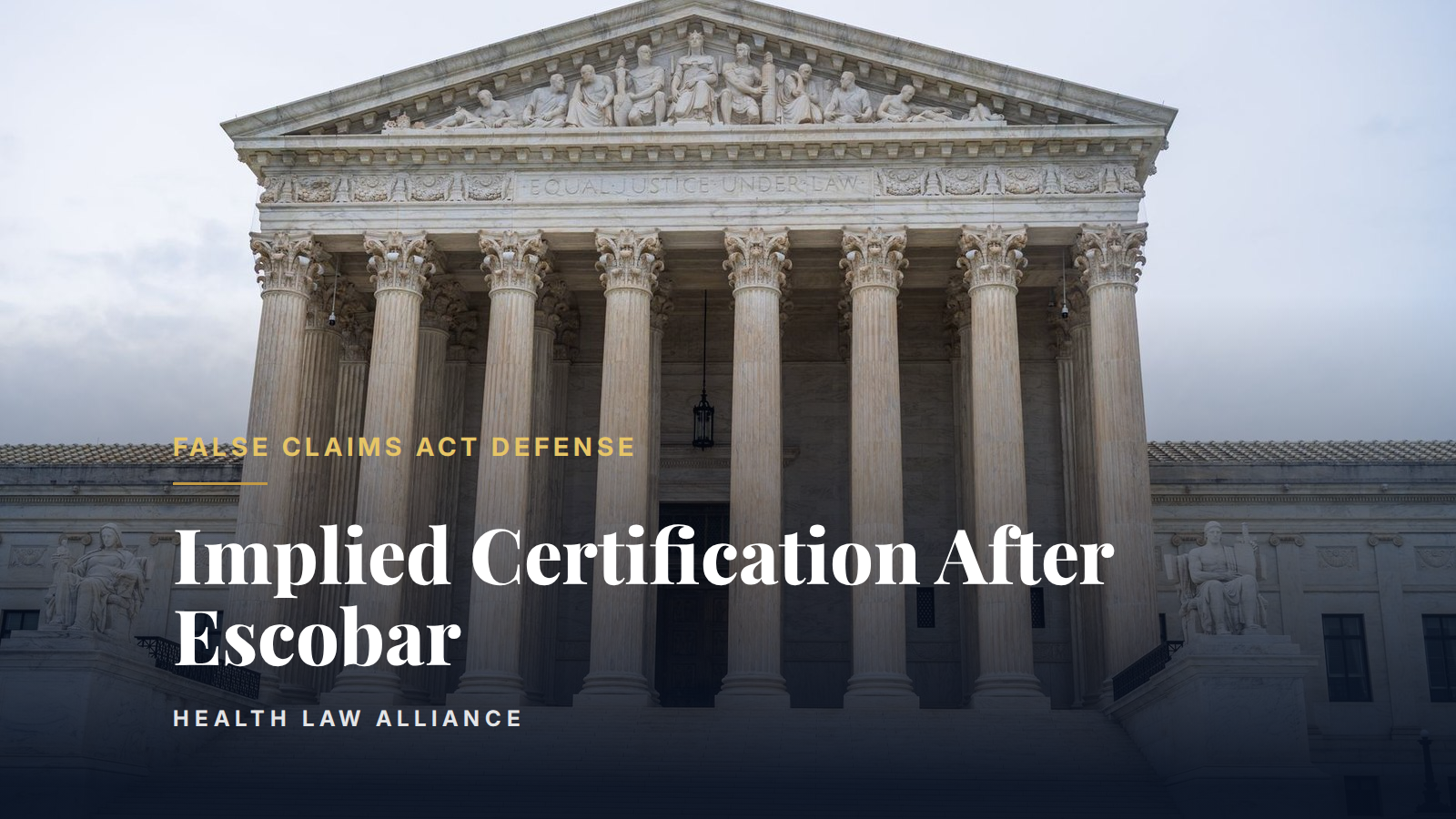
The implied certification theory allows the government, or a private relator, to impose liability under the civil False Claims Act (FCA), 31 U.S.C. § 3729, even when a claim for payment contains no express false statement. A claim that requests payment while silently omitting noncompliance with a material legal requirement can trigger FCA exposure, including treble damages and per-claim penalties. In Universal Health Services, Inc. v. United States ex rel. Escobar, 579 U.S. 176 (2016), the U.S. Supreme Court confirmed that the theory can support liability, but only within limits every compliance officer needs to understand before an audit, a subpoena, or a qui tam suit reaches the organization. Escobar set the two-part liability test and, more significantly for defense purposes, imposed a materiality standard that has narrowed the scope of viable implied certification claims across the circuit courts since 2016.
The Two-Part Test For Implied Certification
The Court held that implied certification liability applies at least where two conditions are satisfied. First, the claim does not merely request payment: it makes specific representations about the goods or services provided. Second, the defendant's failure to disclose noncompliance with a material statutory, regulatory, or contractual requirement makes those representations misleading half-truths. The full opinion rejected the argument that implied certification liability should be confined to violations of requirements expressly labeled conditions of payment, and it rejected the government's broader position that any known statutory, regulatory, or contractual violation could support liability regardless of its bearing on payment. Both elements, a specific representation and a material omission, must be present. Neither element is sufficient standing alone under Escobar.
The Escobar Materiality Standard
Escobar described the materiality standard as demanding, and the Court has separately characterized the FCA's enforcement mechanisms as rigorous. A misrepresentation is not automatically material merely because the government designates compliance with a particular statute, regulation, or contract term as a condition of payment. Materiality instead turns on facts such as whether the government has expressly identified a provision as a condition of payment, whether the alleged violation goes to the essence of the bargain, and how the government has responded to similar noncompliance in comparable matters.
If the Government pays a particular claim in full despite its actual knowledge that certain requirements were violated, that is very strong evidence that those requirements are not material.
That single sentence from Escobar has become the most frequently cited materiality principle in post-2016 FCA litigation. The government's continued, informed payment of claims despite knowledge of a particular type of noncompliance cuts against a materiality finding, a factor defense counsel now raise routinely in qui tam litigation and in pre-suit negotiations with the Department of Justice.
How Circuit Courts Have Applied Materiality
Since 2016, circuit courts applying Escobar have dismissed a substantial share of implied certification claims on materiality grounds. On remand, the Seventh Circuit in United States ex rel. Nelson v. Sanford-Brown, Ltd., No. 14-2506, 2016 WL 6205746 (7th Cir. Oct. 24, 2016), rejected a relator's claim against a for-profit college because the relator offered no evidence that the government's payment decision would have changed had it known of the alleged noncompliance with Department of Education program requirements. The Fifth Circuit reached a comparable result in United States ex rel. Harman v. Trinity Industries, Inc., 872 F.3d 645 (5th Cir. 2017), reversing a $663 million jury verdict over highway guardrail certifications after finding that the Federal Highway Administration's repeated, unwavering position that the product remained eligible for reimbursement undercut any claim of materiality. The Supreme Court later denied certiorari, leaving that reversal in place. Both decisions illustrate the same pattern: courts scrutinize the government's own conduct toward the alleged violation, not just the violation itself, when a provider raises the Escobar materiality defense. Providers responding to an active inquiry can review the firm's guide to responding to an FCA investigation for the procedural steps that typically follow.
Why Early Legal Counsel Is Critical
It is critical that healthcare providers promptly retain experienced healthcare defense counsel upon receiving a subpoena, audit notice, investigative request, or other government inquiry touching potential implied certification exposure. Early legal intervention can protect the provider's rights, ensure appropriate responses to government requests, avoid inadvertent admissions, preserve relevant defenses including the materiality arguments described above, and allow counsel to communicate with investigators on the provider's behalf. Delaying legal representation can significantly affect the outcome of a matter and expose the provider to unnecessary risk.
How Health Law Alliance Can Help
Health Law Alliance's healthcare fraud defense practice represents pharmacies, physician groups, and other providers facing implied certification and False Claims Act allegations, from initial audit inquiries through qui tam litigation and government intervention decisions. If your organization has received a subpoena, a civil investigative demand, or notice of a False Claims Act investigation, contact us for a free, confidential consultation to review the matter and discuss False Claims Act defense strategy specific to your facts.