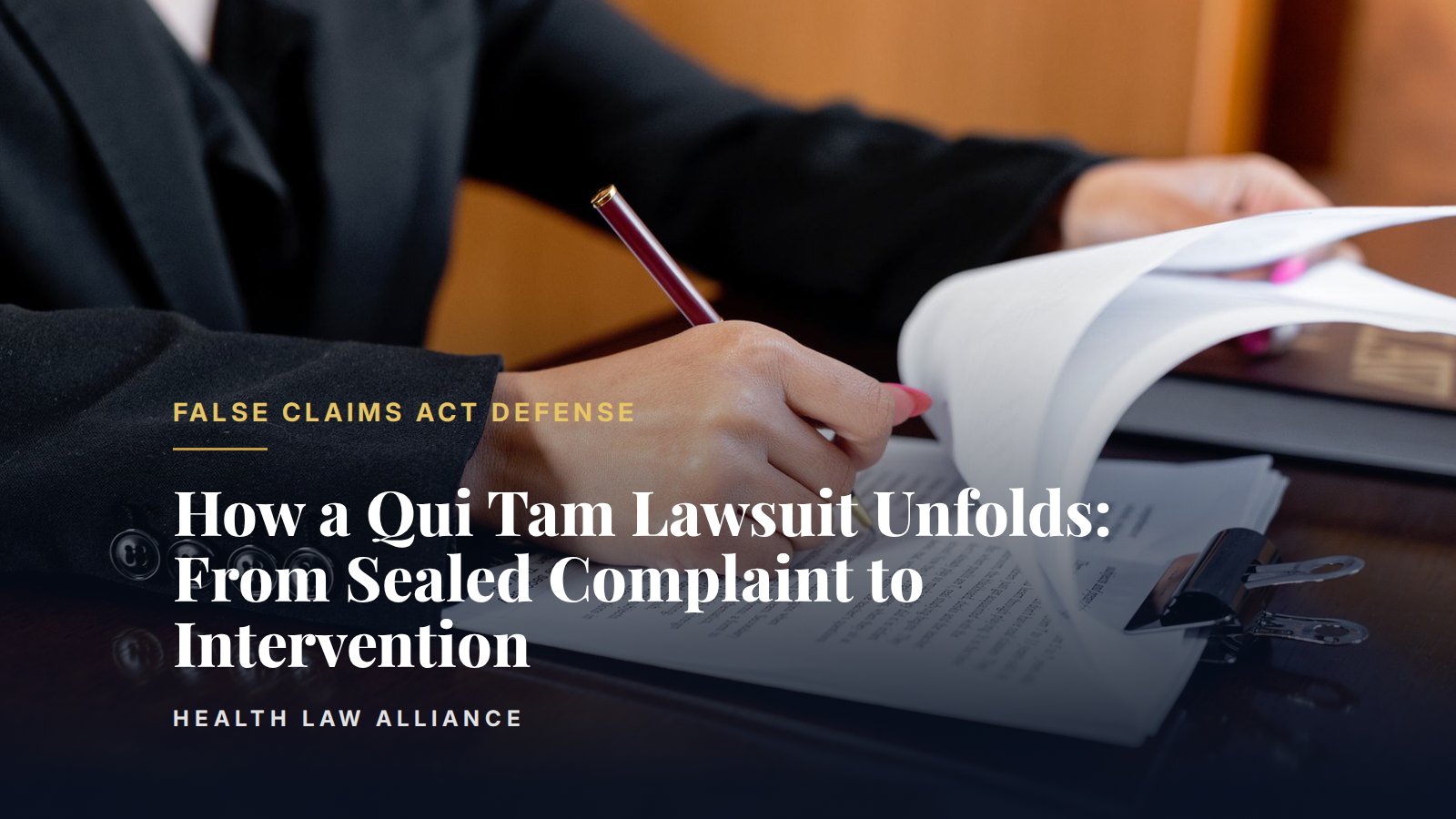
A qui tam lawsuit is a private civil action filed under the False Claims Act, 31 U.S.C. § 3729 et seq., in which a private individual, called a relator, sues on behalf of the federal government and may share in the recovery. A relator, often a current or former employee, biller, or competitor, files the complaint under seal, and the target is typically not served and has no notice a case exists. What happens during the sealed period, and how the government later decides whether to intervene, shapes the case a defendant eventually confronts.
The Complaint Is Filed Under Seal
Under 31 U.S.C. § 3730(b)(2), a qui tam complaint must be filed in camera and remains under seal for a minimum of 60 days. The complaint cannot be served on the named defendant until the court lifts the seal. Alongside the complaint, the relator must serve the government with a written disclosure of substantially all material evidence and information the relator possesses. The seal exists so that the Department of Justice can investigate the allegations, including through subpoenas, civil investigative demands, and interviews, without alerting the target and risking the destruction of records or coordination among witnesses.
Seal Extensions Can Last Years
The initial 60-day period is rarely enough time to investigate billing patterns, medical records, and internal communications. The statute permits the government to move for good cause shown to extend the seal, and courts routinely grant successive extensions while the Department of Justice continues to gather evidence. Matters involving healthcare billing often remain sealed for a year or more while investigators review claims data and consult with agencies such as HHS-OIG. During this period, the named physician or practice ordinarily has no formal notice that a relator's complaint is pending, even while continuing to bill the programs at issue.
The seal period means a healthcare provider can be under active federal investigation for months or years before receiving any indication that a case exists.
The Government Decides Whether to Intervene
Before the seal period or any extension expires, 31 U.S.C. § 3730(b)(4) requires the government to choose one of two paths. It may notify the court that it will intervene and take over prosecution of the action, or it may notify the court that it declines to intervene, in which case the relator retains the right to pursue the case alone. Intervention typically signals that the Department of Justice found the allegations and evidence substantial enough to commit its own resources. A declination is not a finding that the allegations lack merit. It often reflects resource constraints, weaker evidence, or a case better suited to private litigation, and the relator may proceed independently, with the government retaining the right to intervene later for good cause.
The Government Can Also Move to Dismiss
A third path exists under 31 U.S.C. § 3730(c)(2)(A), which allows the government to move to dismiss a qui tam action over the relator's objection after notice and a hearing. In United States ex rel. Polansky v. Executive Health Resources, the Supreme Court held in 2023 that the government may seek dismissal at any point in the litigation, provided it first intervenes for that purpose, and that courts should evaluate the motion under the ordinary voluntary-dismissal standard applied to civil cases generally. For a healthcare defendant, a government dismissal ends the case entirely, regardless of whether the relator wishes to continue.
Why Early Legal Counsel Is Critical
It is critical that physicians and healthcare organizations promptly retain healthcare defense counsel upon learning of an unsealed relator's complaint, receiving a civil investigative demand, or being notified of a government intervention decision. Because the sealed period leaves a provider unaware that an investigation is underway, the first formal notice a practice receives often arrives after the government has already gathered substantial evidence. Early legal intervention can protect the provider's rights, ensure appropriate responses to government requests, avoid inadvertent admissions during informal contact with investigators, preserve relevant defenses before records are lost or witnesses' recollections fade, and allow counsel to communicate with the government or the relator's attorneys on the provider's behalf. Delaying legal representation can significantly affect the outcome of a matter and expose the provider to unnecessary risk.
How Health Law Alliance Can Help
Health Law Alliance defends physicians, pharmacies, and healthcare organizations at every stage of a qui tam matter, from the first sign a sealed complaint may exist through an intervention decision and any resulting litigation or settlement. We respond to civil investigative demands and subpoenas, engage directly with the Department of Justice and relator's counsel, and build the record needed to support a declination, a negotiated resolution, or a defense at trial. If your practice has received a subpoena, a civil investigative demand, or notice of a False Claims Act case, contact us for a free, confidential consultation.