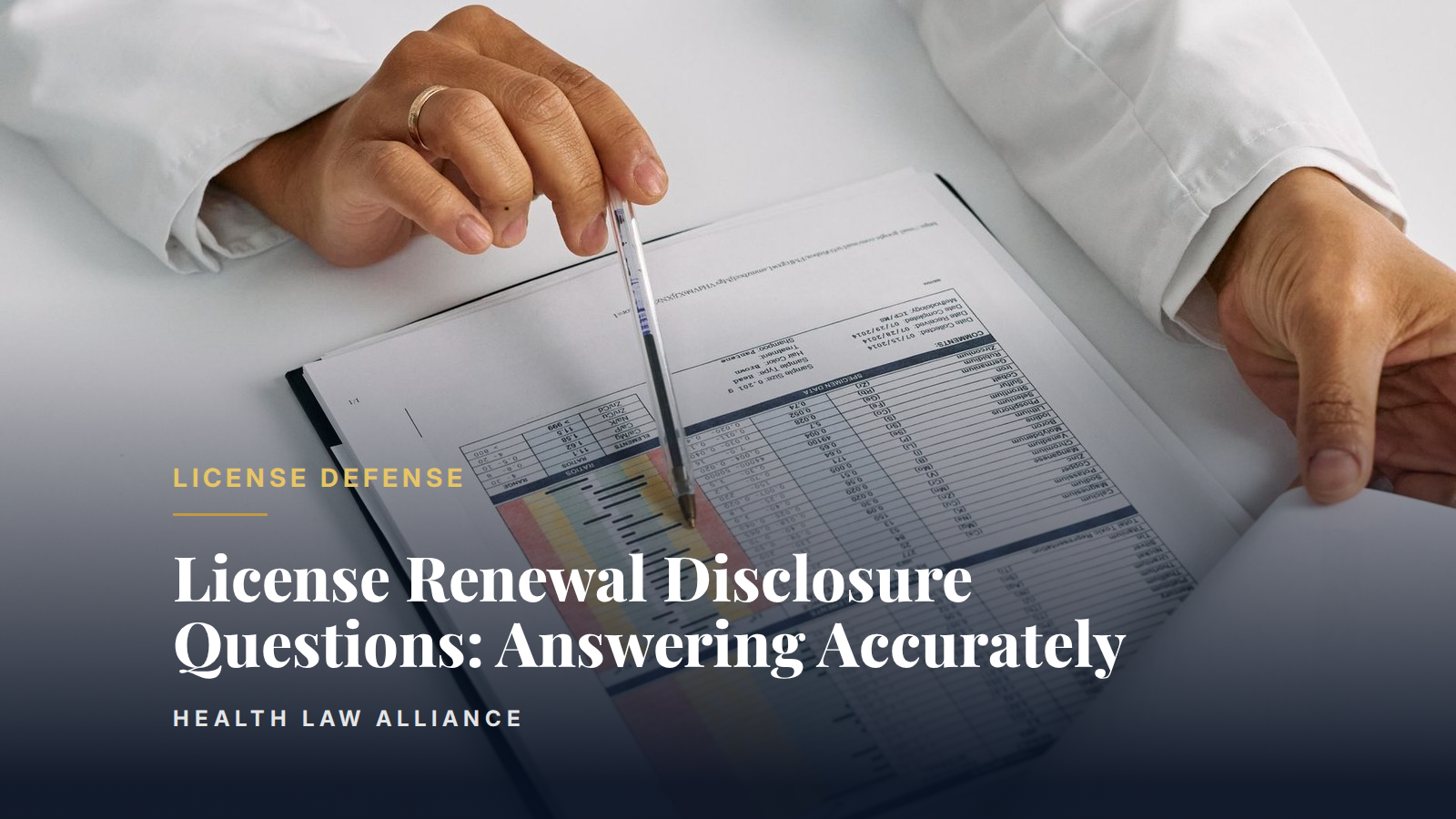
Every state medical, pharmacy, and nursing board renewal application asks some version of the same question: has the licensee been arrested, convicted, subject to a hospital privilege action, or named in a malpractice settlement since the last renewal cycle. The questions sit between continuing education attestations and address updates, and read as routine. They are anything but. A board can discipline a physician for the underlying conduct and, separately, for how the renewal application answered the question about it. An incomplete answer, even about a matter the physician believed was resolved or expunged, can become the more serious problem in the file.
What Renewal Applications Actually Ask
Renewal applications are not uniform, and the specific disclosure categories vary by state and by license type. The pattern that recurs across boards asks about arrests and criminal charges, not only convictions, hospital or health-system privilege actions, malpractice settlements or judgments, discipline by another state board, and denial or restriction of a license elsewhere. New Jersey's regulation governing physician reporting, N.J.A.C. 13:35-6.19, requires a licensee to notify the Board of Medical Examiners within 10 days of any arrest or conviction, and within 21 days of a hospital privilege curtailment or an adverse action by a malpractice carrier. The rule treats a missed report as professional misconduct in its own right, independent of the underlying arrest or hospital action.
Why a Dismissal or Expungement Does Not Always End the Disclosure Duty
Whether a dismissed charge, an expunged record, or a matter resolved through deferred adjudication still has to be disclosed depends on the exact wording of the specific board's question, and the answer is not consistent from state to state. Some boards ask only about convictions and treat a dismissal as outside the question. Others ask about any arrest or charge regardless of the ultimate disposition, so a case resolved entirely in the physician's favor is still a reportable event on the next renewal. A licensee who assumes the more forgiving rule applies, without checking the actual question on the actual form, is guessing with the license on the table.
The False Statement Exposure
A false or incomplete answer on a renewal application is a distinct disciplinable act, prosecuted on its own terms and independent of whatever the underlying conduct was. North Carolina General Statutes Section 90-14(a)(3) gives the state medical board authority to deny, suspend, or revoke a license where the holder has made a false statement or representation to the board, or willfully concealed material information, in connection with a license application or an annual registration, which is the statutory term for a renewal. The provision does not require the board to prove the underlying conduct was itself disciplinable, only that the answer given was false or that material information was withheld.
A false or incomplete answer on a renewal application can become a more serious disciplinary matter than the arrest, conviction, or malpractice action the question was asking about.
Where Renewal Disclosure Intersects Other Proceedings
A renewal disclosure question rarely stands alone. The same record can also surface in a hospital credentialing review, a National Practitioner Data Bank report, or, in more serious cases, an OIG exclusion review. A physician also responding to a subpoena or a board investigative request faces the same accuracy standard on the renewal form. For a related board inquiry, see Physician License Investigations: Standard of Care and Documentation Cases and National Practitioner Data Bank Reports: Triggers and Disputes. Pharmacists carry the same category of duty on pharmacy board renewals; see Pharmacist License Defense: Common Allegations and Outcomes.
Why Early Legal Counsel Is Critical
It is critical that physicians and other licensed providers consult experienced healthcare defense counsel before answering a disclosure question on a license renewal application, particularly where the answer touches an arrest, a malpractice action, or discipline in another jurisdiction. Early legal review can confirm what the specific board's question requires, distinguish a reportable event from one that is not, and help the licensee draft an accurate answer before it is submitted rather than after a board raises a discrepancy. Correcting an inaccurate answer after the fact is a materially harder position than answering it correctly the first time.
How Health Law Alliance Can Help
Health Law Alliance has represented physicians, pharmacists, and other licensed providers in 5,000+ matters over 25+ years, including license renewal disclosure questions, board investigations, and the hospital and payor proceedings that can follow a disclosure dispute. If you have a pending renewal application and are unsure how to answer a disclosure question, or a board has already raised a concern about a prior answer, contact Health Law Alliance's professional license defense attorneys for a free, confidential consultation before the application is submitted.