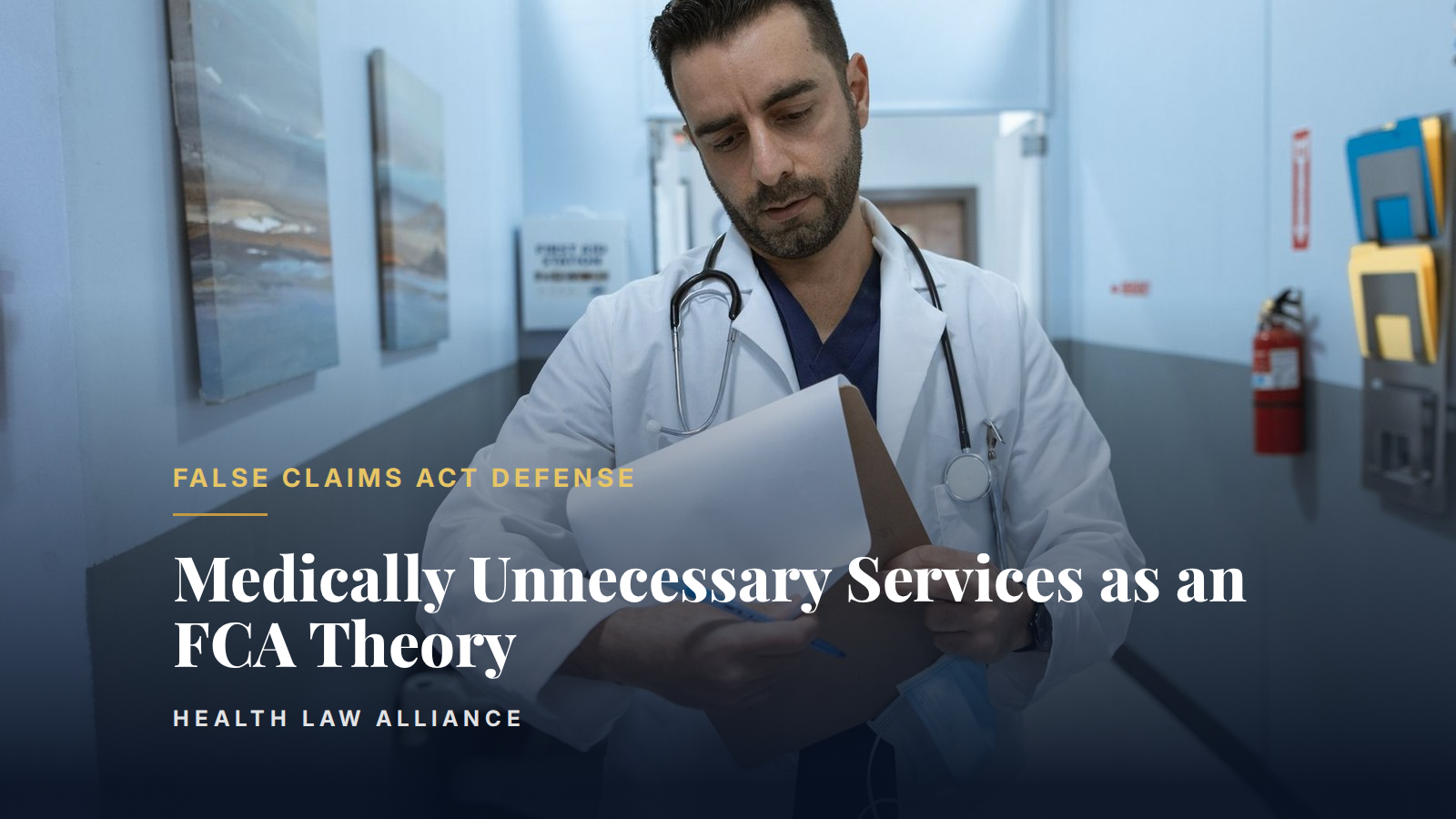
Medical necessity is the most litigated falsity theory in healthcare False Claims Act practice, and it is also the least predictable. When a hospice, surgical, or wound care claim is later reviewed by a physician who reaches a different clinical conclusion than the treating physician, the Department of Justice or a qui tam relator can allege the claim was false from the moment it was submitted. FCA settlements and judgments reached $6.8B in FY2025, with $5.7B tied to healthcare claims, and DOJ's 2026 health care fraud enforcement named medically unnecessary testing, hospice eligibility, and wound care billing among its priority categories.
How Medical Necessity Becomes a Falsity Theory
Medicare and Medicaid pay only for services that are reasonable and necessary for diagnosis or treatment. When a provider certifies a claim as medically necessary and the government later concludes the service should not have been performed at all, the certification itself becomes the alleged false statement. That is a different theory than a coding error: the government's position is that the underlying service should never have been billed, not that it was billed under the wrong code. The theory anchors some of the largest FCA settlements on record, including DOJ's $309M settlement over allegedly unnecessary skin substitute applications and a $45M settlement with Vohra Physicians Management over allegedly unnecessary surgical debridement.
The Circuit Split on Clinical Judgment
Whether a clinical judgment can be false under the FCA depends heavily on where the case is filed. The Eleventh Circuit, in United States v. AseraCare, held that a claim is not false merely because one physician disagrees with another's clinical call. The government must show an objective falsehood, not just a competing opinion. The Fourth and Seventh Circuits apply a similar standard. The Third Circuit reached the opposite conclusion in Druding v. Care Alternatives, holding that a documented disagreement between physician reviewers can itself create a triable issue of falsity, and the Ninth Circuit followed a comparable path in Winter v. Gardens Regional Hospital and Medical Center, asking only whether the opinion was honestly held. The Supreme Court denied certiorari on the split in February 2021, so the standard a compliance program faces turns on where a relator files.
A documented, honestly held clinical rationale is a defense in every circuit. An undocumented one is a liability in all of them.
Where the Cases Turn on Competing Physician Opinions
In practice, most medical necessity cases become a contest between physician reviewers. The government or relator retains a physician to review a sample of claims and opine that the clinical record did not support the service. The defense retains its own physician reviewer to explain the reasoning available to the treating provider at the time, not in hindsight. Because Medicare's medical necessity standard is written in general clinical terms rather than a fixed checklist, both opinions can be reasonable and still conflict. In circuits that follow AseraCare, that conflict alone will not sustain a falsity finding. In circuits that follow Druding and Winter, it can be enough to send the case to a jury. Either way, the case is decided on the record the treating provider created at the time, not the record reconstructed after a subpoena arrives.
Building a Defensible Clinical Record
Compliance programs that hold up under a medical necessity investigation share one feature: the clinical rationale was written down when the decision was made. Contemporaneous notes stating why a service was ordered and what findings supported the diagnosis give a physician reviewer, and eventually a jury, something concrete to evaluate. Retaining defense-side clinical review before the government's theory hardens into a formal demand lets counsel test the record against the falsity standard that will actually govern the case. Self-auditing the service lines DOJ has already targeted, hospice eligibility, surgical debridement, and skin substitute applications, closes the gap between clinical practice and what the record can prove.
Why Early Legal Counsel Is Critical
It is critical that healthcare providers and compliance officers promptly retain experienced healthcare defense counsel upon receiving a subpoena, civil investigative demand, audit notice, or other government inquiry touching on medical necessity. Early legal intervention can protect the organization's rights, ensure appropriate responses to government requests, avoid inadvertent admissions in physician interviews, and let counsel communicate with investigators on the organization's behalf. Delaying legal representation can significantly affect the outcome of a matter and expose the organization to unnecessary risk.
How Health Law Alliance Can Help
Health Law Alliance defends physicians, pharmacies, and healthcare companies against False Claims Act theories built on medical necessity, from the first civil investigative demand through summary judgment on falsity. Our bench includes a former federal prosecutor who evaluated these cases from the government's side of the table. If your organization is facing a medical necessity investigation, contact us for a free, confidential consultation.