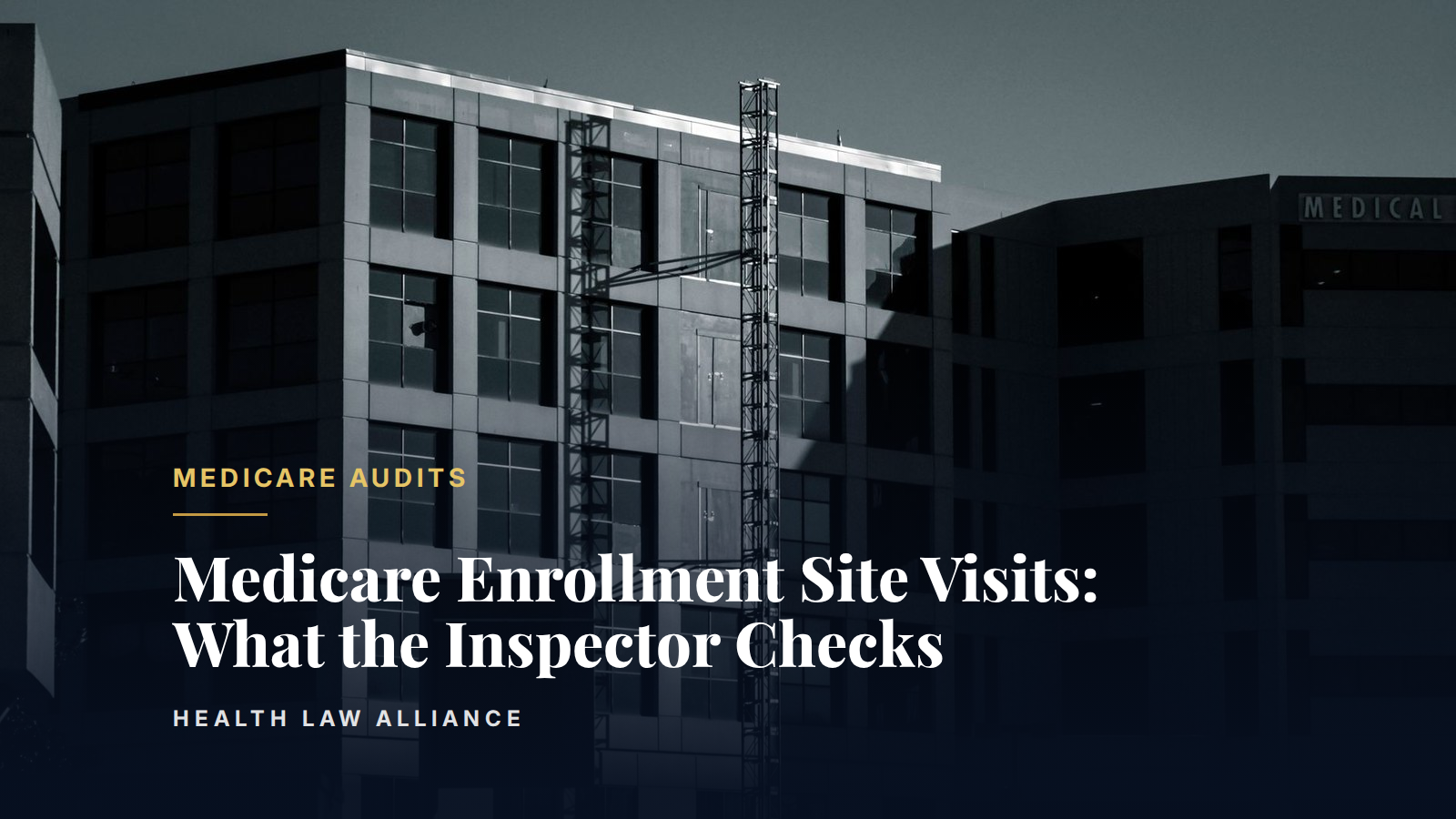
A Medicare enrollment site visit can end a provider's or supplier's billing privileges before CMS ever reviews a claim. Under 42 CFR 424.517, CMS and its contractors may inspect the address listed on an enrollment application without advance notice, to confirm the practice is real, staffed and operating. A location found closed, vacant or unstaffed gives CMS grounds to revoke Medicare billing privileges under 42 CFR 424.535(a)(5), the provision that governs exactly this finding.
Who Performs Medicare Enrollment Site Visits
CMS contracts enrollment site visits to the same network of contractors that handles claims and enrollment review. The National Supplier Clearinghouse inspects durable medical equipment suppliers. Medicare Administrative Contractors (MACs) inspect most physician practices and other Part A and Part B providers. Unified Program Integrity Contractors (UPICs) run their own site visits when a matter is already under program-integrity investigation rather than routine enrollment. DME suppliers answer to a separate set of supplier standards on top of the site-visit requirement, covered in DME Supplier Standards and Revocation for Noncompliance. A UPIC visit carries different stakes than a routine enrollment check, addressed directly in UPIC Site Visit Preparation.
What the Inspector Verifies at the Location
The inspector verifies that the enrolled location exists, is staffed and operates the way the enrollment file describes it: a working sign, posted hours that match an open office, personnel present during those hours, and, where the provider type requires it, patients, equipment or inventory consistent with the services billed to Medicare. The address, the authorized official and the Medicare-assigned provider or supplier number on file must match what the inspector finds in person.
The review targets enrollment status. A claims-level review runs on a separate track, where a Recovery Audit Contractor (RAC) applies extrapolation to a sample of claims measured against a local coverage determination to calculate a recoupment demand. RAC Audits Versus UPIC Audits: Know Which One You Have explains how that claims review differs from a site visit.
When a Site Visit Becomes a Revocation
A site visit that finds the location closed, vacant or unable to support the billed services gives CMS the basis to revoke billing privileges under 42 CFR 424.535(a)(5). That provision applies when CMS determines, from onsite review or other reliable evidence, that a provider or supplier is no longer operational or otherwise fails to satisfy an enrollment requirement. A provider can request reconsideration immediately after a revocation and, failing that, appeal before an administrative law judge. QIC Reconsideration: Building the Record for ALJ covers how to build that record once a revocation notice has arrived. Provider-Based Billing and Medicare Audit Exposure covers a related enrollment exposure for practices billing under a hospital's provider-based status.
A facility found closed, unstaffed or vacant during a site visit can lose its Medicare billing privileges under 42 CFR 424.535(a)(5) before CMS reviews a single claim.
Why Early Legal Counsel Is Critical
Providers should retain experienced healthcare defense counsel promptly after a site visit, a revocation notice or any other government inquiry into enrollment status. Early legal intervention protects the provider's rights, keeps responses to CMS and its contractors accurate, avoids inadvertent admissions and preserves the defenses available on reconsideration and appeal. Waiting to retain counsel can affect the outcome of the reconsideration and narrow the record available on appeal.
Health Law Alliance's attorneys have overseen 2,000+ audits and handled 5,000+ matters, with 25+ years of experience.
How Health Law Alliance Can Help
Health Law Alliance represents physicians, DME suppliers and other Medicare providers through every stage of a site visit, from the inspection itself through reconsideration and appeal, as part of our broader Medicare audit defense practice. If a site visit has already produced a revocation notice, contact us today for a free, confidential consultation.