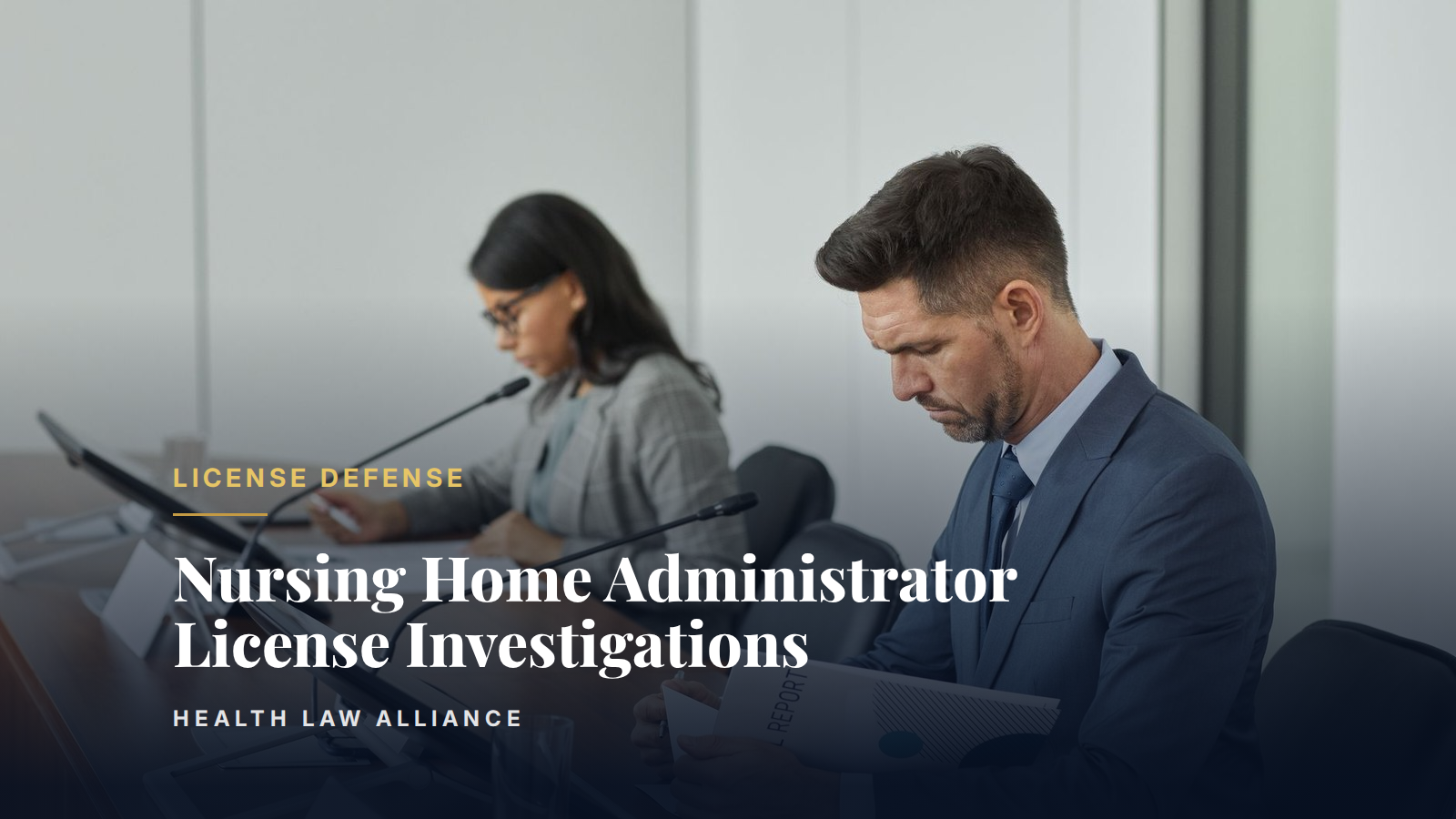
A nursing home administrator holds a license that two different authorities can put at risk over the same facts: the state board of examiners that licenses the administrator personally, and the state survey agency that inspects the facility for Medicare and Medicaid certification. A single deficiency citation can open a facility enforcement case and a personal license investigation at once, and the board proceeding decides whether this administrator keeps working in the profession at all.
How a Board Complaint Begins
A complaint can come from a resident's family, facility staff, the facility itself, or the state survey agency that inspected it. Maryland's Board of Examiners of Nursing Home Administrators assigns an investigator and a board-member liaison to gather documents and interview witnesses, then reports findings to the full board, which dismisses the matter, resolves it informally, or charges the administrator and refers the case to the Attorney General. Procedures vary by state, so confirm the sequence under your own board's governing statute rather than assume Maryland's steps apply everywhere.
When a Survey Deficiency Becomes the Administrator's Case
A facility survey deficiency and an administrator's license case are legally separate proceedings, even when both trace to the same inspection report. The facility's certification exposure, civil monetary penalties, denial of payment, or termination of its provider agreement, runs against the facility; the administrator's exposure runs under a separate licensing statute, and some states tie the two together by law. Minnesota Statutes section 144A.251 requires the state board to open a suspension or revocation proceeding against an administrator whose facility accumulated, within the two years that administrator was employed there, two or more uncorrected violations within that administrator's jurisdiction and control that created an imminent risk of resident harm and carried a fine that was assessed and allowed to be recovered, or ten or more such uncorrected violations of any kind. That is a mandatory proceeding under Minnesota law, not a discretionary one, and it shows how directly an uncorrected survey record can become the administrator's own case in a state that writes the connection into its statute.
A facility's survey deficiency and an administrator's license complaint are two different proceedings against two different parties, and resolving one does not resolve the other.
The Hearing and the Range of Sanctions
Once a board decides to charge an administrator, Maryland's board can hold a case resolution conference to let the licensee resolve the case before a hearing; otherwise a formal hearing follows where both sides present evidence, subject to questioning by board members, counsel, and a hearing officer, and the result becomes a public disciplinary order. In Maryland, the board's disciplinary actions include suspension or revocation of the license, a reprimand, a fine, probation, or another order. Some boards also carry subpoena power during an investigation. Arizona's governing statute for its nursing care institution administrators board lets the board compel witness testimony and the production of records by subpoena, and ask a state court to enforce one the administrator ignores.
National Credentialing, State-by-State Discipline
The National Association of Long Term Care Administrator Boards (NAB) develops the national licensing exam that state boards, including Ohio's and Massachusetts's, require for licensure, and sets the continuing-education approval standard Maryland's board requires toward renewal. Discipline stays with each state's own board, which licenses, investigates, and sanctions administrators in its own facilities under its own statute, so a finding in one state is that state's record, not a national one. A board's revocation or suspension of a license for reasons bearing on professional competence, professional performance, or financial integrity can still reach beyond that state: under 42 U.S.C. § 1320a-7(b)(4), HHS-OIG may impose a permissive program exclusion from Medicare and Medicaid based on that same state license action, a separate federal consequence layered on top of the board's own sanction.
Why Early Legal Counsel Is Critical
It is critical that nursing home administrators promptly retain experienced healthcare defense counsel upon receiving a licensing board complaint, an investigator's request for records or an interview, or notice of a survey finding that implicates their own conduct. Early legal intervention can shape the response delivered to the board, avoid inadvertent admissions during an initial investigator contact, preserve relevant defenses, and allow counsel to communicate with the board on the administrator's behalf. Delaying representation can affect the outcome and expose the administrator to a public disciplinary record that follows every future license application and background check.
How Health Law Alliance Can Help
Health Law Alliance represents nursing home administrators nationwide in state board investigations, from the first complaint through a formal hearing, including matters tracing back to a facility survey deficiency or running alongside a parallel government inquiry. Health Law Alliance's attorneys have overseen 2,000+ audits and handled 5,000+ matters, with 25+ years of experience. If a state board has opened a complaint against your license, contact Health Law Alliance's professional license defense practice for a free, confidential consultation before the board's investigation advances further.