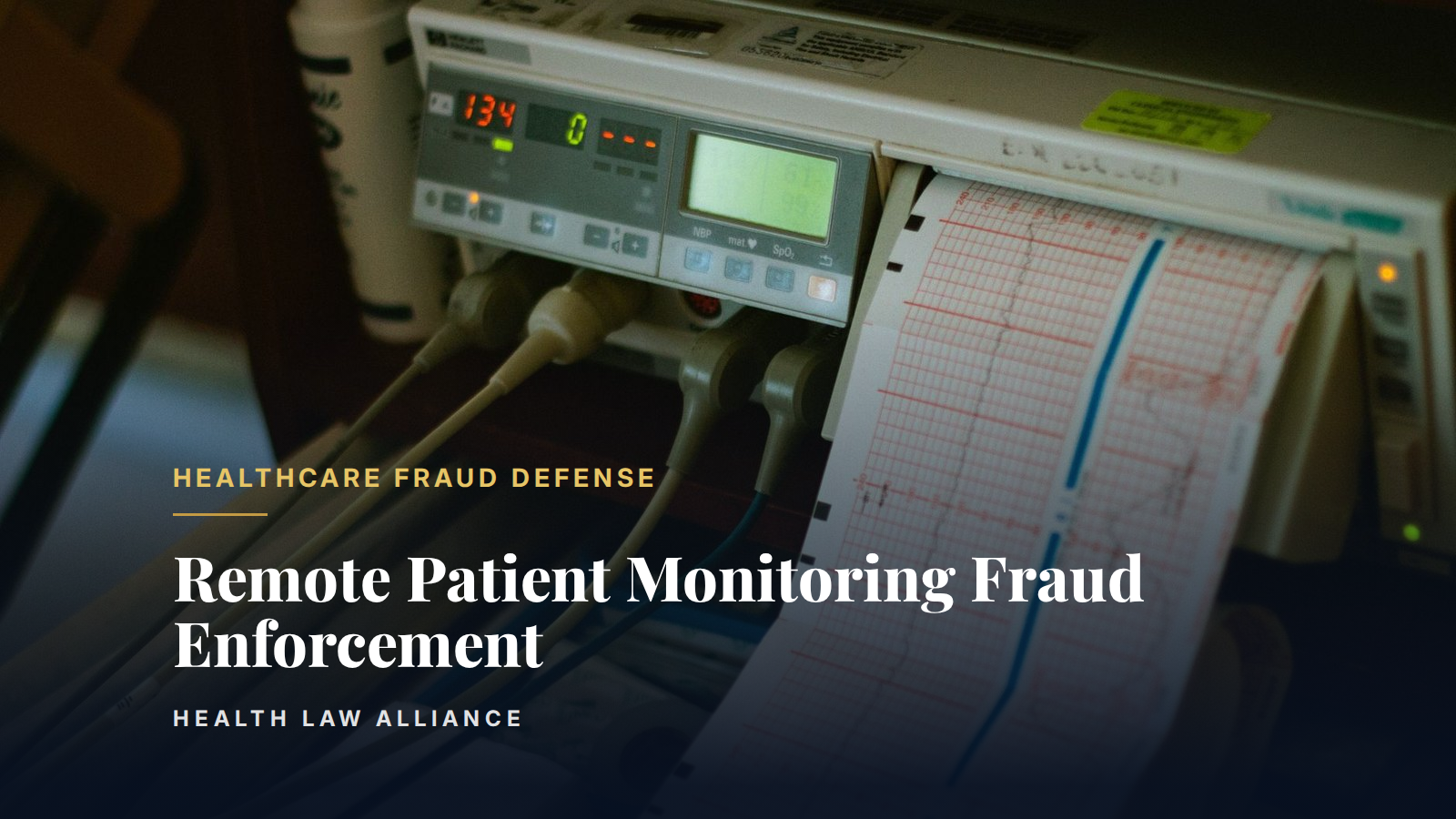
Medicare paid $536 million for remote patient monitoring (RPM) in 2024, a 31 percent jump over 2023, and the HHS Office of Inspector General (OIG) has published two reports, one in September 2024 and one in August 2025, naming the billing patterns it treats as fraud signals. In the same window, federal prosecutors resolved a False Claims Act case built specifically on RPM billing. A physician or practice that orders, supervises, or bills for RPM, including through a third-party vendor, is a plausible subject for the next RPM audit or False Claims Act inquiry.
RPM Billing Growth OIG Has Documented
In a September 2024 report, Additional Oversight of Remote Patient Monitoring in Medicare Is Needed (OEI-02-23-00260), OIG found that the number of Medicare enrollees receiving RPM grew more than 10 times from 2019 to 2022, reaching more than 570,000 enrollees, while Medicare payments for RPM grew more than 20 times over the same period, from $15 million to $311 million. The average payment per enrollee doubled, from $266 to $545. OIG also found that about 43 percent of enrollees who received RPM in 2022, roughly 244,000 people, did not receive all three billed components of the service: education and device setup, device supply, and treatment management.
In an August 2025 data snapshot, Billing for Remote Patient Monitoring in Medicare (OEI-02-23-00261), OIG reported that 2024 payments rose further to $536 million and that nearly 1 million Medicare enrollees received RPM that year, a 27 percent increase in enrollees over 2023. OIG built that report around five billing measures it now uses to flag practices for further scrutiny.
Five Billing Patterns OIG Treats as Fraud Signals
The August 2025 snapshot names outlier practices on each measure. 32 medical practices had a single-month spike of at least 150 percent in new RPM enrollees, and one of them billed for nearly 3,400 new enrollees in a single month. Before billing, CMS requires a prior in-person or telehealth visit with the patient; 45 practices lacked that relationship with more than 80 percent of the patients they billed, and one had no relationship with more than 30,000 enrollees. Treatment management requires at least 20 minutes a month of clinical review and patient contact, yet 52 practices never billed it for more than 75 percent of their enrollees. 34 practices billed more than 25 percent of their enrollees in common with two or more other practices, a pattern OIG treats as a signal of unnecessary services. And about 20 practices repeatedly billed Medicare for two or more RPM devices in the same month for the same enrollee, one of them nearly 1,700 times in a year.
A False Claims Act Settlement Built on RPM Billing
On June 26, 2025, the U.S. Attorney's Office for the Northern District of Georgia announced that Health Wealth Safe, Inc., an RPM company, and its owner, Dr. Subodh Agrawal, paid $1.29 million to resolve allegations under the False Claims Act that they knowingly caused false claims to be presented to Medicare for RPM services that were not reimbursable.
Physician and Practice Liability for RPM Billing
An RPM arrangement can run through a vendor that supplies devices, enrolls patients, and reviews incoming data for the ordering physician. That structure does not move the billing exposure. The physician practice that submits the claim to Medicare owns three questions: did it satisfy the prior-relationship requirement before enrollment, were the billed treatment management minutes actually furnished, and does a kickback arrangement with the vendor implicate the anti-kickback statute alongside the False Claims Act exposure.
A medical practice that bills Medicare for remote patient monitoring carries the billing exposure even when a vendor, not the practice's own staff, enrolls the patient and reviews the data.
Why Early Legal Counsel Is Critical
It is critical that healthcare providers promptly retain experienced healthcare defense counsel upon receiving a subpoena, civil investigative demand, audit notice, or other government inquiry touching remote patient monitoring billing. Early legal intervention can protect the provider's rights, shape the government's review of enrollment and treatment-management records before a position hardens, and help distinguish a documentation gap from a pattern the government is prepared to treat as fraud. Delaying representation narrows these options and can increase the eventual exposure.
How Health Law Alliance Can Help
Health Law Alliance's attorneys have overseen 2,000+ audits and handled 5,000+ matters, with 25+ years of experience.
If your practice bills Medicare for remote patient monitoring, or has received an inquiry tied to RPM enrollment, device billing, or treatment management records, contact Health Law Alliance's healthcare fraud defense attorneys, including the firm's remote patient monitoring audit defense team, for a free, confidential consultation.